


















Lesson 34 of 46 · Skills, Expertise and Transfer
Deliberate practice and the making of experts
How experts differ from novices: chess chunks and schemas, Ericsson's deliberate practice, the 10,000-hour myth, and the meta-analysis that questions how much practice explains.
A chess master glances at a mid-game position for five seconds and sets it up again almost perfectly. A novice who looks at the same board for the same time puts back a handful of pieces. It looks like a gift for memory. Then the experimenter shows a board with the same pieces in random places, and the master does little better than the novice. So the master has not got a better memory in general. The master has something else, and finding out what it is revealed a great deal about how skill works.
This lesson has two halves. The first is about what is different in the heads of experts: chunks and schemas. The second is about how that difference is built: deliberate practice, and the argument about how much of expertise it explains.
What you will learn
- What Chase and Simon found about chess masters and what chunking means
- How schemas let experts see deep structure
- The features of deliberate practice according to Ericsson
- Why the "10,000-hour rule" is a distortion of the research
- What a large meta-analysis says about how much practice matters, and the open debate
Key terms
Chunk: a group of items that are strongly associated in memory and handled as one unit.
Schema: an organized structure of knowledge about a type of situation or problem.
Deliberate practice: individualized, effortful training with specific goals and immediate feedback, usually guided by a coach or a good training design.
Autonomous stage: the final stage in Fitts and Posner's model, in which a skill runs automatically.
Mental representation: the internal structure experts use to perceive, plan and monitor their performance.
Chunks: what chess masters see
Adriaan de Groot, a Dutch psychologist and chess master, studied grandmasters in the 1940s. He expected them to search deeper than weaker players when choosing a move, but found that the main difference was in what they noticed: they quickly saw the few strong candidate moves. William Chase and Herbert Simon (1973) followed up with the memory test described above. Masters reconstructed real game positions after a five-second look far more accurately than beginners. With random arrangements of the same pieces, the advantage almost disappeared. Later studies found masters were still a little better with random positions, but the large effect belonged to meaningful positions.
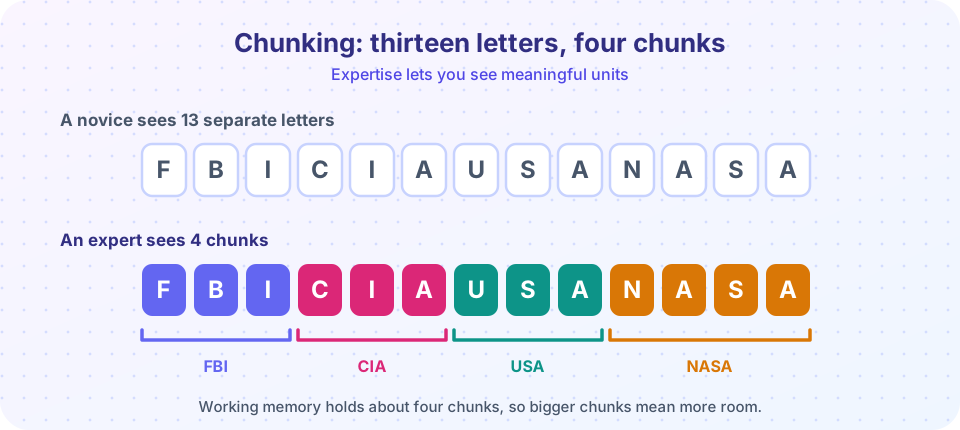
Chase and Simon's explanation was chunking. A master has seen so many positions that familiar clusters of pieces, such as a castled king with its pawn shield, are single units in memory. Simon estimated that a master stores tens of thousands of such chunks, and later work by Fernand Gobet and Simon proposed larger structures called templates. Because working memory holds only a few chunks (the lesson on cognitive load gave the limit as about four), a master holding four big chunks holds more of the board than a novice holding four pieces.
The same pattern turned up in other fields. Studies reported better recall for meaningful material among expert programmers reading real programs, electronics technicians looking at circuit diagrams and doctors reading case descriptions, and little or no advantage when the material was scrambled.
Chunking can be trained, but it is narrow
In a well-known experiment (Ericsson, Chase and Faloon, 1980), a student called S.F. practiced remembering strings of digits for about 230 hours over some twenty months. His digit span rose from about seven to nearly eighty. He did not become a different kind of person. He was a keen runner, and he coded the digits as running times, then grouped these into larger structures. When the experimenters gave him letters instead of digits, his span fell back to about that of an ordinary person. Chunks are made of knowledge and so belong to a domain. You will see in the next lesson how this limit relates to transfer.
Schemas: seeing deep structure
Chunks are about perception and memory. Schemas are about understanding. Michelene Chi, Paul Feltovich and Robert Glaser (1981) asked physics experts and novices to sort physics problems into groups. Novices grouped by surface features, such as "problems with inclined planes" or "problems with pulleys". Experts grouped by the underlying principle, such as "conservation of energy problems". An expert's knowledge is indexed by deep structure, so seeing a new problem calls up the right principle. This is what experts mean when they say a problem "looks like" something.
From chunks to practice: how experts are made
If expertise is a large store of chunks and schemas, how do you build it? A common answer is "practice makes perfect". Anders Ericsson and colleagues (1993) argued that this is not quite right. In a study at a music academy in Berlin, they compared violinists at three levels: the best, good ones and a group training to be music teachers. The groups differed little in when they started and in the amount of formal group practice. They differed in time spent on solitary practice designed to improve, which they called deliberate practice. The best violinists had accumulated much more of it by age twenty.
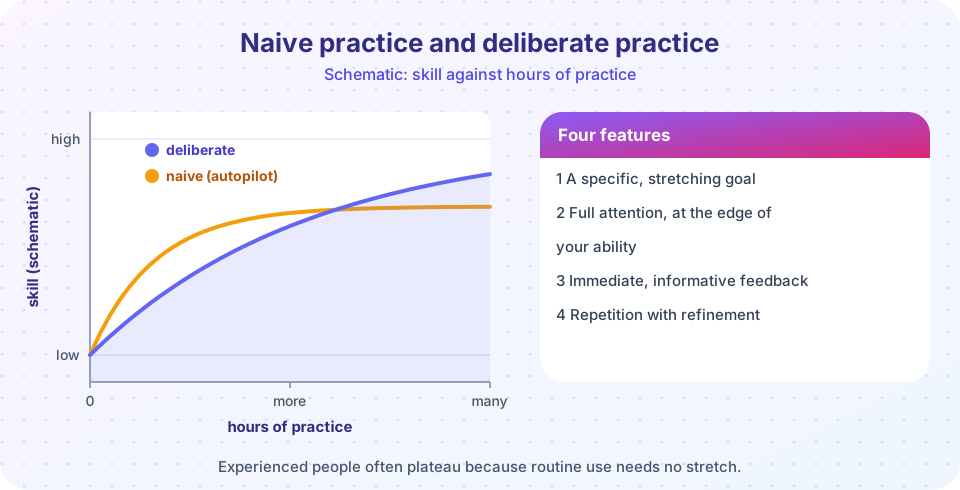
Deliberate practice has four defining features.
- A specific goal for a session, such as "play bars 12 to 20 at full tempo without errors", not "practice the sonata".
- Full attention at the edge of ability. The task is hard enough to need effort, but not out of reach.
- Immediate, informative feedback, from a teacher, a recording or the result itself.
- Repetition with refinement: do it again, adjust, do it again.
It is usually not fun. Ericsson found that the best performers limited deliberate practice to a few hours a day, because the concentration cannot be kept up for longer, and they often rested or napped.
A related idea comes from Paul Fitts and Michael Posner (1967), who described three stages of skill: a cognitive stage (understand what to do), an associative stage (refine, reduce errors) and an autonomous stage (automatic). Automaticity frees attention, but it also stops improvement. A person who drives for thirty years does not keep improving, because driving no longer demands effort. That is why experienced people sometimes plateau, and why deliberate practice has to be deliberately started again. A review of research on physicians (Choudhry, Fletcher and Soumerai, 2005) found that years in practice did not reliably predict higher quality of care, and in some studies predicted lower quality. The authors suggested one reason may be that knowledge goes out of date, which fits the idea that experience alone is not a substitute for targeted learning.
The 10,000-hour myth
Malcolm Gladwell's 2008 book Outliers summed up Ericsson's violin study with a slogan: it takes 10,000 hours to become an expert. The number is a distortion. In the study, 10,000 hours was an average for the top group by about age twenty, and the good violinists had much less. Ericsson himself objected that there is no magic threshold: it depends on the field and on the quality of training, and the best performers in some fields reach elite level with fewer hours while others need more. In a sample of chess players studied by Guillermo Campitelli and Gobet (2008), the number of hours needed to reach master level ranged from a few thousand to more than twenty thousand. Practice matters a lot, but it is not a fixed price.
How much does deliberate practice explain?
A 2014 meta-analysis by Brooke Macnamara, David Hambrick and Frederick Oswald in Psychological Science pooled dozens of studies. They found that deliberate practice explained about 26 percent of the differences in performance in games, about 21 percent in music, about 18 percent in sports, about 4 percent in education and under 1 percent in professions. That is a lot in some domains, but far from everything, and in this analysis, a large part of the variance is unexplained. Ericsson and Robert Harwell (2019) replied that many of the studies did not measure deliberate practice as defined (they counted any practice or experience) and that the analysis mixed things that should not be combined. The debate continues. Fair conclusions for now: practice quality and quantity matter a great deal, they do not explain everything, and other factors such as starting age, coaching, opportunity, health, personality and perhaps genetic differences are involved too.
Press Run (or Ctrl + Enter) to see the result here.
Program input · what you'd type while the program runs
Type the answers before you press Run, one per line. Each time the program reads a line (with input()), it gets the next line from this box.
Practice that works: a checklist
- Set a narrow target for every session, and write it down.
- Work at the edge: if you succeed every time, raise the difficulty. If you fail every time, simplify.
- Get feedback that tells you what to change: a coach, a recording, a test or a checker.
- Study how experts do it. Models and worked examples (Chapter 5) help you build the right chunks.
- Mix it up and space it (Chapter 6). Deliberate practice is not an alternative to spacing and interleaving, it uses them.
- Keep sessions short and focused, and rest.
Common misconceptions
"Anyone can become world-class in anything with 10,000 hours." The number is an average from one study, and many factors beyond practice matter.
"Experts have better memories." Their advantage is in the domain, through chunks and schemas, and vanishes for random material.
"More years of experience means more expertise." Not without effortful improvement and feedback.
Check your understanding
Quick check · 6 questions
of 6 answered You scored / 6 · perfect!
-
1. What happened when chess masters looked at random arrangements of pieces?
The masters' advantage depended on meaningful chunks found in real positions. -
2. In how experts sorted physics problems (Chi and colleagues, 1981), what did the novices focus on?
Experts sorted by principle. Their knowledge is organized by deep structure. -
3. Which is NOT a feature of deliberate practice?
Easy repetition keeps you on autopilot. Deliberate practice stretches you. -
4. What is wrong with the claim that it takes 10,000 hours to become an expert?
Ericsson himself rejected the rule, and hours needed vary widely. -
5. What did the Macnamara and colleagues (2014) meta-analysis find?
About 26, 21 and 18 percent for games, music and sports and much less for education and professions. -
6. Why does the autonomous stage of skill sometimes lead to a plateau?
Fitts and Posner's third stage frees attention but also removes the demand that drives improvement.
Summary
- Chess masters' advantage comes from chunks of meaningful positions, not a general memory. It disappears for random positions.
- Experts' knowledge is organized by deep principles (schemas), and chunk training is narrow.
- Deliberate practice has specific goals, stretch, immediate feedback and refinement.
- The 10,000-hour rule is a distortion of one study. A meta-analysis found that deliberate practice explains a varying share of skill differences.
- Plan targeted practice sessions and keep them short.
Next: Transfer of learning
Track your progress
Create a free account to tick off lessons and pick up where you left off on any device.
of The Psychology of Learning lessons completed