


















Lesson 20 of 46 · Attention, Motivation and Mindset
Motivation theories: what moves learners
Why do people choose to learn and keep going? Explore intrinsic and extrinsic motivation, self-determination theory, the overjustification effect, expectancy-value theory and flow.
Two students face the same dull assignment. One does it because a teacher said so and a grade is at stake. The other has decided it will help with a project she cares about. Both finish the work, but the second learns more, remembers longer and is more likely to read further. What differs is not ability, it is why each one is doing it. Motivation is the set of reasons, beliefs and feelings that start, direct and sustain behavior, and it is one of the strongest predictors of how much effort a learner will invest.
Psychologists have proposed many theories of motivation. In this lesson you will meet the ones with the best support in education: self-determination theory, expectancy-value theory, achievement goals and flow. You will also see what happens when rewards go wrong.
What you will learn
- The difference between intrinsic and extrinsic motivation, and the continuum between them.
- The three basic needs in self-determination theory and how to support them.
- What the overjustification effect shows about rewards, and its limits.
- How expectancy, value, goals and challenge-skill balance predict effort.
Key terms
Intrinsic motivation: doing an activity for its own sake, because it is interesting or satisfying.
Extrinsic motivation: doing an activity for a separable outcome, such as a reward, a grade or avoiding punishment.
Self-determination theory (SDT): Deci and Ryan's theory that autonomy, competence and relatedness are basic needs whose satisfaction supports high-quality motivation.
Expectancy-value theory: the idea that effort depends on how likely you think you are to succeed and how much you value the outcome.
Flow: a state of deep absorption in a task whose challenge matches your skill.
Intrinsic and extrinsic motivation
The simplest picture has two kinds. Intrinsic motivation is doing something because you enjoy or value it: reading a novel for fun, practicing guitar because the sound pleases you. Extrinsic motivation is doing it for an outcome: revising to avoid a poor grade, practicing to earn a prize. Both are real, and in school most activity is partly extrinsic. The more useful question is how extrinsic motivation is internalized.
Edward Deci and Richard Ryan's self-determination theory describes a continuum.
- External regulation: acting only to obtain a reward or avoid punishment ("I study because my parents check").
- Introjected regulation: acting to avoid guilt or protect self-worth ("I would feel like a failure if I skipped it").
- Identified regulation: acting because you personally value the goal ("This will help me become a doctor").
- Integrated regulation: the goal fits with your sense of who you are.
- Intrinsic motivation: interest and enjoyment in the activity itself.
Moving along the continuum toward identified and intrinsic motivation is associated with more persistence, deeper learning strategies and better well-being. The goal for teachers and parents is therefore not to remove all extrinsic structure, but to help learners internalize reasons for what they do.
Three basic needs
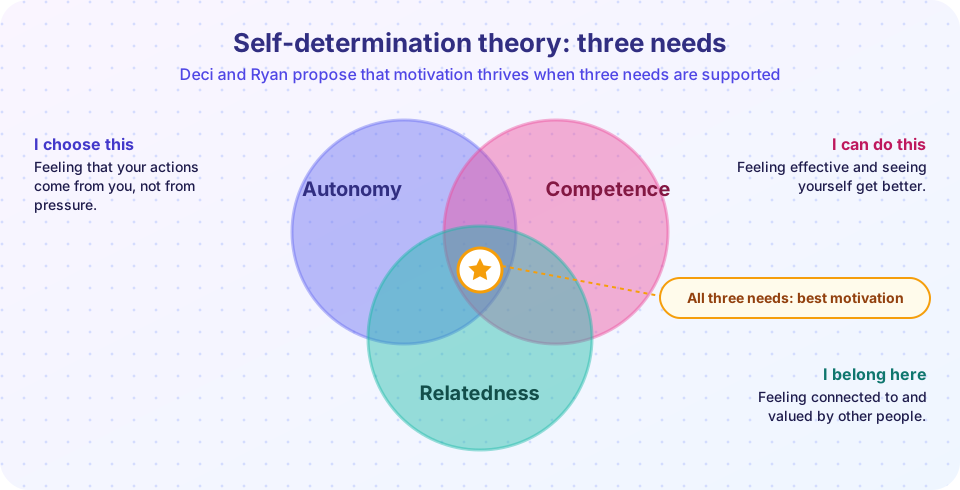
SDT argues that people have three basic psychological needs. When a setting supports them, motivation moves toward the autonomous end of the continuum, and when it frustrates them, motivation becomes controlled or disappears.
- Autonomy: feeling that your actions are chosen and endorsed, not forced. Support it by giving real choices (topic, order, method), explaining the reason for tasks, and using non-controlling language ("you might" rather than "you must").
- Competence: feeling effective and seeing yourself improve. Support it with tasks at the right level (recall the zone of proximal development), clear goals, informative feedback and visible progress.
- Relatedness: feeling connected to and valued by others. Support it with a respectful, warm classroom or study group, and with teachers who show care.
Studies across many countries and age groups find that need support is associated with better engagement and achievement, though much of the evidence is correlational, and intervention studies exist but vary in size.
When rewards backfire: the overjustification effect
Rewards often work: they raise short-term performance on dull tasks. But in some conditions they can reduce later interest in activities people already enjoy. In a classic study by Mark Lepper, David Greene and Richard Nisbett (1973), preschoolers who liked drawing were divided into three groups. One group was told they would receive a "good player" award for drawing, one got an unexpected award, and one got none. Two weeks later, the children who had expected the reward spent less free time drawing than the other two groups. The researchers argued that the reward shifted the children's explanation of their behavior from "I draw because I like it" to "I draw for the prize".
A 1999 meta-analysis by Deci, Koestner and Ryan concluded that tangible, expected rewards given for doing or completing a task tended to undermine intrinsic motivation, while verbal praise tended to increase it. Other researchers, such as Judy Cameron and David Pierce, argued that the negative effects are smaller and limited to narrow conditions. A fair summary: rewards are neither always good nor always harmful. They are most risky when the activity is already interesting, when the reward is expected and controlling, and when it signals that the task is a chore. They are less risky when they provide information about competence ("this shows how far you have come") or when the task is dull and the reward kick-starts a habit.
Expectancy-value theory: "Can I?" and "Does it matter?"
Jacquelynne Eccles and Allan Wigfield developed a theory that links effort to two questions: Can I do this? (expectancy for success) and Is it worth it? (value). Value has several parts.
- Attainment value: how important it is to do well, in relation to who I am.
- Intrinsic value: the enjoyment of the task.
- Utility value: how useful it is for my goals.
- Cost: what I give up, such as time, effort and the risk of failure.
If either expectancy or value is near zero, motivation collapses: no one works hard at something they believe is impossible, or at something they see as worthless. In a study published in 2009 (Chris Hulleman and Judith Harackiewicz), students who wrote about how course material connected to their own lives showed higher interest and better grades than those who wrote a plain summary, and the benefit was largest for students who initially expected to do poorly. Connecting learning to real value is a practical way to raise motivation.
Achievement goals
People pursue different kinds of goals in learning situations. Mastery goals focus on understanding and improving ("I want to get better at this"). Performance goals focus on demonstrating ability, either to look good (approach) or to avoid looking bad (avoidance). Mastery goals are associated with deeper strategies, persistence after failure and interest, while performance-avoidance goals are associated with anxiety and worse outcomes. Classroom environments that emphasize improvement and effort promote mastery goals, while those that rank students against each other promote performance goals.
Flow and the challenge-skill balance
Mihaly Csikszentmihalyi studied people deeply absorbed in activities such as chess, climbing or surgery, and described a state he called flow: intense focus, loss of self-consciousness, a sense of control, and distorted time. Flow tends to occur when challenges are high and skills are high and matched, with clear goals and immediate feedback. If the challenge is too low for your skill, you feel bored; if it is much higher than your skill, you feel anxious. Flow is a useful design principle, rather than a guarantee: games and good lessons both increase and adjust difficulty as the learner improves.
You may have heard of the Yerkes-Dodson law: performance is best at moderate arousal. It is often drawn as an inverted U. The original 1908 experiment was done with mice and electric shocks; the law is a rough, much-simplified generalization, and many tasks do not fit it. Use it as a loose image, not a rule.
Putting it together: a motivation checklist
- Autonomy. Can the learner choose something, and do they understand why the task matters?
- Competence. Is the task challenging but achievable, and does feedback show progress?
- Relatedness. Do they feel they belong and are supported?
- Expectancy. Do they believe effort can lead to success?
- Value. Do they see a link to their own goals?
- Rewards. If rewards are used, are they informational and not controlling?
Common misconceptions
"Rewards always kill motivation." They can in some situations (expected, controlling rewards for interesting tasks) but not always.
"You are either motivated or you are not." Motivation is situational and can be shaped by tasks, relationships and beliefs.
"Intrinsic motivation is always better." Not every necessary task is interesting. Internalized, personally valued extrinsic motivation is perfectly good and often what carries people through hard practice.
"Praise always helps." Praise that is specific and informative helps; empty or controlling praise does not.
Try it
First, a flow explorer. Set your skill and the challenge of a task. The map shows which region you fall in: apathy, boredom, anxiety or flow. The boundaries are simplified for illustration.
Second, an expectancy-value map. In the simple multiplicative form of the model, motivation is proportional to expectancy times value. The heat map shows why zero on either axis kills motivation. The model is a stylized illustration, not a prediction formula.
Press Run (or Ctrl + Enter) to see the result here.
Program input · what you'd type while the program runs
Type the answers before you press Run, one per line. Each time the program reads a line (with input()), it gets the next line from this box.
Check your understanding
Quick check · 5 questions
of 5 answered You scored / 5 · perfect!
-
1. Which are the three basic needs in self-determination theory?
Deci and Ryan propose autonomy, competence and relatedness as basic needs. -
2. In Lepper, Greene and Nisbett (1973), which children later drew less in free time?
Expecting a reward seemed to shift their explanation of drawing from interest to payoff. -
3. If you believe a task is worthless, expectancy-value theory predicts:
Motivation depends on both expectancy and value, so near-zero value means low motivation. -
4. According to flow theory, what produces anxiety?
When demands exceed ability, people feel anxious. -
5. Which approach best supports autonomy?
Choice and rationale help people feel that actions are self-endorsed.
Summary
- Motivation varies along a continuum from controlled to autonomous; identified and intrinsic motivation tend to be most productive.
- Autonomy, competence and relatedness are the three needs in self-determination theory.
- Expected, controlling rewards can undermine interest in already enjoyable tasks, but the effect depends on conditions.
- Expectancy and value jointly drive effort; connecting content to students' goals can help.
- Flow appears when challenge and skill are matched.
Track your progress
Create a free account to tick off lessons and pick up where you left off on any device.
of The Psychology of Learning lessons completed