


















Lesson 41 of 46 · Learning Technology and Projects
Chapter 8 review: learning technology
Review Clark's truck, multimedia principles, adaptive tutoring, spaced-repetition algorithms and AI study habits with a recap table, a summary picture and a ten-question quiz.
Technology changes what is possible, but the psychology of learning stays the same. The chapter's tools, from slides to spaced-repetition apps to AI assistants, help exactly to the extent that they respect working memory and make learners retrieve, practice with feedback and think. This review gathers the key points and gives you a way to judge new tools as they arrive.
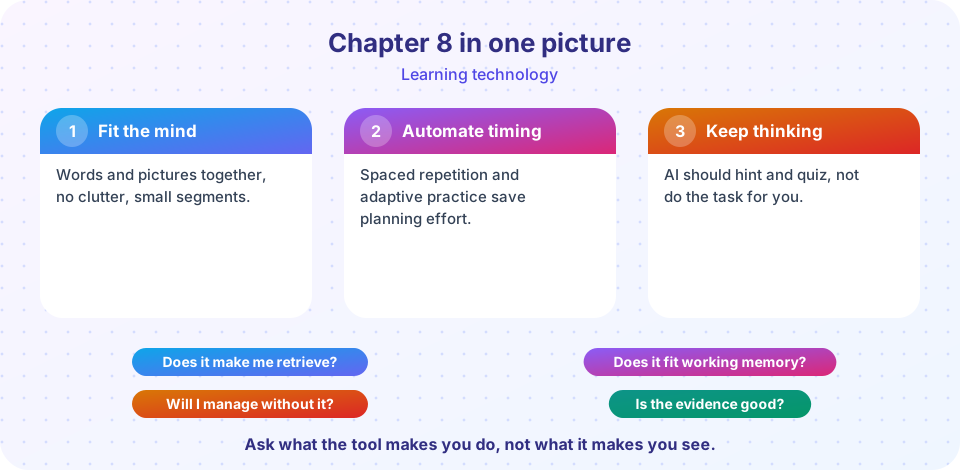
What you will learn
- A recap of the chapter's main findings
- A short evaluation routine for any learning tool
- How the chapter connects to the rest of the course
Recap table
| Idea | Who and when | Key finding | Caveat |
|---|---|---|---|
| Media are vehicles | Clark, 1983 | The method, not the medium, carries the benefit | Kozma: some media enable activities others cannot |
| Online learning | Means and colleagues, 2010 | Blended courses did somewhat better. Fully online was not reliably different | Linked to extra time and materials |
| Laptop multitasking | Sana, Weston and Cepeda, 2013 | Multitasking lowers the comprehension of users and nearby peers | Short lecture experiments |
| Multimedia principles | Mayer and colleagues | Words plus relevant pictures, integrated labels, narration with graphics, no redundancy | Mostly short lessons with immediate tests |
| Split attention | Chandler and Sweller, 1991 | Integrated text and diagrams beat separated ones | Depends on complexity and prior knowledge |
| Animation | Tversky and colleagues, 2002 | Not consistently better than good static graphics | Differences in content confound many comparisons |
| Learning styles | Pashler and colleagues, 2008 | Little credible evidence for matching presentation to style | Preferences exist |
| Two sigma | Bloom, 1984. VanLehn, 2011 | Tutoring is powerful, but human tutoring is nearer 0.8 SD | Systems vary a lot in quality |
| Knowledge tracing | Corbett and Anderson, 1995 | Bayesian updates estimate whether a skill is known | Parameters must be estimated. Gaming and wheel spinning occur |
| Spaced repetition | Leitner, 1972. Wozniak, SM-2 | Schedules reviews at growing intervals | Helps you remember what you understand. Card quality matters |
| AI without guardrails | Bastani and colleagues, 2024 and 2025 | Practice scores rose, unaided exam scores fell | One school, one subject, short duration |
| Tutor-style AI | Bastani and colleagues. Kestin and colleagues, 2025 | Designs with hints and scaffolds avoided harm or improved learning | Early evidence, small samples |
A routine for judging any tool
Ask these questions, in this order, before adopting a tool or a method.
- What does it make the learner do? Look for retrieval, practice with feedback, explanation and problem solving. If the answer is "watch" or "read", look further.
- Does the design fit working memory? Check for split attention, redundancy, clutter and unpaced delivery.
- Can I tell if it works? Is there a test of learning without the tool, at a delay?
- What does the evidence say, and who produced it? Prefer independent, controlled studies. Treat developer-run studies with care.
- What happens to effort? The best tools raise the quality of effort and do not remove it.
- What are the costs? Time, money, data privacy and distraction.
How the chapter ties the course together
- Chapter 5 gave you scaffolding, worked examples and feedback, which good tutoring software implements.
- Chapter 6 gave you spacing, interleaving and retrieval, which SRS tools automate.
- Chapter 7 told you that skill needs stretching practice, a thing that no tool can do for you.
- This chapter added a warning: tools can make practice look better than learning is.
Common misconceptions
"A tool that is fun is a tool that teaches." Engagement is not learning. Check what learners can do afterwards.
"Personalized means better." It depends on what is personalized: adapting to what you know is useful, adapting to a "style" is not.
"New technology makes old findings obsolete." Working memory and the benefits of retrieval did not change with the tools.
Check your understanding
Quick check · 10 questions
of 10 answered You scored / 10 · perfect!
-
1. Clark compared media to a delivery truck. What was his point?
He argued that studies comparing media found no effect of the medium itself. -
2. Which design best follows the modality principle?
Narration uses the auditory channel, leaving the visual channel for the diagram. -
3. In the split-attention effect, what hurts learning?
Integrating text into the diagram removes the need to search and combine. -
4. What does the evidence say about matching teaching to learning styles?
Pashler and colleagues found little support for the meshing hypothesis. -
5. In SM-2, what happens after a successful review (rating 3 or more) when the learner has already had two successes?
After the first two fixed intervals of 1 and 6 days, intervals grow by the ease factor. -
6. In Bayesian knowledge tracing, a correct answer will:
Bayes' rule updates the belief using the guess and slip probabilities. -
7. A student's practice scores with an AI assistant are excellent. What is the best way to check that she has learned?
Learning is what a person can do alone. -
8. What did the Bastani field study find about the tutor-style assistant that gave hints?
Guardrails that forced thinking kept most of the harm away in that study. -
9. Which of the following is NOT a sensible use of AI for studying?
Copying solutions removes retrieval and generation, which are the engines of learning. -
10. Why is a study run by the maker of an app weaker evidence than an independent trial?
Conflicts of interest and favourable measures are a known risk.
Summary
- The method, not the medium, determines whether technology helps. Ask what the tool makes you do.
- Multimedia design should fit working memory: integrate words and pictures, avoid redundancy, segment and cut decoration.
- Adaptive tutors and spaced-repetition software implement ideas from earlier chapters. They need good content and honest use.
- AI can be a shortcut or a tutor. Design and habits decide.
- Chapter 9 puts the course into practice with a study plan project, case studies and a glossary.
Track your progress
Create a free account to tick off lessons and pick up where you left off on any device.
of The Psychology of Learning lessons completed