


















Lesson 9 of 46 · How Learning Works
The brain and plasticity
How learning changes the brain: neurons and synapses, Hebbian learning, long-term potentiation, the hippocampus, sleep and consolidation, plus common neuromyths debunked.
Every kind of learning in this chapter leaves a trace in the brain. When a dog learns that a bell predicts food, when a child copies a gesture, when you finally understand a proof, the physical state of some of your roughly 86 billion neurons has changed. The brain is not a recording device that stores facts in drawers. It is a living network whose connections are constantly strengthened, weakened, grown and pruned by experience. This property is called plasticity.
You do not need to memorize brain anatomy to be a better learner. But a basic picture of what happens at the level of neurons explains many of the practical findings later in this course, such as why spacing helps, why sleep matters, and why "use it or lose it" is a fair summary. It also helps you spot neuromyths, popular claims about the brain that sound scientific and are not.
What you will learn
- How neurons and synapses carry signals, in plain language.
- Hebb's rule and long-term potentiation, the best-known cellular model of learning.
- What the hippocampus does, and what the patient H.M. and London taxi drivers showed.
- How sleep helps consolidate memories.
- Which popular brain claims are myths.
Key terms
Neuron: a cell specialized to receive, process and transmit signals.
Synapse: the tiny junction where one neuron passes a chemical signal to another.
Plasticity: the brain's capacity to change its structure and connections with experience.
Long-term potentiation (LTP): a lasting increase in the strength of a synapse after repeated, coordinated activity.
Consolidation: the process by which a fresh, fragile memory becomes more stable over time.
Neurons and synapses in two minutes
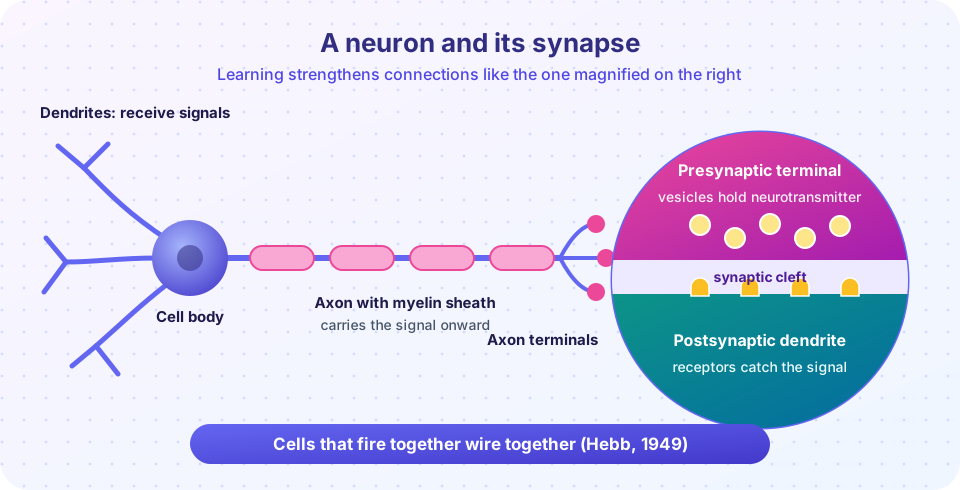
A typical neuron has three main parts. Dendrites, branching extensions, receive signals. The cell body (soma) integrates them. The axon, a long thin fibre, carries an electrical pulse called an action potential away to the next cells. Many axons are wrapped in myelin, a fatty insulating layer that speeds up the signal.
Neurons do not touch. At a synapse, the end of one axon (the presynaptic terminal) releases chemical messengers called neurotransmitters into a tiny gap, the synaptic cleft. Receptors on the next neuron (postsynaptic) catch them and make that neuron more or less likely to fire. Glutamate is the brain's main excitatory transmitter; GABA is the main inhibitory one. Dopamine, among other roles, signals reward prediction errors, linking this lesson to the Rescorla-Wagner model in the conditioning lesson.
What matters for learning is that the strength of a synapse is not fixed. The same signal can produce a bigger or smaller effect depending on past activity. Learning, at one level, is the tuning of those strengths.
Hebb's rule: fire together, wire together
In 1949 the Canadian psychologist Donald Hebb proposed in The Organization of Behavior that when one neuron repeatedly takes part in firing another, the connection between them is strengthened. A catchy paraphrase, "cells that fire together wire together", was popularized later (Carla Shatz, 1992). Hebb's idea explains why association works. If a bell and food activate neurons at the same moments, the circuits become more tightly linked.
The idea was confirmed in a laboratory phenomenon. In 1973 Timothy Bliss and Terje Lømo showed that brief high-frequency stimulation of pathways in the rabbit hippocampus produced a lasting increase in synaptic response, now called long-term potentiation (LTP). Its opposite, long-term depression (LTD), weakens synapses. LTP depends on special glutamate receptors (NMDA receptors) that act as coincidence detectors: they open only when the sending neuron is active and the receiving neuron is already depolarized, which is literally "firing together". Over hours, LTP involves new proteins and even physical growth of the small spines on dendrites, which is why long-term memory requires time and, as you will see, sleep.
Whether LTP is the mechanism of memory is still being tested, and the picture is more complex than Hebb's slogan. But it is the best-supported cellular model we have, and it matches the behavior we see: repetition strengthens, disuse weakens, and timing matters.
The hippocampus and the case of H.M.
In 1953 a young man known for decades only as H.M. (Henry Molaison) had parts of both medial temporal lobes, including most of the hippocampus, removed in an attempt to control severe epilepsy. The seizures improved, but afterward he could not form new long-term memories of events and facts. William Scoville and Brenda Milner reported the case in 1957. H.M. could hold a conversation and recall much of his early life, and his working memory was normal. He also learned a new motor skill (mirror drawing) over several days without remembering the practice sessions. His case showed that the hippocampal region is crucial for forming new explicit memories, and that different kinds of memory rely on different systems. Researchers such as Suzanne Corkin studied him for decades.
The hippocampus continues to be an excellent example of plasticity. Eleanor Maguire and colleagues (2000) used brain scans of licensed London taxi drivers, who spend years memorizing the city's streets, and found that the rear part of their hippocampus was larger on average than in comparison participants, and larger in those who had driven longer. A follow-up study of trainee drivers (Woollett and Maguire, 2011) found that trainees who qualified showed an increase in that region, while those who failed did not. The study did not mean that the larger hippocampus alone makes people better at everything, but it showed that intensive learning is associated with measurable structural change.
Sleep and consolidation
New memories are fragile. Over the hours after learning, they are stabilized by a process called consolidation, and sleep plays an important role. In a classic 1924 study, John Jenkins and Karl Dallenbach had two students learn lists of nonsense syllables and then either sleep or stay awake; recall was better after sleep, with less forgetting. Modern research in animals and humans suggests that during slow-wave sleep the hippocampus "replays" patterns of activity from the day, which helps transfer information to the cortex. Reviews (for example Diekelmann and Born, 2010) conclude that sleep after learning benefits memory, especially for facts and for skills.
The practical message is modest but real: cramming through the night is usually counterproductive. A reasonable plan is to study, sleep, then retrieve again the next day. Studies also find that sleep deprivation harms the ability to encode new information the next day, so skipping sleep hurts twice.
Plasticity across the lifespan
Plasticity is greatest in early childhood, when the brain forms and prunes connections quickly, and some abilities have sensitive periods (for example, hearing the sounds of a first language). But the adult brain remains plastic. Adults learn languages, musical instruments and new careers, though it often takes more deliberate effort. Training changes both function and structure. The "use it or lose it" idea has a basis in synaptic maintenance, although it is an oversimplification: forgotten skills often return faster when practiced again, as in Ebbinghaus's savings.
Neuromyths
Surveys of teachers in several countries (Dekker and colleagues, 2012, in the Netherlands and the UK) found that many believe claims about the brain that scientists reject. Here are the most common.
- "We use only 10 percent of our brains." Brain imaging shows activity throughout the brain over a day, and damage to almost any region has consequences.
- "Left-brain and right-brain people." The hemispheres do specialize in some functions, but healthy people use both together. There is no evidence for "left-brained" and "right-brained" learners.
- "Learning styles." As discussed in the last lesson, matching instruction to preferred style has not been shown to help.
- "Listening to Mozart makes you smarter." A 1993 study by Rauscher and colleagues reported a brief boost on a spatial task in college students, and the idea was inflated into a claim about children's intelligence. Later work found any effect small and probably due to mood and arousal.
- "Brain-training games make you smarter in general." Large reviews find that training improves performance on the trained games, with little transfer to broader abilities.
Common misconceptions
"Learning stops after childhood." Plasticity declines but does not disappear.
"Memories are stored in one spot like files." Memories are distributed patterns across networks, and retrieving them can modify them.
"The brain scan shows the area where learning happens." Colored brain images show correlates, often with small effects and statistical adjustments. They do not by themselves explain thinking or prove a teaching method.
Try it
First, a Hebbian synapse. The connection between neuron A and neuron B has a strength between 0 and 1. Fire A alone, and nothing changes. Fire A and B together, and the connection strengthens a little each time. Let time pass without use, and it weakens slightly. This is a toy model in the spirit of Hebb, not a biological simulation.
Second, a "use it or lose it" simulation. A synapse strengthens on days when both neurons fire and decays every day. The three learners differ only in how often they practice. The model is a deliberately simple toy illustrating balance between strengthening and decay.
Press Run (or Ctrl + Enter) to see the result here.
Program input · what you'd type while the program runs
Type the answers before you press Run, one per line. Each time the program reads a line (with input()), it gets the next line from this box.
Check your understanding
Quick check · 5 questions
of 5 answered You scored / 5 · perfect!
-
1. What is a synapse?
At a synapse, neurotransmitters cross a gap from one neuron to the next. -
2. Which idea does Hebb's rule express?
Hebb proposed that coordinated activity strengthens the link between neurons. -
3. What did the case of H.M. show?
H.M. could not form new event memories after surgery but kept working memory and could learn motor skills. -
4. What is the best-supported practical conclusion about sleep and learning?
Studies from Jenkins and Dallenbach (1924) to modern reviews show better retention after sleep. -
5. Which of these is a neuromyth?
Healthy people use both hemispheres together, and there is no evidence for left-brain or right-brain learner types.
Summary
- Neurons communicate across synapses, and learning changes the strength of those connections.
- Hebb's rule and long-term potentiation provide a cellular model: coordinated activity strengthens synapses.
- The hippocampus is critical for new explicit memories (H.M.) and shows structural change with intense learning (London taxi drivers).
- Sleep after learning helps consolidate memories.
- Many popular claims, including 10 percent of the brain, left/right brain types and learning styles, are myths.
Next: Chapter 2 review
Track your progress
Create a free account to tick off lessons and pick up where you left off on any device.
of The Psychology of Learning lessons completed