


















Lesson 17 of 46 · Attention, Motivation and Mindset
Attention, motivation and mindset: the big picture
Chapter 4 overview: how attention, cognitive load, motivation and beliefs about ability decide whether study time becomes learning, with a short reflection tool.
Chapter 3 described what happens to information once it is in memory. But learning starts earlier, with a question every student knows: can I actually focus on this, and do I want to? Two students can sit in the same lesson for the same hour. One walks out having learned something. The other has been physically present, mentally elsewhere, and walks out with almost nothing. The difference is not just memory strength, it is what the learner paid attention to, how hard they tried and how long they kept going.
This chapter looks at the machinery behind that difference: attention, the limits of the mind's processing capacity, the sources of motivation, and the beliefs people hold about their own abilities.
What you will learn
- How the four topics of this chapter connect.
- What each lesson covers.
- A way to reflect on your own engagement without labeling yourself.
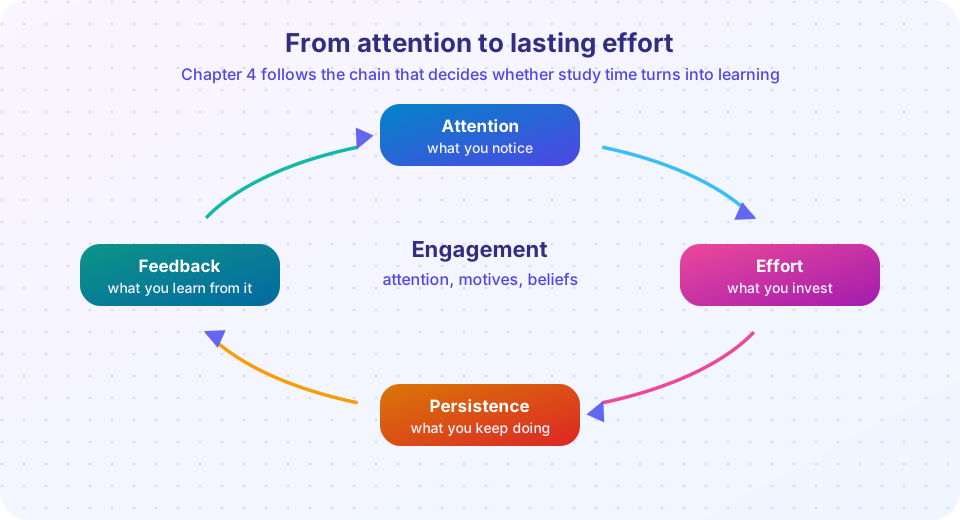
The chain from attention to learning
Attention
Cognitive load
Motivation
Beliefs
Attention decides what gets processed at all. Cognitive load decides whether what you attend to fits in working memory. Motivation decides how much effort you invest and for how long. Beliefs shape motivation: if you think trying is pointless, you will not try. The links run both ways. Success raises motivation and belief; boredom or overload lowers them.
A scenario to keep in mind
Imagine a student, Mara, who wants to learn physics well enough to follow a university course. Look at how this chapter's ideas affect her evening.
Mara sits down with her phone beside her. Each buzz pulls her attention away, and every return to the page costs her a few moments of re-orientation (lesson 1). The textbook page has a diagram on the left and its explanation two pages later, so she spends more effort connecting them than understanding them (lesson 2). She is not sure why she is studying this chapter at all, nobody has asked what she wants from the course, and she has failed the last two tests, so she believes she cannot do physics (lessons 3 and 4). In this situation, even a very good memory strategy would struggle to help.
Now change four things: the phone goes in another room; the textbook page is replaced by one with labels on the diagram; Mara writes down one reason she wants to learn physics and picks her own order for the topics; and she starts with a worked example she can finish, which gives her an early success. None of these changes alters her intelligence or her memory. They remove obstacles between her and the learning, and each one is backed by research you will read in this chapter.
What each lesson covers
- Attention and focus: selective attention, the gorilla study, the real cost of multitasking, and how to protect your focus.
- Cognitive load: Sweller's theory, worked examples, split attention and the principles of effective multimedia.
- Motivation theories: intrinsic and extrinsic motivation, self-determination theory, expectancy-value, flow.
- Mindset and self-efficacy: Dweck's mindset research with its limits, and Bandura's self-efficacy.
- Chapter 4 review.
A note on certainty. This chapter includes both well-established results (the limits of attention, worked examples, self-determination theory) and areas where the evidence is mixed or has been scaled back (some "grit" and "mindset" claims, the "ego depletion" idea). Each lesson tells you which is which.
Try it
A short reflection on how you engage with a subject you are studying. Move each slider from 1 (strongly disagree) to 5 (strongly agree). The tool adds up the scores into four profiles to help you think. It is a reflection aid, not a psychological test, and it has not been validated; do not read it as a diagnosis.
Check your understanding
Quick check · 4 questions
of 4 answered You scored / 4 · perfect!
-
1. Which stage of the chain from attention to learning decides what gets processed at all?
Attention selects what enters further processing. -
2. Which type of cognitive load is caused by poor design rather than the topic itself?
Extraneous load is effort wasted on how information is presented. -
3. Which are the three needs in self-determination theory?
Deci and Ryan identify autonomy, competence and relatedness as basic psychological needs. -
4. How should you treat the engagement reflection in the demo?
It is not validated and gives only prompts for reflection.
Summary
- Attention, cognitive load, motivation and beliefs form a chain that determines whether time becomes learning.
- The links run both ways: success feeds motivation, and boredom or overload drains it.
- Some findings in this area are strong and others are contested; each lesson flags which.
Next: Attention and focus
Track your progress
Create a free account to tick off lessons and pick up where you left off on any device.
of The Psychology of Learning lessons completed