


















Lesson 25 of 46 · Instruction and Feedback
Guided and discovery learning
Examine the long debate between discovery learning and direct instruction: key studies, meta-analyses, scaffolding and productive failure, and when each approach works.
Few topics in education generate as much heat as this one. One camp says children should discover ideas for themselves, because what you work out yourself you understand deeply. The other says that people learn best when an expert explains clearly and then guides practice, because novices are poor at rediscovering what humanity took centuries to work out. Both camps can point to experiments, and for a long time they talked past each other.
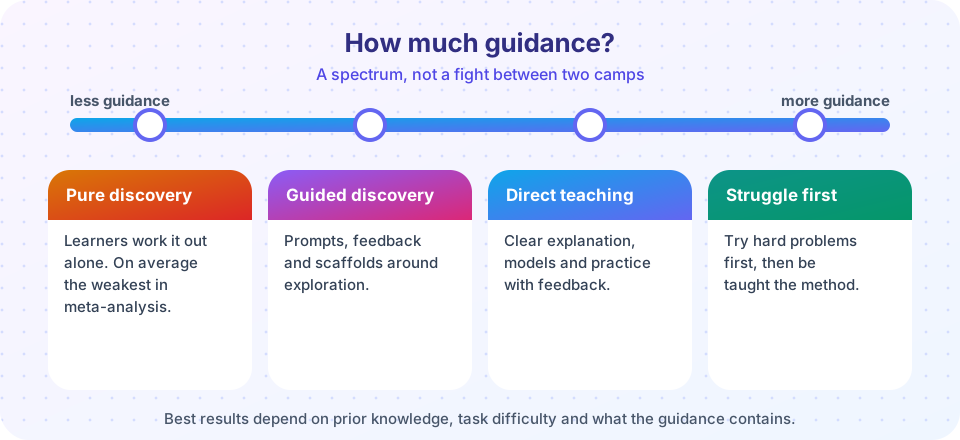
This lesson walks through the main evidence. The short version is that the real question is not "discovery or instruction?" but "how much guidance, of what kind, for which learner, and at which moment?"
What you will learn
- The main arguments for and against minimal guidance
- What the meta-analyses and key experiments found
- What scaffolding and guided discovery actually involve
- What productive failure is, and under which conditions it appears to help
- How to decide how much guidance a learner needs
Key terms
Discovery learning: learners find rules and concepts by exploring, with little or no explanation first.
Direct (explicit) instruction: the teacher explains and models the content, then guides practice.
Scaffolding: support from a more knowledgeable person that makes a task manageable and is withdrawn over time (David Wood, Jerome Bruner and Gail Ross, 1976).
Guided (enhanced) discovery: exploration supported by prompts, feedback, structure or hints.
Productive failure: attempting a hard problem before being taught, so that later instruction lands on prepared ground (Manu Kapur).
The case against minimal guidance
In 2006 Paul Kirschner, John Sweller and Richard Clark published a paper in Educational Psychologist with a blunt title, "Why minimal guidance during instruction does not work". Their argument builds on the previous lesson. Learning means building schemas in long-term memory. Novices have no schemas, so open-ended exploration places a heavy load on a small working memory, and what is found may be wrong, or right without being understood. They reviewed studies of discovery, problem-based, inquiry and similar approaches and concluded that fully or mostly unguided methods tend to be less effective and less efficient than guided ones.
A frequently cited experiment by David Klahr and Milena Nigam (2004) tested this directly with elementary school children learning the control of variables strategy: to find out whether something matters, change only that thing and keep everything else the same. Children either discovered the strategy by exploring or were taught it explicitly. In the direct-instruction condition about three quarters of the children mastered the strategy, but only about a quarter did so by discovering it. There was a twist. The few children who did discover the strategy on their own performed no better on a later transfer task than children who were taught it. So the discovered knowledge was not deeper. It simply took more luck.
A related historical note: Project Follow Through, a very large US program running from the late 1960s, compared many teaching models in disadvantaged communities. In the official evaluations the model based on highly structured direct instruction scored best on basic skills measures, though the study design and the interpretation have been debated for decades.
The reply from the other side
Critics, among them Cindy Hmelo-Silver, Ravit Duncan and Clark Chinn (2007), replied that Kirschner and colleagues lumped together approaches that are in fact heavily guided. Real problem-based learning and inquiry curricula usually include scaffolds, expert facilitation, structured resources and group discussion. The "minimal guidance" that the 2006 paper criticized, they said, hardly exists in well-run classrooms. Studies that show such methods working were therefore not counterexamples, since those methods are guided.
This reply is largely accepted. It also fits the meta-analysis by Louis Alfieri, Patricia Brooks, Naomi Aldrich and Harriet Tenenbaum (2011), which combined 164 studies. Their main results:
- Unassisted discovery was on average worse than explicit instruction, by roughly a third of a standard deviation.
- Enhanced (guided) discovery, where learners explore but get feedback, worked examples, prompts or other help, was on average better than other forms of instruction by a similar margin.
- What mattered most was the guidance, not the label.
Richard Mayer's 2004 article in American Psychologist had reached a similar verdict from a narrative review of research since the 1950s, and gave it a memorable title: should there be a "three-strikes rule against pure discovery learning"? Mayer's answer was yes, pure discovery, but not guided discovery.
What guidance looks like
When researchers say "guidance" they mean something concrete. Examples include:
- A clear goal and a manageable first step
- Worked examples and models, as in the previous lesson
- Prompts that direct attention ("What stays the same in these two cases?")
- Hints that can be requested and gradually withdrawn
- Immediate feedback on errors
- A teacher or tutor who asks questions and adjusts to what the learner says
The word scaffolding comes from a 1976 study by Wood, Bruner and Ross, who watched adults help three- to five-year-old children build a pyramid from wooden blocks. The effective tutors did more than tell. They simplified the task, kept the child focused on the goal, pointed out critical features and demonstrated solutions, and they handed the control back to the child as soon as the child could manage. Lev Vygotsky's idea of the zone of proximal development, the range of tasks a learner can do with help but not yet alone, is the theoretical background.
Productive failure
A newer line of work complicates the picture. Manu Kapur and others have shown that giving learners a problem before teaching them the solution method, even when they fail to solve it, can improve their later understanding. In a typical study, one group first tries to invent a way of measuring variability, such as a formula for how spread out a set of scores is. They produce several partial solutions, none standard. The other group is taught the standard formula first. After a consolidation phase in which a teacher compares student ideas with the canonical method, the "failure" group often does better on conceptual questions and transfer problems, though not always on procedural ones.
Daniel Schwartz and Taylor Martin (2004) found something similar with "inventing with contrasting cases". A 2021 meta-analysis by Tanmay Sinha and Kapur found a small to moderate advantage for productive failure on conceptual knowledge and transfer.
Important conditions apply, and they explain why productive failure does not contradict the cognitive load findings.
- The problem must be one the learners have some relevant knowledge for, for example from everyday experience.
- The failed attempts are used. A teacher must consolidate afterwards by explaining the correct method and relating it to the students' ideas.
- The benefit appears for deep understanding. For plain procedures, direct instruction first often remains at least as good.
Put differently, productive failure is guided exploration followed by explicit instruction: the guidance has moved to the end.
Choosing the amount of guidance
A useful rule of thumb combines the three findings of this chapter so far:
| Learner and task | Likely best approach |
|---|---|
| Complete novice, procedural skill | Worked examples, then faded practice |
| Some prior knowledge, concept to understand | Short exploration or contrasting cases, then explicit explanation |
| Expert in the area | Open problems with little support |
This is a heuristic from research, not a law. A teacher who watches the learners closely will adjust.
Common misconceptions
"Direct instruction means lecturing and rote learning." Well-run direct instruction includes questions, practice, feedback and checks for understanding.
"Discovery means no teacher." Guided discovery has a very active teacher, who designs the situation and gives support.
"Students remember better what they work out alone." Klahr and Nigam found that children who discovered a strategy did not retain or transfer it better than children who were taught it.
Try it
This first demo is a fair-test checker, the idea at the heart of the Klahr and Nigam studies. Pick the variable you want to test and set up two ramps. The page tells you whether your comparison is fair.
The second demo is a simulation with invented numbers. A ball rolls farther on a steeper ramp and less far on a rough one. We compare a confounded experiment with a controlled one.
Press Run (or Ctrl + Enter) to see the result here.
Program input · what you'd type while the program runs
Type the answers before you press Run, one per line. Each time the program reads a line (with input()), it gets the next line from this box.
Check your understanding
Quick check · 5 questions
of 5 answered You scored / 5 · perfect!
-
1. What did the meta-analysis by Alfieri and colleagues (2011) mainly find?
The amount and quality of guidance mattered more than the label discovery or instruction. -
2. In the Klahr and Nigam (2004) study, what was notable about children who discovered the control of variables strategy themselves?
Discovering it did not make the knowledge deeper, though discovery succeeded far less often. -
3. Which is a condition for productive failure to work?
Failed attempts are productive when they are followed by explicit instruction that builds on them. -
4. A scaffold is:
The term comes from Wood, Bruner and Ross (1976): the tutor hands control back as competence grows. -
5. In the confounded ramp experiment, why does the apparent effect of steepness come out too small?
Two causes with opposite signs were changed at the same time, so they partly cancel.
Summary
- The debate is better framed as how much and what kind of guidance, not discovery against instruction.
- Meta-analyses find that unassisted discovery is on average weaker than explicit teaching, while guided discovery does well.
- Klahr and Nigam found that discovered knowledge was not deeper than taught knowledge.
- Productive failure can improve conceptual understanding when problems are doable and a teacher consolidates afterwards.
- Match guidance to prior knowledge: more for novices, less for experienced learners.
Next: Feedback that works
Track your progress
Create a free account to tick off lessons and pick up where you left off on any device.
of The Psychology of Learning lessons completed