


















Lesson 10 of 49 · The Study of Language
Writing Systems
Learn how writing was invented and the five main types of writing systems: logographic, syllabic, abjad, abugida and alphabet, with Hangul and the Latin alphabet.
Everything you have read so far was written, but remember that writing is not language: it is a technology for recording it. Writing was invented only a handful of times in human history, and the systems that resulted work in quite different ways. A Chinese character stands for a word or meaningful part, a Japanese kana stands for a syllable, and an English letter stands, roughly, for a sound.
This lesson tours the main types of writing system, shows how one of them, the alphabet, spread around the world, and explains why English spelling is so irregular.
What you will learn
- How writing began and where it was invented independently.
- The five types of writing system and an example of each.
- How the Phoenician letters became the Greek and Latin alphabets.
- Why spelling and pronunciation can drift apart.
Key terms
Writing system (script): a set of symbols and rules for recording a language.
Logogram: a symbol that stands for a word or a meaningful part of a word.
Syllabary: a script in which each symbol stands for a syllable.
Abjad: a script that writes consonants and leaves most vowels unwritten.
Abugida: a script whose basic symbols are consonants with an inherent vowel, modified by marks.
Orthography: the conventional spelling rules of a language.
How writing began
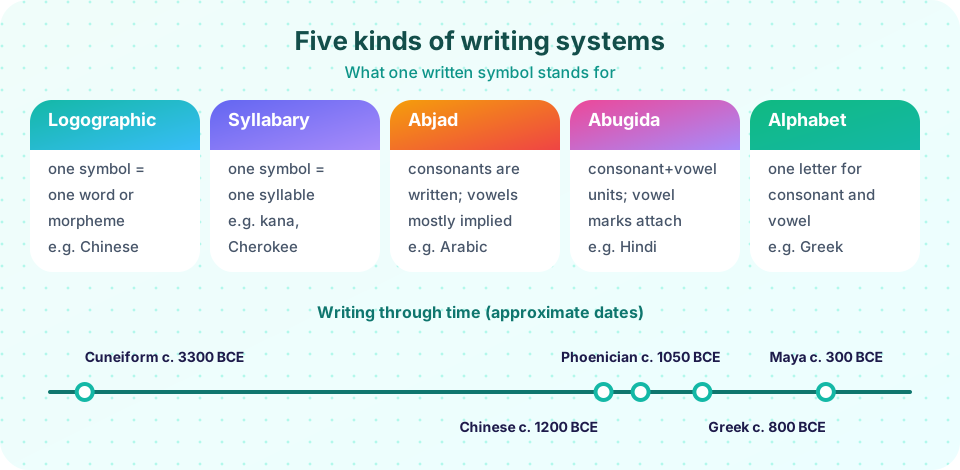
Writing appears to have been invented independently in a few places. The earliest, in Mesopotamia, is cuneiform, which developed around 3300 to 3200 BCE from clay-tablet records of grain, livestock and other goods, and later grew to record stories and law. Egyptian hieroglyphs appear at about the same time; scholars debate whether they were influenced by Mesopotamia. In China, the earliest securely dated writing is found on oracle bones from about 1200 BCE. In Mesoamerica, scripts such as Zapotec and later Maya developed independently, with Maya writing attested from the last few centuries BCE.
In each case, writing began as a record-keeping tool and only gradually became a way of writing everything that can be said. The key step was the rebus principle: using a picture for its sound rather than its meaning, as if you drew a bee and a leaf to write belief. Once signs can stand for sounds, you can write any word.
Five types of writing system
Logographic. Each character stands for a word or a meaningful unit (a morpheme). Chinese characters (hanzi) are the main living example. Most characters are not pictures but combine a part hinting at meaning with a part hinting at sound. A logographic system needs thousands of characters, but it has a benefit: speakers of mutually unintelligible Chinese varieties can read the same text.
Syllabary. Each symbol stands for a syllable. Japanese uses two syllabaries, hiragana and katakana, each with about 46 basic symbols, alongside Chinese characters (kanji). The Cherokee syllabary was devised by Sequoyah around 1821 and soon used by thousands of Cherokee readers, a rare case of a single person inventing a working script.
Abjad. Symbols stand for consonants; vowels are mostly left for the reader to supply, perhaps with optional marks. Arabic and Hebrew are the main modern examples. This works well when a language's grammar is built on consonant patterns, as in Semitic languages, where a root such as k-t-b ("write") produces many related words.
Abugida. Each basic symbol is a consonant with a built-in vowel (usually a), and marks attached to it change the vowel. Devanagari (used for Hindi and many other languages of India) and the Ethiopic script (used for Amharic) are abugidas.
Alphabet. Separate letters stand for consonants and vowels. Greek, Latin, Cyrillic and many others belong here. In a perfectly phonemic alphabet each letter stands for one sound; real alphabets only approximate that.
Many systems are mixed. Written Japanese freely mixes all three of its scripts and often Latin letters (rōmaji) too.
A special case: Hangul
Korean is written in Hangul, created in the 1440s by a team working for King Sejong of Joseon and promulgated in 1446. Its consonant letters are designed to show where in the mouth the sound is made (a letter for the back-of-the-tongue consonant /k/ depicts the tongue's shape), a design principle called featural. Letters are stacked into syllable blocks, so one block looks like a single character but is built from two or more letters. Hangul is one of the few scripts whose date and inventors are firmly known.
The path of the alphabet
The first alphabet-like system probably arose among Semitic-speaking workers in Egypt in the early second millennium BCE, drawing on hieroglyphs. By about 1050 BCE the Phoenicians were using a consonant script of 22 letters. Each letter had a name that began with the sound it stood for: aleph ("ox") began with a glottal stop, bet ("house") with /b/, dalet ("door") with /d/. This is the acrophonic principle.
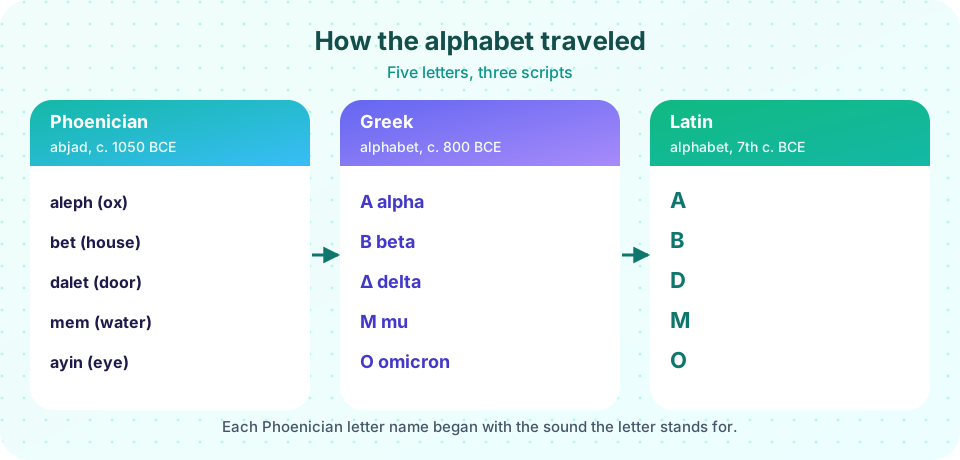
Around 800 BCE, the Greeks adopted the script and made a key change: they used letters for Phoenician consonants that Greek did not have to write vowels. This produced the first full alphabet. The Latin alphabet came from Greek (through the Etruscans), and it is now used for hundreds of languages. The Cyrillic alphabet, used for Russian and others, was created in the 9th and 10th centuries based on Greek.
Spelling and sound
Why is English spelling so hard? The words though, through, tough and cough use the same letters ough for four different sounds. There are historical reasons. English spelling was largely fixed around the time of the arrival of printing in the 15th century, while pronunciation continued to change. In the Great Vowel Shift (roughly 1400 to 1700), long vowels changed their sounds, but spelling kept the old patterns. English also borrowed thousands of words with their original spellings from French, Latin and Greek.
Linguists describe orthographies as shallow (a close match between letters and sounds, as in Finnish, Spanish or Italian) or deep (a loose match, as in English or French). Reformers have proposed spelling changes for centuries, but a spelling system is a social habit that is hard to change, and some irregularities also preserve useful information about word relations (compare sign and signature).
Common misconceptions
"Chinese characters are pictures." A few began as pictures, but most characters combine meaning and sound components, and they record words of the language.
"An alphabet is the most advanced kind of writing." Each type fits its language well; Japanese and Arabic scripts serve their languages very successfully.
"Spelling is language." Spelling is a convention. Speech changes continuously while spelling is deliberately conservative.
Try it
Hangul syllable blocks are built from letters by a precise formula in Unicode: a syllable is a vowel, plus an initial consonant, plus an optional final consonant. This program builds blocks from their letters and also takes a block apart. Choose different positions in the lists and run it again.
Press Run (or Ctrl + Enter) to see the console output here.
No output.
The second demonstration looks at a mixed script. It takes a Japanese sentence and counts which kind of writing each character belongs to, using the Unicode names of the characters.
Press Run (or Ctrl + Enter) to see the result here.
Program input · what you'd type while the program runs
Type the answers before you press Run, one per line. Each time the program reads a line (with input()), it gets the next line from this box.
Check your understanding
Quick check · 5 questions
of 5 answered You scored / 5 · perfect!
-
1. Which script type uses one symbol for each syllable?
Japanese kana and the Cherokee script are syllabaries. -
2. What is the rebus principle?
The rebus principle is the step that lets pictures stand for sounds and so write any word. -
3. What important change did the Greeks make when they borrowed the Phoenician script?
Using letters for vowels turned a consonant script (abjad) into an alphabet. -
4. Why is English spelling irregular?
Printing helped freeze spelling in the 15th century, while sounds shifted (for example in the Great Vowel Shift). -
5. Hangul is unusual because
Hangul was created deliberately, with letter shapes related to articulation, and stacked into syllable blocks.
Summary
- Writing was invented independently in a few places (Mesopotamia, China, Mesoamerica and probably Egypt) and began as record-keeping.
- The five types are logographic, syllabic, abjad, abugida and alphabet; many languages mix systems.
- The alphabet passed from Phoenician to Greek, which added vowels, and then to Latin.
- Hangul is a deliberately designed featural alphabet.
- Orthography can be shallow or deep; English is deep because spelling froze while pronunciation changed.
Next: Chapter 2 Review
Track your progress
Create a free account to tick off lessons and pick up where you left off on any device.
of Linguistics lessons completed