


















Lesson 11 of 49 · The Study of Language
Chapter 2 Review: The Study of Language
Review Chapter 2 of the linguistics course: design features, branches of linguistics, language families and writing systems, with a one-picture summary and a ten-question quiz.
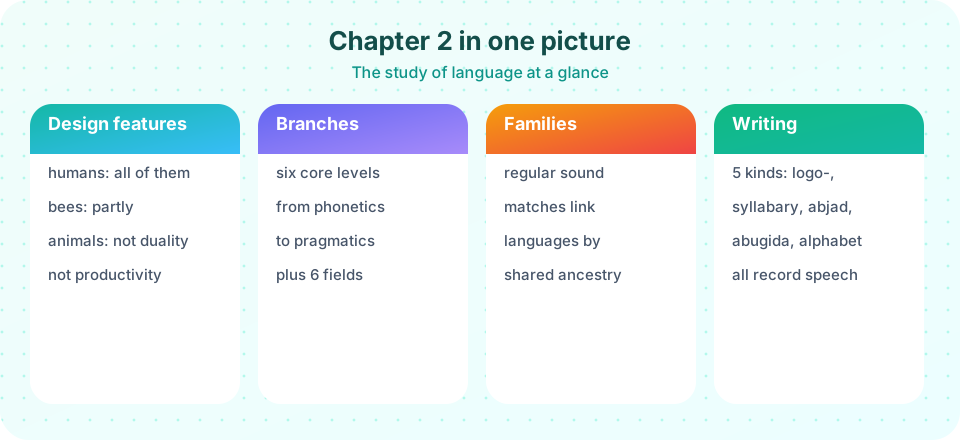
Chapter 2 took a wide-angle view of language. You compared human language with the bee dance and monkey calls, mapped the branches of the field, saw how thousands of languages fall into families, and toured the world's writing systems. This review pulls those threads together before you zoom in on sounds in Chapter 3.
What you will learn
- To recall the key ideas of each lesson in Chapter 2.
- To connect design features, levels, families and scripts.
- To test yourself with a longer quiz.
Recap table
| Lesson | Big idea | Key terms |
|---|---|---|
| Design features | Human language combines meaning, arbitrariness, displacement, productivity, duality and cultural transmission; animal systems have only some | semanticity, displacement, duality of patterning |
| Branches of linguistics | Six core levels from sound to meaning in context, plus links to society, mind, brain, history, computers and teaching | phonetics, phonology, morphology, syntax, semantics, pragmatics |
| Language families | Regular sound correspondences show shared ancestry; language and dialect are partly social labels; many languages are endangered | cognate, comparative method, proto-language, isolate |
| Writing systems | Five types of script; the alphabet spread from Phoenician to Greek to Latin; spelling can be shallow or deep | logogram, syllabary, abjad, abugida, orthography |
Key terms
Duality of patterning: meaningless sounds combine into meaningful words.
Cognates: words in related languages from the same ancestor word.
Pragmatics: meaning in context.
Abugida: a script of consonant-plus-vowel units with modifying marks.
Common misconceptions
"Language and communication are the same thing." Language is one communication system with a special combination of features.
"Similar words prove relatedness." Only regular correspondences do; chance and borrowing can also create resemblance.
"The alphabet is the only real writing." Several script types serve their languages well.
Try it
First, test your recall of design features. Edit my_answers (use the feature names "displacement", "duality", "arbitrariness" or "productivity") and run the program.
Press Run (or Ctrl + Enter) to see the console output here.
No output.
Second, a timeline of writing events from this chapter (dates approximate), drawn with matplotlib. Add an event to the list and see where it falls.
Press Run (or Ctrl + Enter) to see the result here.
Program input · what you'd type while the program runs
Type the answers before you press Run, one per line. Each time the program reads a line (with input()), it gets the next line from this box.
Check your understanding
Quick check · 10 questions
of 10 answered You scored / 10 · perfect!
-
1. Which design feature is shown when a speaker talks about yesterday's trip?
Displacement is reference to things not present in space or time. -
2. Which is true of the honeybee waggle dance?
It shows displacement and meaning, but it is innate and narrow. -
3. Which branch would study how the mouth makes the sound /p/?
Phonetics studies the physical production of speech sounds. -
4. Latin pater and English father illustrate
The p-to-f pattern recurs in many pairs, a sign of shared descent. -
5. Why can't 'language or dialect' be answered by structure alone?
Mutual intelligibility is a starting point, but national and cultural factors matter. -
6. Approximately what share of the world's languages is considered endangered?
Common estimates put it around 40 percent. -
7. Which script type writes consonants and leaves most vowels to the reader?
Arabic and Hebrew are typical abjads. -
8. Japanese writing is an example of
Japanese combines logographic kanji with hiragana and katakana. -
9. What did the Greeks add to the Phoenician script?
Using unneeded consonant letters for vowels created a full alphabet. -
10. Which pairing is correct?
Cuneiform is Mesopotamian, oracle bones Chinese, Cherokee 1820s.
Summary
- Design features show how human language differs from other systems: duality, productivity, displacement and more.
- The core levels run from phonetics to pragmatics; other fields connect language to mind, society and computers.
- Related languages share regular sound correspondences; many languages are endangered.
- Writing has five main types and a long history; spelling can lag behind speech.
Track your progress
Create a free account to tick off lessons and pick up where you left off on any device.
of Linguistics lessons completed