


















Lesson 7 of 49 · The Study of Language
Design Features of Language
Compare human language with the bee waggle dance and monkey alarm calls using Hockett's design features: arbitrariness, displacement, productivity and duality.
If you want to know what is special about human language, one good method is to compare it with other communication systems and ask: what does language have that they lack? In 1960 the American linguist Charles Hockett proposed a list of design features, properties that a communication system may or may not have, and used it to compare human language with animal signals.
The list is not a scientific law and it has been revised and criticized. But it gives you precise words for talking about what language is and for judging claims like "dolphins have a language".
What you will learn
- The main design features and what each means.
- How the honeybee dance and vervet alarm calls compare with human language.
- What ape language experiments did and did not show.
- Why duality of patterning matters.
Key terms
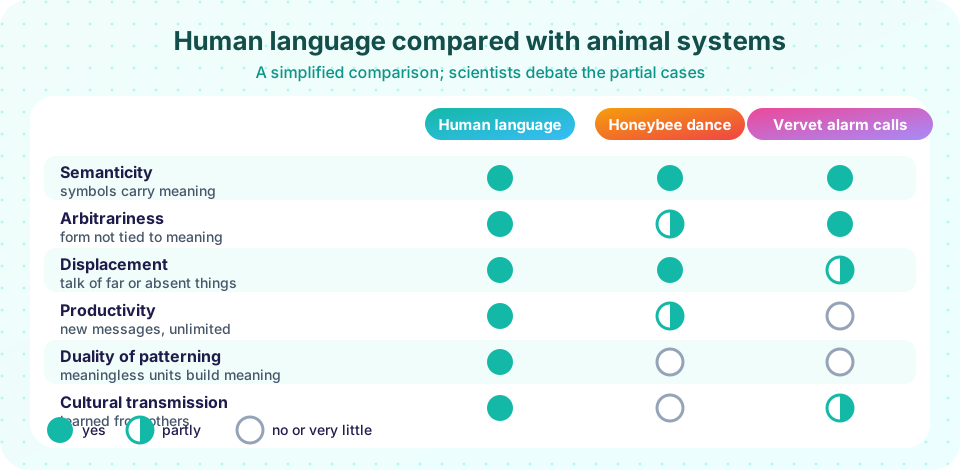
Semanticity: the signals carry meanings.
Displacement: the ability to refer to things that are not present, in the past, the future or elsewhere.
Productivity: the ability to create and understand new messages.
Duality of patterning: meaningless units (sounds) combine into meaningful units (words), which combine into larger meaningful units (sentences).
Cultural transmission: the system is learned from other members of the community, not just inherited.
Hockett's features
Hockett's 1960 list had thirteen features. Some describe the spoken channel (the vocal-auditory channel, rapid fading of sound), and some are about how signals work. The ones that matter most for the comparison are these:
- Semanticity: signals mean something.
- Arbitrariness: the form is not tied to the meaning (as you saw in What Is Language?).
- Discreteness: the units are separate and distinct (a /p/ and a /b/ are different sounds, not points on a smooth scale).
- Displacement: you can talk about things that are not here and now.
- Productivity: new messages are easy to make and understand.
- Duality of patterning: a few meaningless sounds build many meaningful words.
- Cultural transmission: you learn your language from your community. A child raised among Mandarin speakers learns Mandarin, not Spanish; the capacity is innate, the particular language is learned.
The honeybee dance
The Austrian biologist Karl von Frisch received a Nobel Prize in 1973 (shared with Konrad Lorenz and Nikolaas Tinbergen) partly for decoding how honeybees tell nestmates where food is. A forager that has found a good patch returns to the hive and performs a waggle dance on the vertical comb:
- the angle of the straight waggle run, measured from vertical, corresponds to the direction of the food measured from the sun's direction (up on the comb means toward the sun);
- the duration of the waggle run increases with distance to the food.
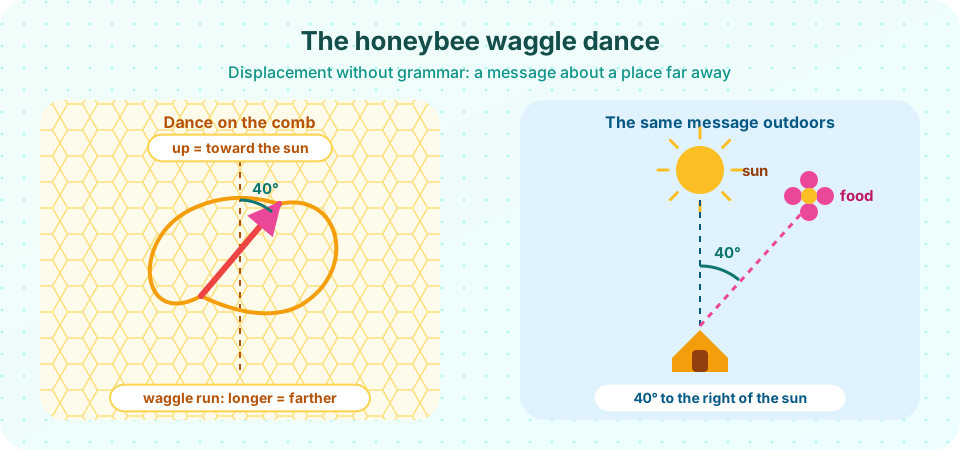
This is real displacement: the dancer reports a place she is no longer at. It also has meaning. But it differs from human language in important ways. It is largely innate, it is not interchangeable (only foragers dance, and only about food and nest sites), it has no duality of patterning, and its signals are partly iconic (the angle of the dance is a map of the angle of the flight). Its "vocabulary" is a continuous variation of two numbers (direction and distance), so it is productive only in a narrow sense.
Vervet monkey alarm calls
Vervet monkeys in East Africa give distinct alarm calls to different predators. In field experiments in the early 1980s, Dorothy Cheney, Robert Seyfarth and Peter Marler played recorded calls to vervets when no predator was around and watched the reactions: a "leopard" call sent monkeys up into trees, an "eagle" call made them look up or dive into bushes, and a "snake" call made them look at the ground. The calls function like words with meanings and the form is not an imitation of the predator, so they are good examples of semanticity and fairly arbitrary signs. But the system is small (a handful of call types), usually tied to a predator being present, and young monkeys refine their use of the calls with experience rather than inventing new ones. Productivity and duality are absent.
What about teaching apes?
If apes lack language, can we give them one? Several famous projects tried. Washoe, a chimpanzee raised by Allen and Beatrix Gardner from the 1960s, learned well over a hundred signs adapted from American Sign Language. Another chimpanzee, Nim Chimpsky, was studied by Herbert Terrace in the 1970s, who concluded that Nim's multi-sign utterances showed little real syntax and much imitation and prompting. The bonobo Kanzi, studied by Sue Savage-Rumbaugh, learned to use symbols on a keyboard and understood many spoken English requests.
Scientists still disagree about what these projects prove. Most agree that apes can learn and use dozens or hundreds of symbols and can understand some spoken words. Most also agree that the evidence for human-like grammar, with productive structure and recursion, is weak. A careful summary: apes can acquire a vocabulary, but nothing in their natural communication or in these projects matches the full set of human design features.
Duality of patterning
Duality is the most subtle feature, and it explains the power of language. Human languages have a small stock of meaningless sounds (about 20 to 60 in most languages). The sounds of cat are /k/, /æ/ and /t/. None of those sounds means anything on its own, but arranged one way they make cat, another way act, and another tack. This gives a huge vocabulary from a small inventory. An animal system with one signal for each message must have as many signals as messages; a system with duality can grow without limit.
Another way to see it: duality is what lets a child store tens of thousands of words using only a few dozen sound categories.
Common misconceptions
"Animals do not communicate." They do, often very cleverly. The point is that no known system has the whole package of features.
"Chimps who sign prove that apes have language." The evidence supports vocabulary learning but not full human-style grammar; scholars debate how to interpret it.
"The design features are a checklist you either pass or fail." Hockett's list is a tool for comparison, and many cases are partial.
Try it
The first demo is a decoder for a bee dance. Move the sliders to set the dance angle, the waggle duration and the sun's compass bearing, and read the flight instructions. The distance scale (1 second = 1,000 meters) is an illustration; real calibrations differ between bee populations. This is a model of the code, not a bee.
The second demo shows duality of patterning. A few "sounds" (here letters standing in for sounds) are combined into many different words. The program finds every word in a small dictionary that can be built from the available letters.
Press Run (or Ctrl + Enter) to see the console output here.
No output.
Check your understanding
Quick check · 5 questions
of 5 answered You scored / 5 · perfect!
-
1. Which design feature does the honeybee waggle dance clearly show?
The dance reports the direction and distance of food away from the hive, but it lacks duality and has limited productivity. -
2. What did the playback experiments with vervet monkeys show?
The calls act like meaningful signals: hearing one made the monkeys behave as if the matching predator were near. -
3. Duality of patterning means that
Duality is the two layers: sounds (no meaning) and words or morphemes (with meaning). -
4. What is a fair summary of ape language projects such as Washoe, Nim and Kanzi?
Vocabulary learning is well documented; productive syntax and recursion are not. -
5. Why is cultural transmission a design feature of human language?
Children acquire the language they are exposed to, which is why the same child could learn any language.
Summary
- Hockett's design features give a vocabulary for comparing communication systems.
- Human language combines semanticity, arbitrariness, discreteness, displacement, productivity, duality and cultural transmission.
- The honeybee dance has meaning and displacement but is largely innate and limited in what it can say; vervet calls are meaningful but few and tied to context.
- Ape language projects show vocabulary learning, with a lively debate about syntax.
- Duality of patterning lets a few sounds yield a huge vocabulary.
Next: Branches of Linguistics
Track your progress
Create a free account to tick off lessons and pick up where you left off on any device.
of Linguistics lessons completed