


















Lesson 6 of 49 · The Study of Language
Chapter 2 Overview: The Study of Language
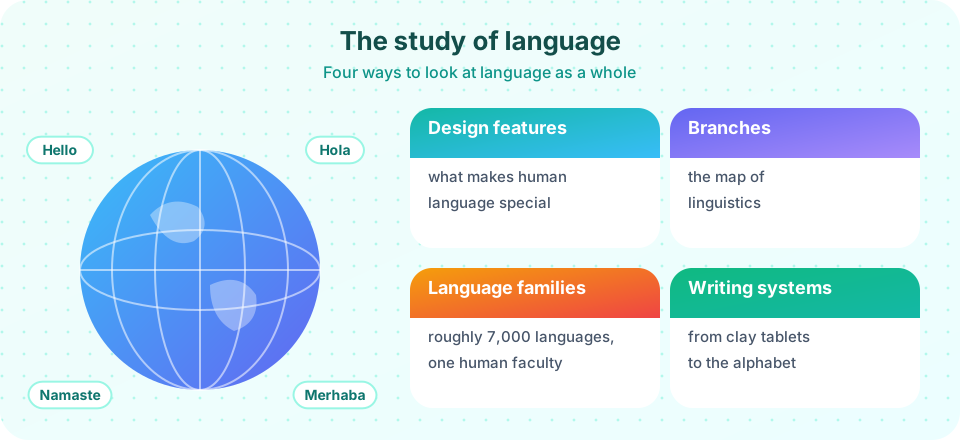
Preview Chapter 2: what makes human language special, how linguistics is organized, how thousands of languages relate, and how writing systems record speech.
In Chapter 1 you learned what a language is and how linguists collect evidence. In this chapter you zoom out and look at language as a whole. What makes human language different from a dog's bark or a bee's dance? How is the science of language organized? Roughly how many languages are there, and how are they related? And how did humans learn to write them down?
What you will learn
- What the big questions of this chapter are and how the four lessons answer them.
- A first look at the design features that make human language special.
- Why linguistics has so many branches and how they fit together.
Key terms
Design feature: a property of a communication system, such as arbitrariness or productivity, used to compare systems.
Language family: a group of languages descended from a common ancestor.
Script: a writing system used to write one or more languages.
Subfield: a branch of linguistics with its own questions and methods, such as phonology or syntax.
The chapter in four slides
Design features
Branches of linguistics
Families and diversity
Writing systems
What each lesson covers
- Design features of language: the features Charles Hockett proposed in 1960 for comparing communication systems, applied to honeybees, vervet monkeys and people.
- Branches of linguistics: a map of the field, from phonetics to pragmatics and out to sociolinguistics, psycholinguistics and more.
- Language families and diversity: how regular sound changes let us reconstruct ancestors, the major families, and why so many languages are endangered.
- Writing systems: logograms, syllabaries, abjads, abugidas and alphabets, and how writing was invented.
- Chapter 2 review: a one-picture summary and a longer quiz.
The big picture
Two themes run through the chapter.
Universality and diversity. All human communities have a language, and all those languages are complex. At the same time, languages differ in remarkable ways: in sounds, word building, sentence structure and the way they are written. Linguistics tries to describe both the differences and the deep similarities, and to ask whether the similarities come from shared ancestry, shared cognition, or shared communicative needs.
Language as a system. To compare languages you need a vocabulary for their parts. The design features give you one for entire communication systems; the branches of linguistics give you one for the levels inside a single language; the writing-system types give you one for how languages are recorded.
Common misconceptions
"There are only a few real languages." Estimates put the number of living languages at around 7,000, and every one of them is a complete system.
"Animal communication is a simple version of language." Some animal systems share a few features with language, but none matches the full combination of properties you will see in the next lesson.
"Writing systems all work like the alphabet." Some write words, some syllables, some only consonants.
Try it
First, a quick comparison tool for the next lesson. It scores three communication systems on five features (2 = yes, 1 = partly, 0 = no). The scores are a simplified teaching summary, and some of the "partly" cases are debated. Edit the scores to see how the table changes.
Press Run (or Ctrl + Enter) to see the console output here.
No output.
Second, a letter-frequency chart. Writing systems record language in symbols, and counting how often each symbol occurs is a classic first step in studying a script. This uses a short original text; real frequency studies need far more.
Press Run (or Ctrl + Enter) to see the result here.
Program input · what you'd type while the program runs
Type the answers before you press Run, one per line. Each time the program reads a line (with input()), it gets the next line from this box.
Check your understanding
Quick check · 4 questions
of 4 answered You scored / 4 · perfect!
-
1. A design feature is
Design features such as arbitrariness and productivity let us compare human language with other systems. -
2. Roughly how many living languages are there?
Common estimates are around 7,000, though the exact number depends on how languages and dialects are counted. -
3. What is a language family?
Family means shared ancestry, shown by systematic similarities, not shared script or location. -
4. Which statement about writing systems is correct?
Scripts differ in what a symbol stands for, and they are much younger than speech.
Summary
- Chapter 2 compares communication systems, maps the field, explores language families and surveys writing systems.
- Human languages are universal and diverse at the same time.
- There are roughly 7,000 languages; families group them by ancestry, not by script or place.
- Scripts differ in what each symbol stands for.
Track your progress
Create a free account to tick off lessons and pick up where you left off on any device.
of Linguistics lessons completed