


















Lesson 47 of 49 · Projects and Practice
Glossary: syntax to computation
A glossary of key linguistics terms from syntax, semantics, pragmatics, acquisition, change, variation and computational linguistics, each with a short definition.
Linguistics has a lot of vocabulary, and the vocabulary is useful: each term names a distinction that took scholars decades to make. This glossary gathers the terms from chapters 5 to 9 in alphabetical order, each with a one-line definition and a link to the lesson where it is explained. Terms from phonetics, phonology and morphology are in the earlier chapters.
What you will learn
- The precise meaning of about sixty core terms
- Which lesson to revisit for each term
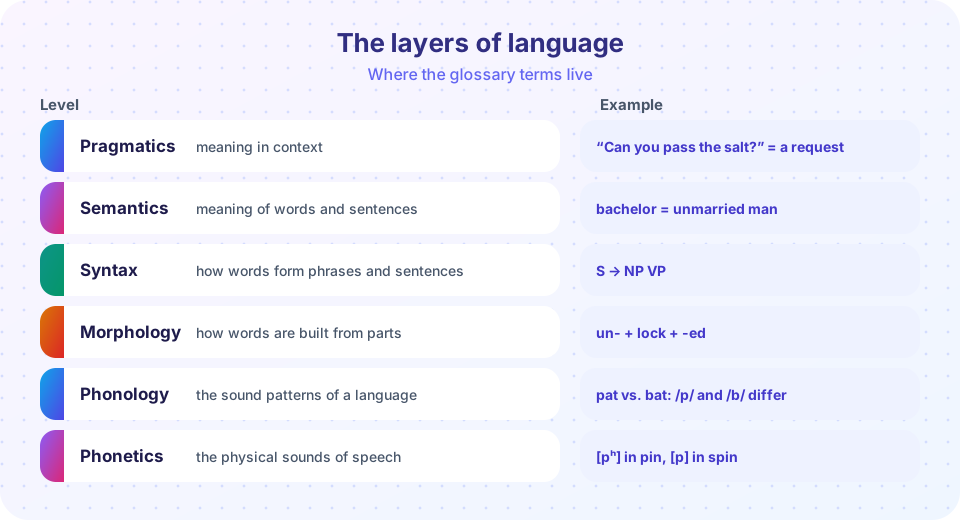
- How the terms group into layers of language and into three research areas
How to use this page
Look up a term, read the definition, then follow the link if you need the full story. When you study, cover the definitions and try to recall them. The two demos below turn the glossary into a lookup tool and a self-test.
Glossary
| Term | Definition | Lesson |
|---|---|---|
| Ambiguity (structural) | One string with more than one tree | Rules |
| Analogy | Reshaping a form to match a regular pattern | Change |
| Antonym | A word with the opposite sense | Word senses |
| Apocope | Loss of a final sound or syllable | Sound-change project |
| Attachment | The choice of which node a phrase joins | Rules |
| Bigram | A pair of adjacent words, or a model using the previous word | n-grams |
| Category | A word class such as noun or verb | Constituents |
| CKY | A chart-parsing algorithm for grammars in normal form | Parsing |
| Code-switching | Alternating between languages in a conversation | Second language |
| Cognate | A word descended from the same ancestor word as a word in a related language | Change |
| Collocation | Words that occur together more than chance predicts | Corpora |
| Competence | A speaker's tacit knowledge of grammar | Syntax overview |
| Compositionality | The meaning of a whole is built from its parts and structure | Truth conditions |
| Concordance | A list of occurrences of a word with context | Corpora |
| Constituent | A group of words that acts as one unit | Constituents |
| Corpus | A structured collection of real texts | Corpora |
| Critical period | A developmental window when language learning is easiest | First language |
| Entailment | A entails B if B is true whenever A is | Truth conditions |
| Filler-gap dependency | A link between a displaced phrase and its gap | Movement |
| Flouting | Openly breaking a maxim to create an implicature | Pragmatics |
| Fossilization | Persistent errors in a learner's language | Second language |
| Grammaticalization | A content word becoming a grammatical marker | Change |
| Grimm's law | A regular consonant shift between Indo-European and Germanic | Change |
| Hapax legomenon | A word occurring once in a corpus | Corpora |
| Head | The word that determines a phrase's category | Constituents |
| Hypercorrection | Overshooting a prestige norm | Variation |
| Hyponym | A word naming a kind of something, such as beagle for dog | Word senses |
| Illocutionary force | What a speaker does in saying something | Pragmatics |
| Implicature | Meaning conveyed beyond what is said | Pragmatics |
| Interlanguage | A learner's evolving rule system | Second language |
| Island | A structure from which nothing can be extracted | Movement |
| Kneser-Ney | A smoothing method that counts contexts | n-grams |
| Lenition | Weakening of a consonant, such as voicing between vowels | Sound-change project |
| Maxim (Gricean) | One of four conversational guidelines: quantity, quality, relation, manner | Pragmatics |
| Movement | A phrase appearing away from where it is interpreted | Movement |
| n-gram | A sequence of n items, usually words | n-grams |
| Overgeneralization | Applying a rule to an exception, as in goed | First language |
| Perplexity | A measure of how surprised a model is by text | n-grams |
| Phrase | A group of words built around a head | Constituents |
| Polysemy | One word with several related senses | Word senses |
| Pragmatics | Meaning that depends on context and intention | Meaning overview |
| Presupposition | Background content that survives negation | Truth conditions |
| Prototype | The best example of a category | Word senses |
| Proto-language | A reconstructed ancestor of related languages | Change |
| Quantifier | A word such as every, some, no or most | Truth conditions |
| Recursion | A category containing itself | Rules |
| Reference | The thing a word or phrase picks out | Meaning overview |
| Scalar implicature | An inference from a weaker word on a scale to not the stronger | Pragmatics |
| Scope | The range over which a quantifier or operator applies | Truth conditions |
| Semantics | Meaning from words and structure | Meaning overview |
| Sense | The way a word picks out its referent | Meaning overview |
| Smoothing | Giving unseen events some probability | n-grams |
| Speech act | An action performed by speaking | Pragmatics |
| Statistical learning | Detecting regularities in input, such as syllable transitions | First language |
| Token | One occurrence of a word | Corpora |
| Transfer | Carrying L1 habits into L2 | Second language |
| Tree | A diagram of hierarchical structure | Constituents |
| Truth condition | What must hold for a sentence to be true | Truth conditions |
| Type | A distinct word form in a corpus | Corpora |
| Variable (linguistic) | A place where speakers can choose between variants | Variation |
| Viterbi algorithm | Dynamic programming for the best tag sequence | Parsing |
| Zipf's law | Frequency is roughly inversely proportional to rank | Corpora |
Try it
The first demo is a small glossary search: type part of a term and see the matches. It uses a few entries from the table; add the rest to make a full lookup tool.
Press Run (or Ctrl + Enter) to see the console output here.
No output.
The second demo turns definitions into fill-in-the-blank prompts. Cover the answer list, answer each prompt aloud, then check.
Press Run (or Ctrl + Enter) to see the console output here.
No output.
Check your understanding
Quick check · 5 questions
of 5 answered You scored / 5 · perfect!
-
1. Which term names words that occur together more often than chance?
Strong tea is a collocation: strong and tea co-occur more than chance predicts. -
2. Which term describes a structure from which nothing can be moved?
Islands block filler-gap dependencies. -
3. What is a hapax legomenon?
Hapax legomena are one-off words. -
4. Which term refers to what is said versus what is meant?
Implicature is the extra meaning inferred from context. -
5. Which is a smoothing method?
Viterbi is for tagging and CKY for parsing.
Summary
- The glossary lists terms from syntax through computational linguistics, with lesson links.
- Terms group into layers of language and into acquisition, change and variation.
- Use search and cloze practice to learn terms actively.
Next: Cheat sheet
Track your progress
Create a free account to tick off lessons and pick up where you left off on any device.
of Linguistics lessons completed