


















Lesson 34 of 49 · Language Acquisition, Change and Variation
Chapter overview: Acquisition, change and variation
A map of how language is learned, how it changes over centuries and how it varies across speakers, with the questions each lesson in this chapter answers.
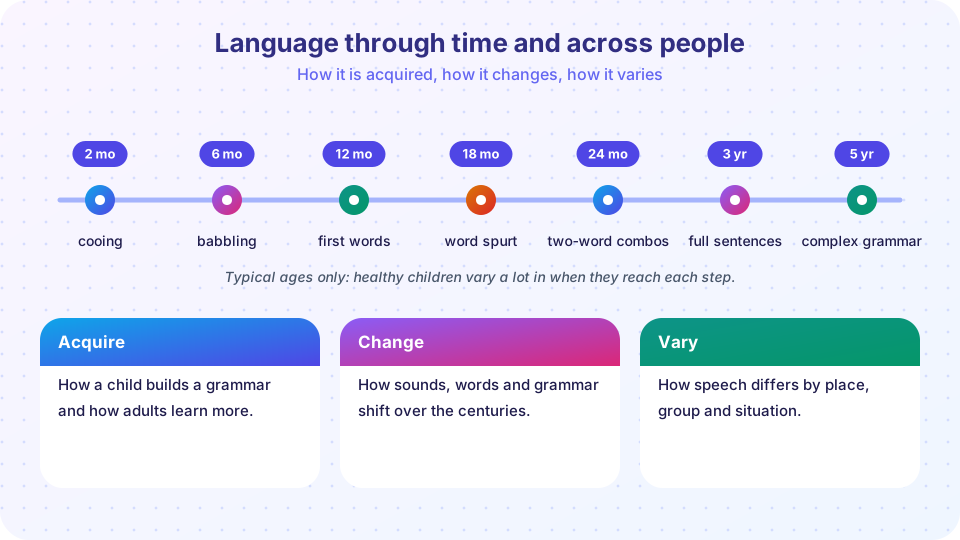
Every language is always doing three things at once. It is being learned by children and second-language learners, it is changing from one generation to the next, and it is varying across places, groups and situations. These three processes are one story seen from different sides: variation among speakers supplies the raw material for change, and each new generation of learners decides which variants survive.
What you will learn
- The typical stages of first-language development, and the main theories of how it works
- How adults learn a second language and what bilingualism does
- How sounds, words and grammar change, and how languages are related
- How social factors such as class, region and style shape speech
Key terms
Acquisition: the process by which a person comes to know a language.
Sociolinguistics: the study of how language varies with social factors.
Variation: differences in how the same thing is said by different people or at different times.
Historical linguistics: the study of how languages change and how they are related.
Dialect: a variety of a language associated with a region or social group.
Three stories, one system
Acquisition. Around two months, babies coo; around six they babble (ba-ba-ba); by about twelve they produce first words; by two they combine words; by five most children have mastered the core grammar of their language. These ages are typical, not fixed: healthy children vary widely in timing. How children manage this with no formal teaching has been a central question since Noam Chomsky argued in the 1950s that experience alone seems too thin to explain it, while Michael Tomasello and others argue that rich social interaction and general learning are enough.
Change. English in the year 1000 would be unintelligible to you. Sounds shift (Great Vowel Shift), words change meaning (nice once meant "foolish"), and grammar is reshaped. Change is not decay: every language that is spoken keeps changing, and no stage is "pure."
Variation. In New York in the 1960s, William Labov showed that pronunciation differences correlate systematically with social class and with how carefully someone speaks. Variation is orderly, not random.
Learning a language
Change over time
Variation in society
How they connect
The lessons in this chapter
| Lesson | What it covers |
|---|---|
| First-language acquisition | Milestones, overgeneralization, nativist and usage-based views |
| Second-language learning and bilingualism | Transfer, interlanguage, age effects, bilingual minds |
| Language change and families | Sound change, comparative method, Indo-European |
| Sociolinguistic variation | Dialect, class, style, code-switching |
| Chapter review | One picture and a ten-question quiz |
Common misconceptions
"Children learn only by imitating adults." Children produce forms they have never heard, such as goed. They are building rules, not copying.
"Languages get worse over time." Linguists find no evidence that change lowers a language's expressive power; complaints about decline have a long history and say more about social attitudes.
"Dialects are corrupted versions of the standard." A standard is one variety that gained prestige, often for political and historical reasons. All varieties follow rules.
Try it
The first demo draws a schematic vocabulary growth curve to show how a typical child's productive vocabulary starts slowly and then speeds up. The shape is illustrative; real values differ greatly between children.
Press Run (or Ctrl + Enter) to see the result here.
Program input · what you'd type while the program runs
Type the answers before you press Run, one per line. Each time the program reads a line (with input()), it gets the next line from this box.
The second demo prints the typical milestones as a quick reference and flags that they are ranges.
Press Run (or Ctrl + Enter) to see the console output here.
No output.
Check your understanding
Quick check · 4 questions
of 4 answered You scored / 4 · perfect!
-
1. At about what age do babies typically start babbling?
Repeated syllables appear around six months. -
2. Why are children's forms like goed evidence for rule learning?
Such forms are not in the input, so they must come from a generalization. -
3. Which researcher is associated with studies of New York speech and social class?
Labov's New York studies of the 1960s are classics of sociolinguistics. -
4. How are variation and change related?
Most changes begin as variants that spread through a community.
Summary
- Acquisition, change and variation are three views of one living system.
- Children build rules rather than only copying; timing varies between children.
- Languages change continuously and variation within a community is orderly.
- Variation supplies the raw material for change.
Track your progress
Create a free account to tick off lessons and pick up where you left off on any device.
of Linguistics lessons completed