


















Lesson 16 of 49 · Phonetics and Phonology
Phonological Rules and Syllables
Learn how sounds change in context (assimilation, deletion, insertion), how syllables are built from onset, nucleus and coda, and what sonority and phonotactics tell us.
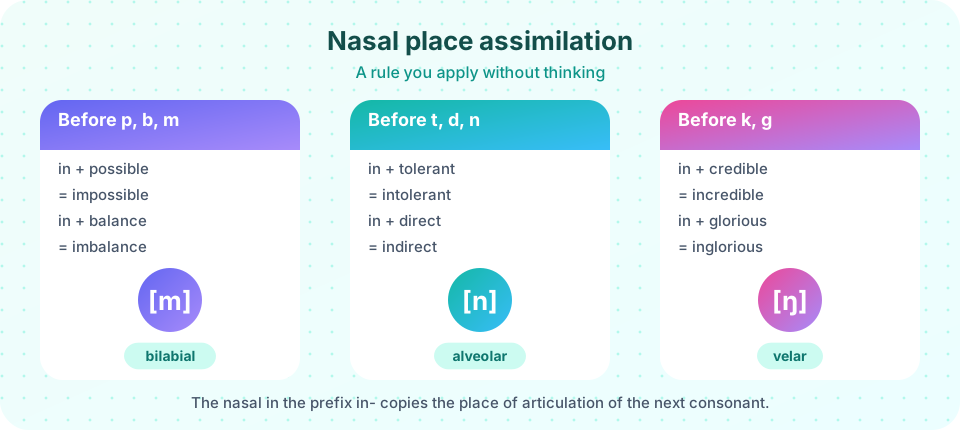
Say impossible and intolerant and incredible. The prefix is the same, in-, yet your mouth quietly changes the final consonant each time: [m], [n], [ŋ]. You never learned this rule in school, and you probably never noticed it, yet you follow it every time.
Phonology is largely the study of such rules: how sounds change depending on their neighbors, and how they group into larger units called syllables. In this lesson you will learn the main types of phonological rule, a simple way to write them, and the structure of the syllable.
What you will learn
- The main kinds of phonological rule: assimilation, deletion, insertion and others.
- How to write a rule as A → B / C __ D.
- The structure of a syllable: onset, nucleus, coda.
- What sonority and phonotactics are.
Key terms
Phonological rule: a statement that a sound changes in a particular environment.
Assimilation: a sound becomes more like a neighboring sound.
Syllable: a unit of sound organized around a vowel (or another sonorous peak).
Onset / nucleus / coda: the consonants before the vowel, the vowel (peak), and the consonants after it.
Phonotactics: the rules about which sound sequences are allowed in a language.
Writing a rule
Linguists write a rule in a compact formula: A → B / C __ D, read "A becomes B in the environment after C and before D". The blank marks the position of the sound that changes. For example, the nasal in the prefix in- before a bilabial consonant:
n → m / __ [p b m]
("/n/ becomes [m] before /p/, /b/ or /m/"). The rule is short, but it is general: it applies to impossible, imbalance and immobile alike, and also across word boundaries in fast speech (ten pounds is often pronounced [tɛm paʊndz]).
Common kinds of rule
Assimilation. One sound takes on a feature of a neighbor. The in- example is place assimilation. A second kind is voicing assimilation. Take the English plural ending -s, which is written the same way but pronounced three ways:
| Word | Sound before the ending | Ending pronounced |
|---|---|---|
| cats | voiceless (/t/) | /s/ |
| dogs | voiced (/g/) | /z/ |
| buses | sibilant (/s/) | /ɪz/ |
The ending copies the voicing of the sound before it, and when the sound before is a sibilant (s, z, ʃ, ʒ, tʃ, dʒ) a vowel is added to keep the two apart. The past tense -ed behaves the same way: /t/ in walked, /d/ in played, /ɪd/ in wanted. This is one rule family, not three random facts. (The word-building side of such alternation is the subject of Chapter 4.)
Deletion. A sound disappears. In fast speech next day is often pronounced [nɛks deɪ], with no [t], and I don't know shrinks to something like [aɪ doʊ noʊ].
Insertion (epenthesis). A sound is added. Many English speakers say warmth with a little [p] between [m] and [θ], like [wɔɹmpθ]. Spanish adds a vowel before s + consonant in loanwords: Latin schola became escuela. Japanese speakers add vowels to break up consonant clusters in loanwords: strike becomes sutoraiku.
Metathesis. Two sounds swap places. Ask is aks in some varieties of English; Old English had both ascian and acsian, so both forms have a long history.
Flapping and reduction. The flap in North American butter (a rule: /t, d/ → [ɾ] between a stressed vowel and an unstressed vowel) and the reduction of unstressed vowels to [ə], as in about and banana.
All of these are natural: they make speech easier to produce, which is why similar rules recur in unrelated languages.
The syllable
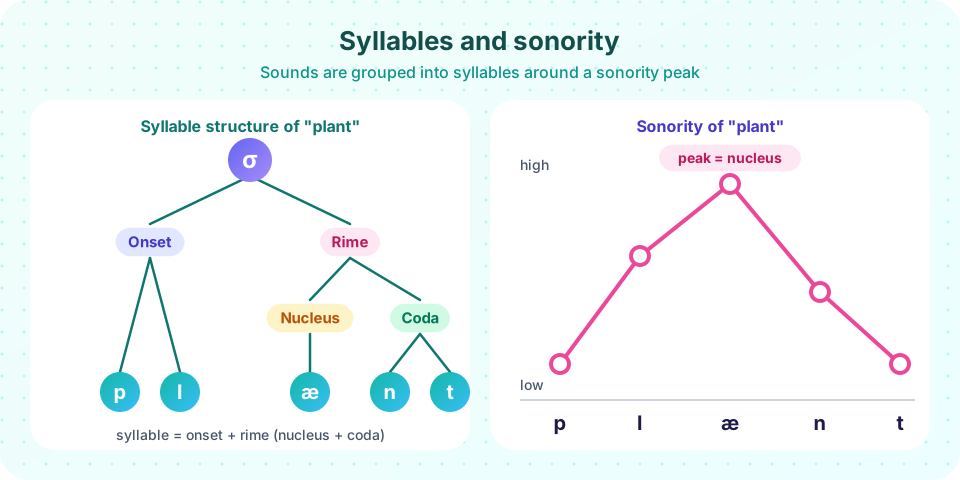
A syllable is the unit you feel when you clap along to a word: ba-na-na has three. Phonologists analyze it as a structure with a core and optional edges.
- The nucleus is the peak, usually a vowel.
- The onset is the consonant(s) before the nucleus.
- The coda is the consonant(s) after it.
- The nucleus plus coda together form the rime (the part that rhymes: -ant in plant and grant).
For plant, /plænt/, the onset is /pl/, the nucleus is /æ/ and the coda is /nt/.
Languages differ in the syllables they allow. Hawaiian permits only (C)V syllables (one consonant at most before a vowel and no coda), so every Hawaiian word ends in a vowel. Japanese allows (C)V(N), the last position being a nasal or the first half of a double consonant. English is very permissive: strengths, /strɛŋkθs/, has three consonants in the onset and four in the coda.
Sonority and phonotactics
Sounds differ in sonority, roughly how loud and vowel-like they are. A common scale, from least to most sonorous: plosives, fricatives, nasals, liquids (/l/ and /ɹ/), glides (/w/ and /j/), vowels. In a well-formed syllable the sonority rises toward the nucleus and falls after it, as the curve in the picture shows for plant: /p/ (low) → /l/ → /æ/ (peak) → /n/ → /t/ (low). This tendency is called the Sonority Sequencing Principle.
English follows it with one classic exception, s + plosive onsets (street, spin), where the fricative /s/ is more sonorous than the plosive after it; this "s-exception" is found in many languages. The number of syllables in a word also equals the number of sonority peaks, which is why banana has three.
Phonotactics is the set of rules about allowed sequences. You know, without being taught, that blick could be an English word (it follows the patterns of brick and black), while bnick could not. Both are made-up words; the difference is phonotactic. It is a classic illustration from the generative phonology of the 1960s. Languages vary: Russian allows mgla ("haze"), but English speakers struggle with that onset, which is why borrowed words get adapted.
Stress and rhythm
In English, one syllable in a word usually carries stress, produced by greater length, louder volume and higher pitch: PHOtograph, phoTOgrapher, photoGRAPHic. Stress can distinguish words: the noun REcord versus the verb reCORD. Some languages, such as English and German, are traditionally described as stress-timed and others, such as Spanish and French, as syllable-timed; researchers still argue about how strictly this holds in actual speech, but the perceived difference in rhythm is real.
Common misconceptions
"Casual speech is lazy speech." Assimilation and deletion follow regular rules, and speakers use them everywhere, including careful speech.
"A syllable always has a vowel." Usually, but some languages and some English words allow a consonant to serve as the nucleus (for example the final [l] in bottle in many accents).
"English spelling shows the number of sounds." Through has seven letters but three sounds.
Try it
The first program applies the English plural and past-tense rules to the last sound of a word. It reads a transcription, looks at the final sound, and chooses /s/, /z/ or /ɪz/ (and /t/, /d/ or /ɪd/). Add your own words with their final sounds.
Press Run (or Ctrl + Enter) to see the console output here.
No output.
The second demonstration draws the sonority profile of three words and counts the peaks (syllables). Notice how strengths starts with a fall and a rise, the "s-exception". The sonority values are the simple scale from this lesson.
Press Run (or Ctrl + Enter) to see the result here.
Program input · what you'd type while the program runs
Type the answers before you press Run, one per line. Each time the program reads a line (with input()), it gets the next line from this box.
Check your understanding
Quick check · 5 questions
of 5 answered You scored / 5 · perfect!
-
1. In the rule n → m / __ [p b m], what does the part after the slash say?
After the slash the environment is given; the blank marks the position of the changing sound. -
2. Why is the plural ending of 'dogs' pronounced /z/?
Voicing assimilation: after a voiced sound the ending is voiced. -
3. What are the parts of the syllable /plænt/?
The nucleus is the vowel; the consonants before it are the onset and after it the coda. -
4. Japanese 'sutoraiku' from English 'strike' illustrates
Japanese syllables are mostly (C)V, so vowels are added to break up the clusters. -
5. Why could 'blick' be an English word but 'bnick' could not?
Phonotactics describes which sequences are permitted at the start of a syllable.
Summary
- Phonological rules are written A → B / C __ D and describe regular changes: assimilation, deletion, insertion, metathesis, flapping.
- The English plural and past endings follow one voicing-assimilation pattern with an inserted vowel after sibilants (or t, d).
- A syllable has a nucleus, an optional onset and an optional coda; onset-less or coda-less structures vary by language.
- Sonority rises to the nucleus and falls after it; the s + plosive onset is the common exception.
- Phonotactics says which sound sequences a language allows.
Next: Chapter 3 Review
Track your progress
Create a free account to tick off lessons and pick up where you left off on any device.
of Linguistics lessons completed