


















Lesson 33 of 49 · Semantics and Pragmatics
Chapter review: Meaning
Review word relations, truth conditions, entailment, speech acts and implicature with a stair diagram, a recap table and a ten-question mixed quiz.
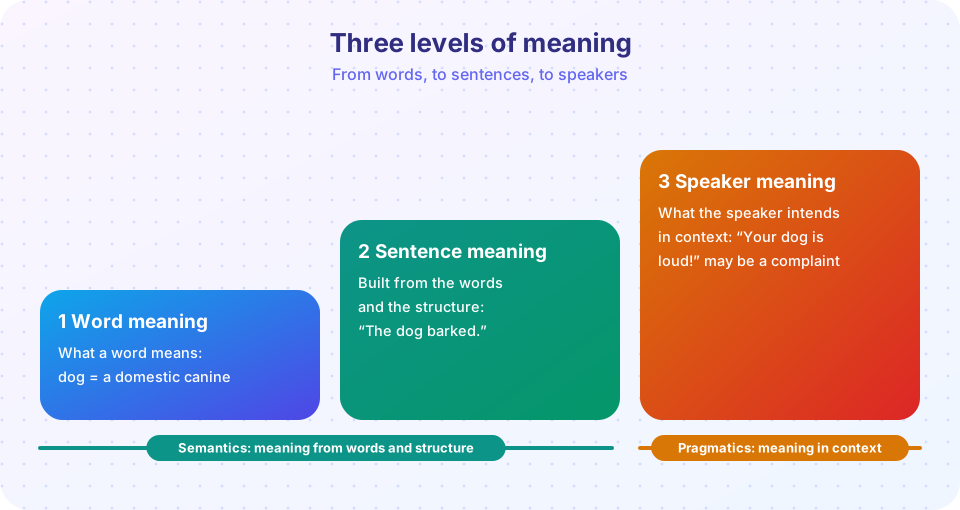
This chapter climbed three levels. Words have senses and relations. Sentences have truth conditions built from their parts. Speakers do things with sentences and mean more than they say. Use this page to check that the levels fit together before moving on to acquisition and change.
The chapter in one table
| Level | Key idea | Names and terms |
|---|---|---|
| Word | Senses connect through relations; categories have prototypes | hyponymy, polysemy, Rosch, WordNet |
| Word and world | Sense differs from reference | Frege, Ogden and Richards |
| Sentence | Meaning is truth conditions on a model | Tarski, Davidson, Montague |
| Sentence relations | Entailment is strict; presupposition survives negation | Russell, Strawson |
| Composition | The whole is built from parts and structure | compositionality, idioms, scope |
| Quantifiers | Relations between sets | every, some, no, most |
| Speaker | Saying is doing | Austin, Searle |
| Speaker | Meaning more than you say | Grice, scalar implicature, relevance theory |
Which level is it?
A good habit when analysing any example is to ask which level the puzzle belongs to:
- Is a penguin a typical bird? A word-level question about prototypes.
- Does "Tom is a cat" entail "Tom is a mammal"? A sentence-level question about truth conditions.
- Why does "Can you pass the salt?" get the salt passed? A speaker-level question about speech acts.
- Why does "some" suggest "not all"? Speaker-level again: a scalar implicature, which can be cancelled.
Try it
The first demo ties word relations to entailment: it answers whether X is a Y follows from X is a Z using a small hierarchy.
Press Run (or Ctrl + Enter) to see the result here.
Program input · what you'd type while the program runs
Type the answers before you press Run, one per line. Each time the program reads a line (with input()), it gets the next line from this box.
The second demo sorts puzzles by level and by the kind of meaning involved.
Press Run (or Ctrl + Enter) to see the console output here.
No output.
Check your understanding
Quick check · 10 questions
of 10 answered You scored / 10 · perfect!
-
1. Which pair of words stands in a hyponymy relation?
A poodle is a kind of dog. -
2. The morning star and the evening star have the same what?
Both pick out Venus, but they present it in different ways, so their senses differ. -
3. A sentence that is true in every model is a:
A tautology cannot be false. -
4. Which test separates a presupposition from an entailment?
Presuppositions survive negation, questions and if clauses. -
5. In the sentence Every student read a book, ambiguity arises from:
The order of the quantifiers can be read in two ways. -
6. Who proposed the cooperative principle and the four maxims?
H. Paul Grice, in his 1975 article Logic and Conversation. -
7. Which is a directive according to Searle?
Directives try to get the hearer to act. -
8. How is a conversational implicature different from an entailment?
Some students passed, in fact all did, is not contradictory. -
9. What is the main claim of prototype theory?
Rosch found typicality effects across many categories. -
10. Which belongs to pragmatics?
Pragmatics is about how speakers' intentions and context shape the meaning conveyed.
Summary
- Meaning has three levels: word, sentence and speaker.
- Sense, reference, truth conditions and entailment give semantics its tools.
- Speech acts and implicature are the core of pragmatics.
- Asking "which level is this puzzle at?" makes most examples easier.
Track your progress
Create a free account to tick off lessons and pick up where you left off on any device.
of Linguistics lessons completed