


















Lesson 37 of 49 · Language Acquisition, Change and Variation
Language change and families
Learn how sounds, words and grammar change, how regular sound laws like Grimm's law work, and how the comparative method reveals language families such as Indo-European.
In 1786 Sir William Jones, a British judge in Calcutta, told the Asiatic Society that Sanskrit, Greek and Latin were so similar in roots and grammar that they must have "sprung from some common source which, perhaps, no longer exists." That remark launched the modern study of language history. It raised a question you can ask of any two languages: are the similarities chance, borrowing, or inheritance from a shared ancestor? Linguists found a method that answers it with surprising precision.
What you will learn
- The main kinds of change: sound, meaning, grammar, borrowing
- Why sound change is regular and what Grimm's law says
- How the comparative method reconstructs ancestors
- How changes spread through a community
Key terms
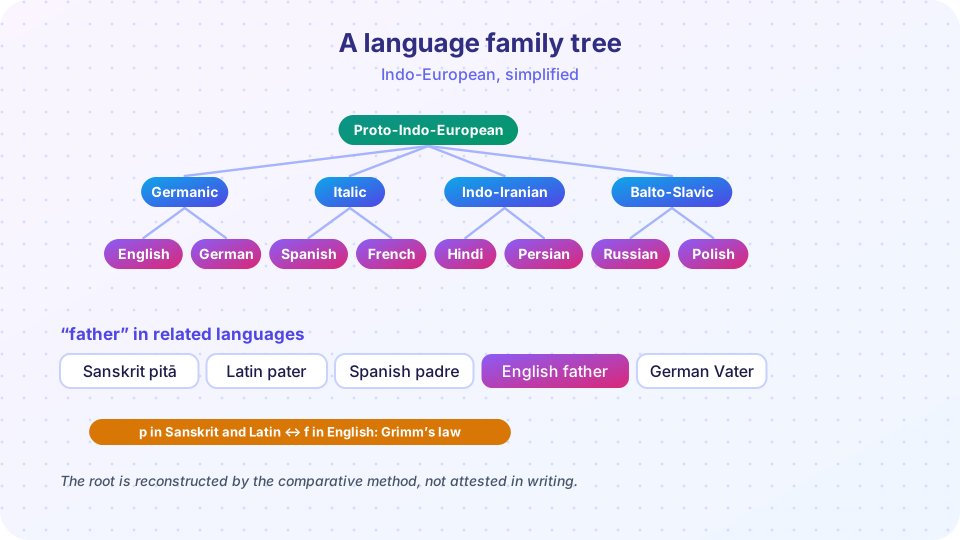
Cognates: words in related languages that descend from a common ancestor word (father, Vater, pater).
Sound law: a regular correspondence between sounds in related languages.
Proto-language: a reconstructed ancestor, marked with an asterisk (*pater).
Grammaticalization: a content word becoming a grammatical marker.
Analogy: reshaping a form to match a regular pattern.
Four kinds of change
Sound change. The Great Vowel Shift (roughly 1400 to 1700) changed English long vowels: Middle English hous [huːs] became house [haʊs], and name, once pronounced like nah-muh, drifted to its modern vowel. The spelling still reflects the older sounds, which is why English spelling looks irregular.
Semantic change. Words broaden, narrow or shift value. Meat used to mean any food, and girl once meant a child of either sex. Nice meant "foolish" in the 1300s. Awful meant "inspiring awe." Linguists call a shift to a better meaning amelioration and to a worse one pejoration.
Grammatical change. Words lose their content and become grammar, a process called grammaticalization. English going to (I'm going to the market) became a marker of future (It's going to rain) and then gonna. Latin habere ("to have") fused with the infinitive to form the French future: cantare habeo became chanterai ("I will sing").
Borrowing. English took thousands of words from Norman French after 1066 (beef, mutton, justice), from Arabic (algebra, coffee), from Hindi (shampoo) and many other languages.
Sound change is regular
The nineteenth-century scholars called the Neogrammarians (Brugmann, Osthoff, Leskien) argued that sound laws admit no exceptions: a sound changes the same way in every word where it occurs in the same environment, and apparent exceptions have other causes (analogy, borrowing, or conditions not yet identified). This strong claim became the foundation of historical linguistics. Karl Verner (1875) showed that one set of apparent exceptions to Grimm's law followed from the position of stress in the ancestor language, a famous success.
Grimm's law
Rasmus Rask and Jacob Grimm (1822) described a pattern linking Germanic languages (English, German, Dutch) to other Indo-European languages such as Latin and Greek. Roughly, ancestral stops became fricatives in Germanic:
| Latin | English | Change |
|---|---|---|
| pes ("foot") | foot | p → f |
| tres | three | t → th |
| cornu | horn | k → h |
| decem | ten | d → t |
| pater | father | p → f, t → th |
The correspondences hold across hundreds of words, which is why chance resemblance is ruled out. Compare the lookalikes that are not related: English day and Spanish día resemble each other but are not cognates, and English much and Spanish mucho are only an accident. A few lookalikes mean nothing; a regular set of correspondences means kinship.
The comparative method
To reconstruct a proto-language, linguists:
- Collect candidate cognates from related languages.
- Establish regular sound correspondences (Latin p : English f).
- Reconstruct the ancestor sound that best explains the correspondences with the fewest, most natural changes.
- Test the proposal against further data.
Using this method, scholars reconstructed Proto-Indo-European (PIE), the ancestor of languages from Iceland to India, spoken probably more than 5,000 years ago. No text in PIE survives: it is a hypothesis built from its descendants. The tree model of August Schleicher (1860s) shows clean splits; Johannes Schmidt's wave model (1872) stresses that features also spread across neighbours. Real histories include both. The method works well for a time depth of a few thousand years; by about 6,000 to 8,000 years, so many changes have accumulated that evidence becomes too thin, and claims about very distant relationships are disputed.
How a change spreads
A change starts as variation. A few speakers use a new form; it spreads among peers, often along social networks, and adoption typically follows an S-shaped curve: slow at first, then rapid, then slow as it nears completion. Anthony Kroch (1989) found that the same grammatical change in English (the rise of do-support in questions) progressed at the same rate in different contexts, the "constant rate effect." Young speakers often lead, and older forms linger.
Common misconceptions
"Change is decay or laziness." Changes follow patterns, and every stage works as a full language.
"Similar words prove a relationship." Chance, borrowing and onomatopoeia produce similarities. Regular correspondences across many words are the test.
"Latin is the ancestor of English." Latin is a sister branch, not a parent. English is Germanic; many Latin words came in through French.
Try it
The first demo applies the Grimm's law correspondence for the first consonant of six Latin words and compares the prediction to the first sound of the English cognate.
Press Run (or Ctrl + Enter) to see the result here.
Program input · what you'd type while the program runs
Type the answers before you press Run, one per line. Each time the program reads a line (with input()), it gets the next line from this box.
The second demo uses the standard logistic model of how a change spreads. The curves share an S shape and differ only in speed, which matches how historical changes look.
Press Run (or Ctrl + Enter) to see the result here.
Program input · what you'd type while the program runs
Type the answers before you press Run, one per line. Each time the program reads a line (with input()), it gets the next line from this box.
Check your understanding
Quick check · 6 questions
of 6 answered You scored / 6 · perfect!
-
1. What does Grimm's law describe?
It links, for example, Latin p to English f. -
2. What did the Neogrammarians claim about sound change?
Sound laws, they argued, admit no exceptions. -
3. Which is an example of grammaticalization?
A content phrase (go + to) became a grammatical marker. -
4. Why does Spanish mucho and English much not show relatedness?
Lookalikes without systematic correspondences are chance. -
5. Proto-Indo-European is:
It is inferred from descendant languages by the comparative method. -
6. How do changes typically spread through a community?
Slow start, rapid middle, slow finish.
Summary
- Languages change in sounds, meanings, grammar and vocabulary.
- Sound change is regular, and regular correspondences are the proof of kinship.
- The comparative method reconstructs unattested ancestors such as Proto-Indo-European.
- Changes spread along S-shaped curves through communities.
Track your progress
Create a free account to tick off lessons and pick up where you left off on any device.
of Linguistics lessons completed