


















Lesson 28 of 49 · Syntax
Chapter review: Syntax
Review constituents, phrase-structure rules, ambiguity, movement and islands with a one-picture summary, a recap table and a ten-question quiz.
You have seen that sentences are structured, that a few rules build the structure, and that some phrases appear far from where they are interpreted. This review ties the pieces together. Read the picture, scan the table, run the two demos and then test yourself.
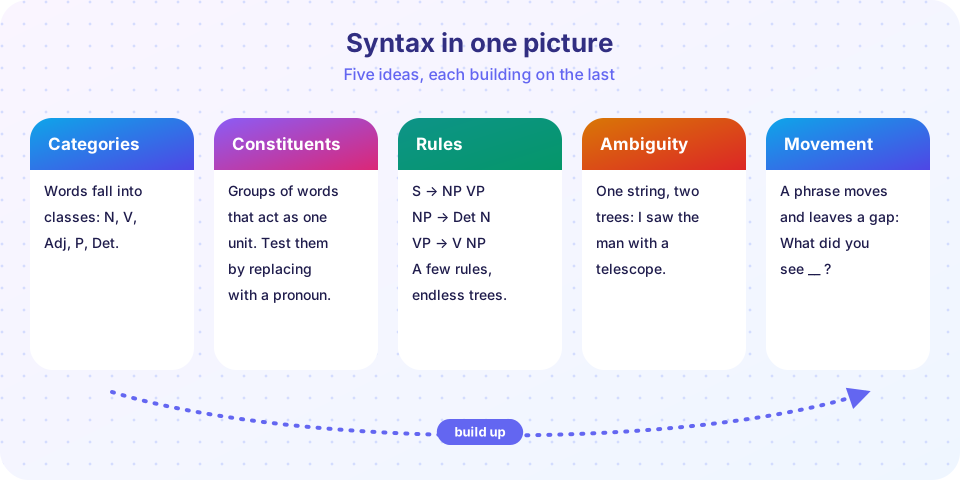
The chapter in one table
| Idea | Core claim | Example |
|---|---|---|
| Categories | Words fall into classes (N, V, Adj, P, Det) by behavior | dog takes the and a plural |
| Heads and phrases | A phrase is built around a head | a tiny dog is an NP headed by dog |
| Constituency | Strings that pass substitution, movement, coordination and fragment tests are units | a tiny dog ✓, adopted a ✗ |
| Rewrite rules | A few rules generate trees | S → NP VP, NP → Det N |
| Recursion | A category can contain itself | NP → NP PP, PP → P NP |
| Ambiguity | One string, several trees | I saw the man with a telescope |
| Movement and gaps | A phrase is linked to a distant gap | What did Mia say that Ben bought __ ? |
| Islands | Some structures block the link | relative clauses, coordination |
| Rival theories | Dependency grammar, HPSG, LFG, construction grammar | same data, different explanations |
Try it
The first demo checks which strings a small grammar accepts. It uses a chart over spans, the same idea as the counting demo earlier in this chapter, but only asks yes or no.
Press Run (or Ctrl + Enter) to see the result here.
Program input · what you'd type while the program runs
Type the answers before you press Run, one per line. Each time the program reads a line (with input()), it gets the next line from this box.
The second demo prints a leftmost derivation, replacing the first non-terminal at each step, so you can watch a tree grow one rule at a time.
Press Run (or Ctrl + Enter) to see the console output here.
No output.
Check your understanding
Quick check · 10 questions
of 10 answered You scored / 10 · perfect!
-
1. Which word is the head of the verb phrase adopted a tiny dog?
The verb determines that the phrase is a VP. -
2. Which test uses a single word like it or there?
Substitution replaces the string with a pro-form. -
3. How many constituents (counting words and the whole sentence) does a binary tree over 8 words have?
2n - 1 = 15. -
4. Which rule pair creates recursion?
An NP can contain a PP, which contains an NP again. -
5. What kind of ambiguity does I saw the man with a telescope show?
The two readings correspond to two attachments of the PP. -
6. How many binary bracketings does a 4-word string have?
That is the Catalan number C(3) = 5. -
7. In What did Mia say that Ben bought __?, the word what is the:
The filler is the displaced phrase; the gap is the position it is linked to. -
8. Which structure is an island for extraction?
Extraction out of a relative clause is blocked. -
9. Which framework describes sentences as word-to-word links with no phrase nodes?
Dependency grammar, associated with Tesnière, uses direct dependencies. -
10. Why do linguists treat acceptability judgments as data?
Native speakers' judgments reveal the system of rules they use without having been taught it.
Summary
- Syntax describes the hierarchical structure of sentences.
- Constituency tests find units; rewrite rules and recursion generate trees.
- Ambiguity and movement show that structure, not word order alone, matters.
- Several theories agree on the data and differ on the explanation.
Track your progress
Create a free account to tick off lessons and pick up where you left off on any device.
of Linguistics lessons completed