


















Lesson 24 of 49 · Syntax
Chapter overview: Syntax
A tour of syntax: how words combine into phrases and sentences, why word order matters, and how rules, trees and movement explain what speakers know.
You have never heard most of the sentences you will say tomorrow, and yet you will produce them without effort. Other people will understand them. Syntax is the part of linguistics that explains how this works: how a finite stock of words and rules builds an unlimited number of sentences.
What you will learn
- Why a sentence is more than a list of words
- What constituents, categories and phrase-structure rules are
- Why one string of words can have two structures (ambiguity)
- How questions and passives show that phrases can move
- How different theories describe the same facts
The big picture
Take two sentences with exactly the same words:
- The dog bit the postman.
- The postman bit the dog.
Nothing differs but the order, yet the meaning flips. Now compare Colorless green ideas sleep furiously, the famous example Noam Chomsky used in Syntactic Structures (1957). Its meaning is absurd, but English speakers feel it is a well-formed sentence, unlike Furiously sleep ideas green colorless. So syntax is not the same thing as meaning, and it is not just a matter of word order either. It is a system of structure.
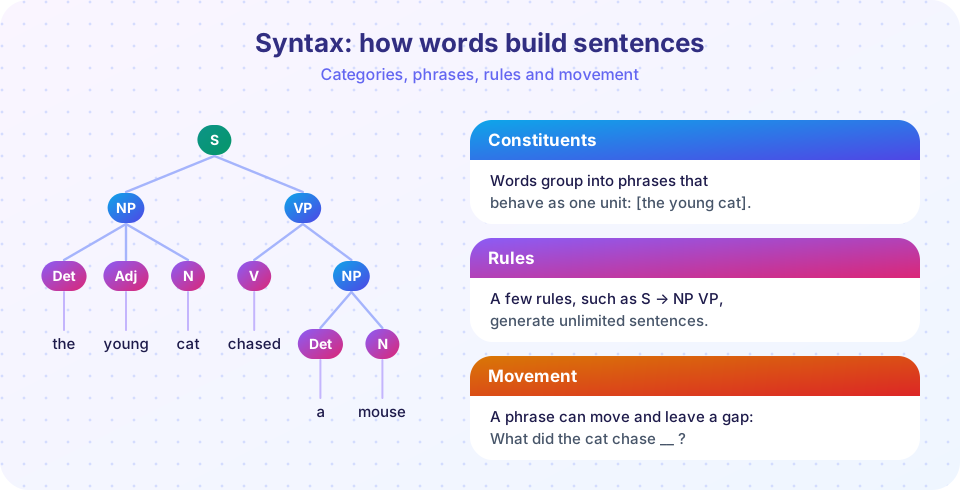
Linguists make three claims about this system, and the chapter follows them in order.
Words have categories
Words group into phrases
A few rules build trees
Phrases can move
Movement leaves a gap that listeners can still fill in.
Why linguists say "rules"
A syntactic rule here is not a school rule like "never end a sentence with a preposition." It is a description of what competent speakers actually do. Speakers of English reject chased the cat the and cat the chased mouse a without ever having been taught a rule about it. Linguists call this tacit knowledge a speaker's grammar. Chomsky's term for it was competence, contrasted with performance, the messy use of language in real time. Not everyone accepts this split: usage-based approaches, such as those of Michael Tomasello and Joan Bybee, argue that grammar emerges from experience with real use. You will meet both views.
The lessons in this chapter
| Lesson | What it covers |
|---|---|
| Constituents and trees | Categories, heads, phrases and the tests that find them |
| Phrase-structure rules and ambiguity | Rewrite rules, recursion, and why one string can mean two things |
| Movement and dependencies | Questions, passives, gaps and islands |
| Chapter review | One picture, a recap table and a longer quiz |
Several theories, one set of facts
Phrase-structure trees, as used here, descend from Chomsky's generative tradition. Rival frameworks describe the same sentences differently. Dependency grammar (Lucien Tesnière) links words directly to the words they depend on and uses no phrase nodes. Head-driven Phrase Structure Grammar (HPSG) and Lexical-Functional Grammar (LFG) encode most information in rich lexical entries and avoid movement. Construction grammar treats whole patterns, such as the more, the merrier, as the basic units. The facts you will see in this chapter, such as constituency and ambiguity, are shared; the explanations differ. Where theories disagree, this chapter says so.
Try it
The first demo is a toy generator. Four rules and a short word list produce sentences, which shows how finite rules give endless variety. It is a demonstration of the idea, not a model of English.
Press Run (or Ctrl + Enter) to see the result here.
Program input · what you'd type while the program runs
Type the answers before you press Run, one per line. Each time the program reads a line (with input()), it gets the next line from this box.
The second demo lists every ordering of four words. Count how many you would accept as English.
Press Run (or Ctrl + Enter) to see the console output here.
No output.
Check your understanding
Quick check · 4 questions
of 4 answered You scored / 4 · perfect!
-
1. What does syntax study?
Syntax is the study of sentence structure: how words combine into phrases and phrases into sentences. -
2. Why is the sentence Colorless green ideas sleep furiously useful to linguists?
Chomsky used it to show that grammatical structure can be separated from meaning. -
3. Which theory links words directly to the words they depend on, without phrase nodes?
Dependency grammar, associated with Lucien Tesnière, describes sentences as networks of word-to-word relations. -
4. In the linguist's sense, what is a syntactic rule?
Descriptive rules capture speakers' tacit knowledge; prescriptive rules are style advice.
Summary
- Syntax explains how finite means build unlimited sentences.
- Structure is hierarchical: words form phrases, phrases form sentences.
- Rules, trees and movement are the three main tools of this chapter.
- Competing theories agree on the data but explain it differently.
Next: Constituents and trees
Track your progress
Create a free account to tick off lessons and pick up where you left off on any device.
of Linguistics lessons completed