


















Lesson 49 of 49 · Projects and Practice
Further study: where linguistics leads
Where to go after this course: connections from linguistics to psychology, neuroscience, sociology, anthropology, cognitive science and NLP, with a study plan and reading list.
You have now traveled from the sounds of speech through words, sentences, meaning, learning and change, to the algorithms that process language. Linguistics is a hub: almost every question about language leads out to another field. This last lesson maps the paths, suggests how to practise, and lists books worth reading next.
What you will learn
- Which neighbouring fields grow out of each part of this course
- How to choose a next step based on your interests
- How to practise so that knowledge stays
- A short reading list for each direction
Key terms
Psycholinguistics: how people produce, understand and learn language in real time.
Sociolinguistics: how language varies and changes in society.
Neurolinguistics: how the brain represents and processes language.
Linguistic anthropology: how language shapes and reflects culture.
Computational linguistics / NLP: building and testing models of language on computers.
Paths from here
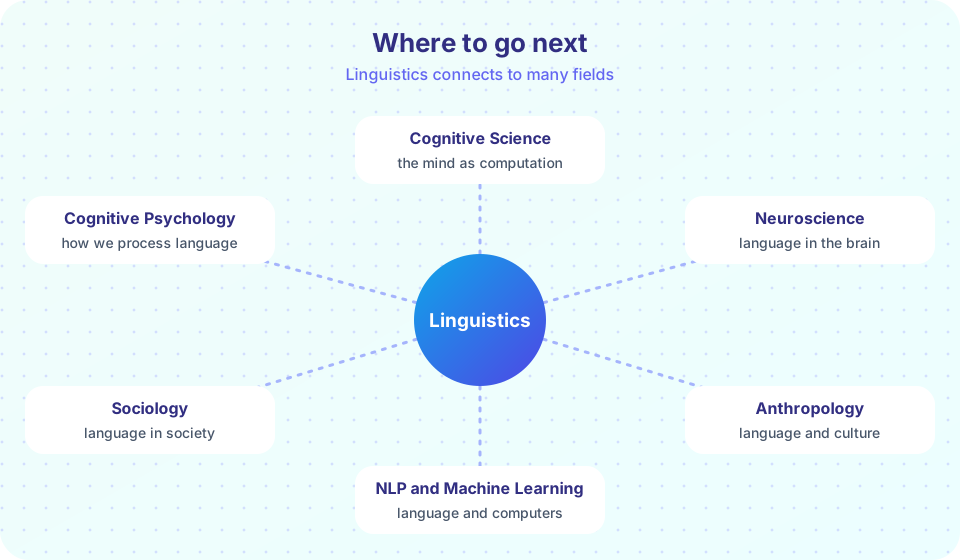
If you liked how children and learners acquire language (chapter 7), go toward psychology and the brain. The Cognitive Psychology track covers memory, attention and language processing, and Neuroscience explains how the brain supports speech and reading. Cognitive Science asks what kind of computation the mind performs.
If you liked variation, dialect and social meaning (chapter 7), go toward society and culture: Sociology studies class, identity and institutions, and Anthropology connects language to culture, kinship and history.
If you liked the models and the code (chapter 8), go toward the technology. The NLP track builds on tokenization, tagging and parsing with modern tools, Machine Learning explains the learning methods behind language models, and Python gives you the programming skills used in every demo here. A solid grounding in probability helps too: see Statistics and Probability.
If you liked syntax and meaning (chapters 5 and 6), the next step is the formal side: theories of grammar (minimalism, HPSG, LFG), formal semantics and pragmatics. These are heavily mathematical in parts and reward patience.
Specialisations in linguistics proper
| Area | Questions | First reading |
|---|---|---|
| Phonetics and phonology | How are sounds made and organised? | earlier chapters of this course |
| Syntax | What is the structure of sentences across languages? | an introductory syntax textbook |
| Formal semantics | How do we compute meaning? | an introduction to formal semantics |
| Pragmatics | How does context shape meaning? | Stephen Levinson, Pragmatics |
| Psycholinguistics | How does the mind process language? | an introductory psycholinguistics text |
| Historical linguistics | How do languages change and relate? | Lyle Campbell, Historical Linguistics: An Introduction |
| Sociolinguistics | How does society shape speech? | William Labov, Principles of Linguistic Change |
| Language acquisition | How do children learn? | Michael Tomasello, Constructing a Language |
| Computational linguistics | How do computers process language? | Jurafsky and Martin, Speech and Language Processing |
| Language documentation | How do we record endangered languages? | a field-methods guide |
Books for general readers
- Steven Pinker, The Language Instinct (1994): a lively defence of the nativist view; read it alongside Tomasello for balance.
- Victoria Fromkin, Robert Rodman and Nina Hyams, An Introduction to Language: a widely used textbook covering the whole field.
- George Yule, The Study of Language: a short, readable introduction.
- David Crystal, The Cambridge Encyclopedia of Language: a rich, illustrated overview.
- Daniel Jurafsky and James Martin, Speech and Language Processing: the standard NLP textbook, with a draft edition available online.
How to make it stick
Research on learning suggests that spaced retrieval, testing yourself at growing intervals, is more effective than rereading. A practical routine:
- After each lesson, write down five things you remember without looking.
- Review them after one day, three days, a week and a month.
- Analyze real language: take ten sentences from a news article and draw trees, or find the implicatures in a conversation.
- Keep a language diary: note variation you hear (pronunciations, word choices) and ask which social factors explain it.
- Build small projects: the language identifier and sound-change simulator are the model. Extend them.
Careers and uses
People with linguistics training work in language technology, speech and voice products, translation and localisation, lexicography, language teaching, speech-language therapy (with further training), forensic linguistics, user research and policy. The common skill is looking at language data and finding the pattern behind it.
Try it
The first demo suggests a next track from your interests. Edit the list of interests to see how the suggestions change.
Press Run (or Ctrl + Enter) to see the console output here.
No output.
The second demo plots a schematic forgetting curve with and without spaced reviews. It illustrates the idea behind spaced practice; the exact numbers vary by person and material.
Press Run (or Ctrl + Enter) to see the result here.
Program input · what you'd type while the program runs
Type the answers before you press Run, one per line. Each time the program reads a line (with input()), it gets the next line from this box.
Check your understanding
Quick check · 4 questions
of 4 answered You scored / 4 · perfect!
-
1. Which field studies how the brain supports language?
Neurolinguistics links language to brain structure and function. -
2. If you enjoyed building the language identifier, which direction is the most natural next step?
Those fields extend the computational ideas used in chapter 8. -
3. Why is spaced retrieval a good study method?
Retrieval practice and spacing are among the best-supported learning findings. -
4. Which book argues for the nativist view of language in a popular style?
Pinker's book popularised the innateness view; Tomasello is a good counterweight.
Summary
- Linguistics connects to psychology, neuroscience, sociology, anthropology, cognitive science and NLP.
- Pick a path by interest: learning, society, code, or formal theory.
- Use spaced retrieval, real-data analysis and small projects to make knowledge stick.
- Keep the course map and cheat sheet close, and return to the lessons when a question arises.
Back to the course: Linguistics
Track your progress
Create a free account to tick off lessons and pick up where you left off on any device.
of Linguistics lessons completed