


















Lesson 20 of 49 · Morphology
Inflection and Derivation
Learn the difference between inflection, which makes grammatical forms of one word, and derivation, which builds new words, with the eight English inflectional suffixes and tests.
The suffix -s in cats and the suffix -er in teacher are both affixes, but they do very different jobs. Adding -s gives you another form of the same word (one cat, two cats). Adding -er gives you a new word with a new meaning and a new category (teach, a verb; teacher, a noun).
Morphologists call these two processes inflection and derivation. The distinction runs through every language, and learning to tell them apart is one of the most useful skills in morphology.
What you will learn
- What inflection is and the eight inflectional suffixes of English.
- What derivation is, and how it changes category and meaning.
- Tests that separate the two, and why the order of affixes matters.
- How other languages inflect much more than English.
Key terms
Inflection: adding grammatical information (number, tense, case, person) to a word without creating a new word.
Derivation: forming a new word, often with a new category, from an existing one.
Paradigm: the full set of inflected forms of a word.
Productive: an affix is productive if speakers can readily use it to form new words.
Lexeme: a word in the dictionary sense, with all its inflected forms.
Inflection
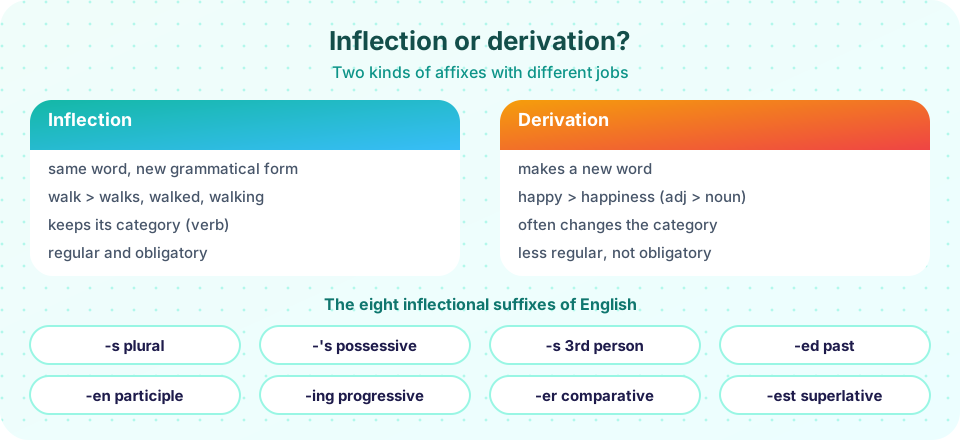
Inflection expresses grammatical categories required by a language's syntax. The word does not change its basic meaning or its part of speech: walk, walks, walked and walking are all forms of the single lexeme WALK.
English has just eight inflectional suffixes:
| Suffix | Category | Example |
|---|---|---|
| -s | noun plural | cats |
| -'s | noun possessive | the cat's tail |
| -s | verb, third person singular present | she walks |
| -ed | verb past tense | walked |
| -en / -ed | verb past participle | taken, walked |
| -ing | verb present participle | walking |
| -er | adjective comparative | taller |
| -est | adjective superlative | tallest |
That is the whole list, which makes English one of the world's least inflected languages. Many languages inflect far more. A Russian noun has six cases, so the noun kniga ("book") has the forms kniga, knigi, knige, knigu, knigoy, knige depending on its role in the sentence. A Spanish verb has a separate form for each combination of person and number in each tense: hablo, hablas, habla, hablamos, habláis, hablan in the present of hablar "speak". The set of such forms for one word is its paradigm.
Derivation
Derivation builds new lexemes. It is often accompanied by a change of category (part of speech), though not always:
| Process | Example | Change |
|---|---|---|
| -er | teach → teacher | verb → noun |
| -ness | kind → kindness | adjective → noun |
| -able | read → readable | verb → adjective |
| -ly | quick → quickly | adjective → adverb |
| -ize | nation → nationalize | noun/adjective → verb |
| un- | happy → unhappy | adjective → adjective (no change) |
Derived words are normally listed in dictionaries because their meanings are not always predictable: a teacher is someone who teaches, but a computer is not just anyone who computes, and a driver can be a golf club. Inflected forms are not listed, because they are fully predictable.
Derivational affixes also differ in productivity. The suffix -ness attaches to a huge number of adjectives and can create new words freely. The suffix -th (warmth, depth, growth) is no longer productive: no one coins coolth seriously.
A single word can pile up several derivations. Start with nation (a noun), add -al to get national (adjective), add -ize to get nationalize (verb), add -ation to get nationalization (noun). Each step can change the category.
How to tell them apart
The following tests work well for English and most other languages. None is perfect, but together they usually give a clear answer.
- Does it make a new word? Derivation does (and gets its own dictionary entry); inflection does not.
- Does it change the category? Derivation often does; inflection never does.
- Is it required by the grammar? Inflection is obligatory in the right context (you must say two cats, not two cat); derivation is a choice.
- How regular is it? Inflection is typically fully regular (with some irregular forms); derivation applies to some words and not others (readable, but not *arrivable).
- What is its position? Derivational affixes sit closer to the root than inflectional ones. Teachers is teach + -er + -s, and *teach-s-er is impossible. This ordering holds in many languages: inflection comes last, at the edge of the word.
There are borderline cases. The -ing form is inflection in she is walking, but it creates nouns in the building and a painting. Linguists debate where to draw the line for some affixes; the distinction is a continuum as much as a pair of boxes.
Common misconceptions
"Inflection is just irregular grammar." It is the regular, systematic part. Irregular forms (mice, went) are exceptions inside inflection.
"Derivation always changes the part of speech." Not always: un-happy and re-read keep the category.
"English is not very inflected, so it has little morphology." English has rich derivation and compounding even though it has little inflection.
Try it
The first program analyzes affixes step by step and reports whether each step is inflection or derivation, and whether it changes the category. It also checks the ordering rule: a derivational affix should not come after an inflectional one. Try adding words of your own.
Press Run (or Ctrl + Enter) to see the console output here.
No output.
The second demonstration draws the derivation chain from nation to nationalizations as boxes and arrows. Derivational steps are pink and the final inflectional step is teal; the labels show the category after each step.
Press Run (or Ctrl + Enter) to see the result here.
Program input · what you'd type while the program runs
Type the answers before you press Run, one per line. Each time the program reads a line (with input()), it gets the next line from this box.
Check your understanding
Quick check · 5 questions
of 5 answered You scored / 5 · perfect!
-
1. Which suffix is inflectional?
-ed marks past tense and gives another form of the same verb. -
2. Why is 'teach-s-er' impossible, while 'teach-er-s' is fine?
The usual order is root, derivation, then inflection. -
3. How many inflectional suffixes does English have?
Plural, possessive, third-person -s, past, past participle, -ing, comparative and superlative. -
4. A paradigm is
Hablo, hablas, habla and so on form the present-tense paradigm of the Spanish verb hablar. -
5. Which of these is a derivational process that does NOT change the category?
un- attaches to an adjective and yields another adjective.
Summary
- Inflection gives grammatical forms of one lexeme; derivation creates new lexemes, often with a new category.
- English has eight inflectional suffixes; languages such as Russian and Spanish inflect much more.
- Derived words are listed in the dictionary and vary in productivity; inflected forms are regular and obligatory.
- Derivational affixes sit inside inflectional ones, as in teach-er-s.
- The boundary has gray areas (-ing nouns), so treat the tests as a guide.
Track your progress
Create a free account to tick off lessons and pick up where you left off on any device.
of Linguistics lessons completed