


















Lesson 25 of 49 · Syntax
Constituents and trees
Learn what constituents are, how word categories and heads build phrases, and how substitution, movement and coordination tests reveal sentence structure.
Read this sentence aloud: My sister adopted a tiny dog. You probably feel that a tiny dog belongs together, and that adopted a does not. That feeling is the starting point of syntax. Words are not strung along a line like beads; they sit in nested groups. This lesson shows what those groups are, how to name them, and how to test for them.
What you will learn
- The main word categories and what a phrase head is
- What a constituent is and how to read a tree or a bracketing
- Four tests that find constituents, and why they sometimes disagree
- Why almost every stretch of words in a sentence is not a constituent
Key terms
Category: a word class such as noun (N), verb (V), adjective (Adj), preposition (P) or determiner (Det).
Phrase: a group of words built around a head: the noun in a noun phrase (NP), the verb in a verb phrase (VP).
Constituent: any group of words that behaves as a single unit in the structure.
Tree: a diagram of the structure; each point is a node, and a node dominates everything beneath it.
Sisters: two nodes with the same parent.
Categories: the labels on the nodes
Words come in classes defined by how they behave, not by what they mean. A noun can follow the and take a plural (the dogs). A verb takes tense (adopts, adopted). An adjective can modify a noun (tiny dog) and often takes very. The classes split into lexical categories such as N, V, Adj and P, which carry content, and functional categories such as Det (the, a, my), which carry grammatical information.
Every phrase has one head, the word that determines its category. In a tiny dog the head is the noun dog, so the phrase is an NP; remove dog and the phrase falls apart. In adopted a tiny dog the head is the verb adopted, so the phrase is a VP. This idea, that phrases are headed, runs through nearly every modern theory.
Reading a tree
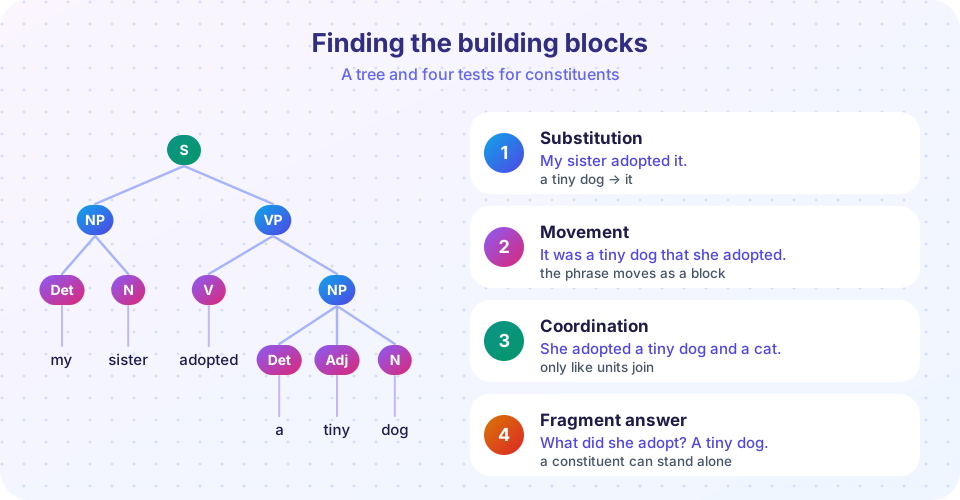
The tree at the top of this lesson says that the sentence (S) divides into a noun phrase, my sister, and a verb phrase, adopted a tiny dog, and that the verb phrase in turn contains a second NP. The same information fits in a labelled bracketing, which is easier to type:
[S [NP [Det my] [N sister]] [VP [V adopted] [NP [Det a] [Adj tiny] [N dog]]]]
Each pair of brackets is one constituent. Counting them gives the full set of units the structure recognises. The word adopted alone is a constituent (a V), and so is the whole sentence.
Four tests for constituency
If groups are real, they should behave as units in several different ways. Linguists use tests, each of which asks the grammar to treat a string as one piece.
- Substitution. Replace the string with a single pro-form (it, she, there, do so). My sister adopted it. works, so a tiny dog is a constituent.
*My sister adopted a itis nonsense, so adopted a is not. - Movement. Move the string to another position as a block. It was a tiny dog that my sister adopted. (a cleft) works.
*It was adopted a that my sister tiny dogdoes not. - Coordination. Only like units join with and. My sister adopted a tiny dog and a parrot. works.
*My sister adopted a and sold the dogis odd. - Fragment answer. A constituent can stand alone as an answer. What did she adopt? A tiny dog. Not Adopted a.
Use several tests together. Each one has exceptions, but a string that passes three or four is almost certainly a constituent.
The tests can disagree
A VP such as adopted a tiny dog passes the do so test (My sister adopted a tiny dog and my brother did so too), but it resists clefting (*It was adopted a tiny dog that she did). Linguists treat such mismatches as data. Sometimes a test needs more careful handling, and sometimes the theory must change. A famous case in the literature is the treatment of verb-plus-particle strings such as look up the word, where different tests give different answers. The lesson for a beginner is simple: tests are evidence, not proof.
How many of the possible groups are real?
A sentence of six words has 21 contiguous stretches (one 6-word, two 5-word, ... six 1-word). A tree over six words has only 2 × 6 − 1 = 11 constituents if every node branches in two. So over half of the stretches, such as adopted a or sister adopted, are not constituents. A grammar's job is to pick out the 11 and reject the rest.
Common misconceptions
"Any group of words that sounds natural is a constituent." No. Sister adopted may sound fine in a rhythm, but it fails every test.
"Trees are just a school diagramming trick." Trees are claims about structure that make predictions, for example that exactly the units in the tree can move or be replaced.
"There is one correct tree for every sentence." Theories disagree about details (flat or layered NPs, for example), and ambiguous sentences have several correct trees.
Try it
The first demo reads a labelled bracketing, draws it as an indented tree and lists every constituent with its span. Edit the bracketing to test your own sentence.
Press Run (or Ctrl + Enter) to see the result here.
Program input · what you'd type while the program runs
Type the answers before you press Run, one per line. Each time the program reads a line (with input()), it gets the next line from this box.
The second demo shows why most strings are not constituents: for a binary-branching tree over n words, the number of constituents grows only linearly, while the number of possible strings grows quadratically.
Press Run (or Ctrl + Enter) to see the result here.
Program input · what you'd type while the program runs
Type the answers before you press Run, one per line. Each time the program reads a line (with input()), it gets the next line from this box.
Check your understanding
Quick check · 5 questions
of 5 answered You scored / 5 · perfect!
-
1. What is the head of the phrase a tiny dog?
The noun dog determines that the phrase is a noun phrase. -
2. Which test shows that a tiny dog is a constituent?
Substitution by a single pro-form treats the string as one unit. -
3. How many constituents does a binary-branching tree over 6 words have, counting single words and the whole sentence?
A binary tree over n words has n words plus n - 1 phrase nodes: 2n - 1 = 11. -
4. Which string fails the fragment-answer test in My sister adopted a tiny dog?
Adopted a is not a unit, so it cannot stand alone as an answer to a question. -
5. A node that has the same parent as another node is its:
Sisters are nodes that share a parent.
Summary
- Words belong to categories, and phrases are built around heads.
- A constituent is a group of words that acts as one unit.
- Substitution, movement, coordination and fragment answers test for constituency; use several together.
- Most strings of adjacent words are not constituents.
Track your progress
Create a free account to tick off lessons and pick up where you left off on any device.
of Linguistics lessons completed