


















Lesson 31 of 49 · Semantics and Pragmatics
Truth conditions and composition
Understand sentence meaning as truth conditions, how entailment and presupposition work, why meaning is compositional, and how quantifier scope creates ambiguity.
If you know what a sentence means, you know what the world would have to be like for it to be true. You do not need to know whether it is true. There are exactly 4,817 pebbles on this beach is perfectly clear, even though neither of us will ever check. This idea, that knowing the meaning means knowing the truth conditions, is the foundation of formal semantics, and it turns meaning into something you can compute.
What you will learn
- What a truth condition is and how entailment follows from it
- How presupposition differs from entailment
- What compositionality means, and where it seems to fail
- How quantifiers work as relations between sets, and why scope can be ambiguous
Key terms
Truth condition: what must hold for a sentence to be true.
Entailment: A entails B if B is true whenever A is true.
Presupposition: background content that a sentence takes for granted and keeps even when negated.
Compositionality: the meaning of a whole is determined by the meanings of its parts and how they combine.
Quantifier: a word such as every, some, no, most that says how many.
Meaning as truth conditions
The logician Alfred Tarski (1933) showed how to define truth for a formal language, and Donald Davidson (1967) proposed using the same idea for natural language. The schema is simple: "Snow is white" is true if and only if snow is white. It looks trivial, but it makes a serious claim: a theory of meaning should assign every sentence a condition on the world. Richard Montague, in the early 1970s, carried the programme out for fragments of English with real rigour, treating English as a formal language.
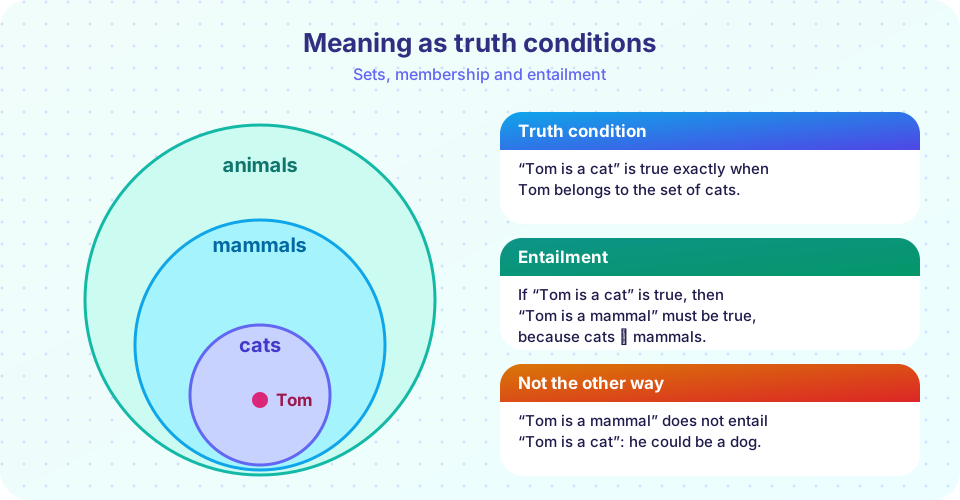
Think of the model as a small world: a set of individuals and facts. Tom is a cat is true in a model if the individual named Tom is in the set of cats. This is the picture above.
Entailment, contradiction and tautology
Truth conditions explain several judgments speakers make:
- Entailment: Tom is a cat entails Tom is a mammal, because every cat in any model is also a mammal. It does not entail Tom is hungry.
- Contradiction: Tom is a cat and Tom is not a cat is false in every model.
- Tautology: Either it is raining or it is not is true in every model.
- Paraphrase: two sentences that entail each other mean the same in this sense: Ben sold Ana a bike and Ana bought a bike from Ben.
Entailment is not the same as what people usually infer. Some students passed does not entail not all passed, although listeners often conclude that (a pragmatic inference you will meet in the next lessons).
Presupposition
Compare Ana stopped smoking with its negation Ana didn't stop smoking. Both suggest that Ana used to smoke. This content, which survives negation, is a presupposition. The same holds for the king of France is bald: both it and its negation presuppose that there is a king of France. Bertrand Russell (1905) analysed such sentences as simply false when no king exists; Peter Strawson (1950) argued they are neither true nor false, because the presupposition fails. The debate continues in modern semantics. A practical test: if content survives negation, questions and if clauses (If Ana stopped smoking...), it is probably a presupposition and not an entailment.
Compositionality
How can you understand a sentence you have never heard? The usual answer is a principle credited to Frege, though he never stated it in exactly this form: the meaning of a complex expression is a function of the meanings of its parts and the way they are put together. The cat chased the mouse and The mouse chased the cat have the same parts but different structures, so different meanings.
Compositionality has challenges. Idioms (kick the bucket) mean something other than their parts, and context-dependence (it's raining, where? when?) means the parts alone seldom fix the full content. Some linguists therefore keep a weaker version, in which composition operates but the parts' meanings are flexible. Others argue that idioms are listed in memory as complete units and do not undermine composition for everything else.
Quantifiers as relations between sets
A quantified sentence such as Every student swims compares two sets: the students (A) and the swimmers (B). In this view of generalised quantifiers (Barwise and Cooper, 1981):
| Quantifier | True when |
|---|---|
| every A is B | A ⊆ B |
| some A is B | A ∩ B is not empty |
| no A is B | A ∩ B is empty |
| most A are B | more A are in B than are outside B |
Scope ambiguity
Every student read a book has two readings. Either each student read some book or other (different books allowed), or there is one particular book that all the students read. The words are the same; the scope of every and a differs. Scope ambiguity is another instance of structural ambiguity, like the telescope sentence in the syntax chapter, but here the structures concern logic and not phrases.
Common misconceptions
"Truth conditions mean the sentence has to be true." They state what would make it true. Knowing them does not require knowing whether they hold.
"Entailment is whatever you can infer." Entailment is a strict guarantee. Looser inferences, like not all, belong to pragmatics.
"Compositionality means every phrase's meaning is predictable." It claims regular combination, and idioms are the well-known exceptions.
Try it
The first demo evaluates quantified sentences in a small model made of sets and brute-forces an entailment check: every A is B entails some A is B only if A is not empty.
Press Run (or Ctrl + Enter) to see the result here.
Program input · what you'd type while the program runs
Type the answers before you press Run, one per line. Each time the program reads a line (with input()), it gets the next line from this box.
The second demo computes the two readings of Every student read a book in two different models.
Press Run (or Ctrl + Enter) to see the result here.
Program input · what you'd type while the program runs
Type the answers before you press Run, one per line. Each time the program reads a line (with input()), it gets the next line from this box.
The third demo plots when each quantifier is true as a function of the share of A that are B.
Press Run (or Ctrl + Enter) to see the result here.
Program input · what you'd type while the program runs
Type the answers before you press Run, one per line. Each time the program reads a line (with input()), it gets the next line from this box.
Check your understanding
Quick check · 6 questions
of 6 answered You scored / 6 · perfect!
-
1. What is a truth condition?
To know the meaning is to know the conditions under which the sentence would be true. -
2. Which sentence is entailed by Tom is a cat?
Every cat is a mammal, so the entailment holds in every model. -
3. Ana didn't stop smoking still suggests that Ana used to smoke. This is:
Content that survives negation is typically a presupposition. -
4. Which situation makes some student swims true but every student swims false?
A ∩ B is non-empty, but A is not a subset of B. -
5. Why does Every student read a book have two readings?
That is a scope ambiguity. -
6. Which is a standard challenge to compositionality?
An idiom's meaning cannot be built from the usual meanings of its parts.
Summary
- Sentence meaning can be modelled as truth conditions on a model of the world.
- Entailment is a strict guarantee; presupposition survives negation.
- Compositionality explains how we understand new sentences, with idioms as the standard exception.
- Quantifiers relate sets, and their scope can create ambiguity.
Track your progress
Create a free account to tick off lessons and pick up where you left off on any device.
of Linguistics lessons completed