


















Lesson 38 of 49 · Language Acquisition, Change and Variation
Sociolinguistic variation
Learn how speech varies with region, social class, style and identity, from Labov's New York and Martha's Vineyard studies to African American English and code-switching.
Say the word car aloud. Do you pronounce the r? Speakers of many American and Scottish varieties do, and speakers of many English and Australian varieties do not. Two people who live in the same city may also differ: one says workin' with a sharp final n, another says working, and the same person says both depending on whom they are talking to. This is variation, and the surprise of sociolinguistics is how orderly it turns out to be.
What you will learn
- What a linguistic variable and its variants are
- Labov's classic studies and what they found
- How class, style, gender, network and identity shape speech
- Why African American English is a rule-governed variety, and how attitudes affect judgments
Key terms
Variable and variant: a variable is a place where speakers can choose between alternative forms (the variants): -ing versus -in'.
Dialect: a variety tied to a region or group; accent refers only to pronunciation.
Register / style: variation with situation, formality and audience.
Hypercorrection: overshooting a prestige norm, for example by adding an r where it does not belong.
Covert prestige: the value attached to non-standard forms as symbols of solidarity.
Language, dialect, accent
Where does a language end and a dialect begin? Mutual intelligibility gives a rough guide, but politics decides more often than linguistics. Norwegian, Danish and Swedish are largely mutually intelligible, yet they count as separate languages because they belong to separate nations. The varieties of Chinese called Mandarin and Cantonese are not mutually intelligible in speech, but they are called dialects of one language, partly because they share a writing system and a national identity. A well-known saying, attributed to the linguist Max Weinreich, puts it as: a language is a dialect with an army and a navy.
The standard variety is one dialect that has gained prestige, usually the speech of the powerful and educated in the capital, and has been codified in dictionaries and schools. It is not linguistically better. Every variety has complete grammar.
Labov's studies
William Labov turned the study of variation into a quantitative science.
Martha's Vineyard (1963). On this Massachusetts island Labov measured the pronunciation of the vowels in right and house. The islanders who used a more centralized vowel were often those who most strongly identified with the island and resisted the influence of summer visitors, so the sound had become a marker of local identity. Pronunciation reflected attitude and community membership.
Department stores (1962). Labov visited three New York department stores of different prestige and asked staff for something he knew was on the fourth floor. He noted whether they pronounced the r in fourth floor. In New York at the time, pronouncing postvocalic r had become the prestige variant. Staff in the highest-prestige store used it more than staff in the middle store, and those in the lowest-prestige store least. When he asked them to repeat in a more careful manner, many pronounced the r more often. A quick, ingenious observation revealed that a speech feature tracked social structure.
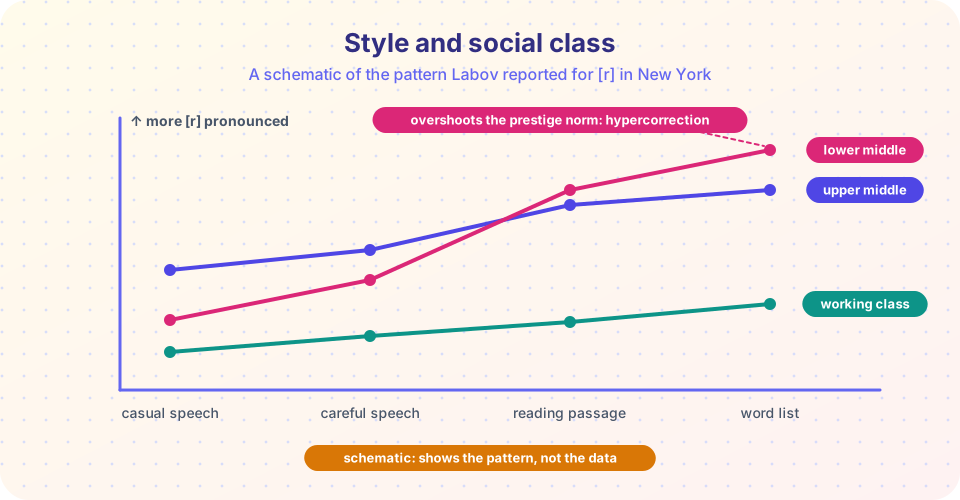
The Lower East Side (1966). In extended interviews, Labov elicited different styles: casual speech, careful speech, reading a passage, reading word lists. All social groups used more of the prestige variant as attention to speech increased. The lower middle class showed the sharpest increase, passing the upper middle class in the most formal styles, a pattern Labov called hypercorrection. This reflects the desire for social mobility and insecurity about status. It is the sketch in the picture above.
Replication and limits
Labov's methods have been widely copied, but note the limits: the department-store study sampled a small number of workers, and "style" is partly an artifact of the interview. Later work stresses that speakers use variation actively to build identities, and does not just mirror social class passively.
Beyond class
Gender. In many communities women use more standard forms than men do in stable variables, and women often lead change toward new forms; the pattern is robust but not universal and varies with local gender roles.
Social networks. Lesley Milroy's Belfast study (1980) found that tightly knit communities maintain local speech through dense networks, so speech depends on who you talk to, not only your class.
Covert prestige. Peter Trudgill's Norwich study (1972) found that many women reported using more standard forms than they actually did, while many men reported using fewer, as if valuing the toughness that non-standard forms signal.
Accommodation. Howard Giles's communication accommodation theory describes how speakers converge toward or diverge from the speech of their partner, depending on social goals.
Attitudes. In matched-guise experiments (Wallace Lambert, 1960) the same bilingual speaker is heard in two languages or dialects, and listeners rate "different" speakers; the ratings expose stereotypes unrelated to the speakers' real qualities.
African American English
African American English (AAE) is a systematic variety with its own regular grammar. It is not "bad English." For example, habitual be (He be working) expresses a meaning that standard English does not mark with a single form: he works regularly, not just now. The absence of the copula in She working follows rules similar to ones governing contraction in standard English: where standard English can contract is (She's working), AAE can delete it, and where standard English cannot contract (Yes, she is), AAE cannot delete either. John Rickford and Labov documented these regularities. In 1996 a school board in Oakland, California sparked a national debate over "Ebonics", and linguists argued that teachers should know the system's rules, not treat the dialect as error. Attitudes toward varieties have real consequences for education and employment, which is why sociolinguists study them seriously.
Common misconceptions
"Standard English is more logical." It carries social prestige, not linguistic superiority. Many non-standard forms are more regular.
"People speak one way." Every speaker has a repertoire and shifts with situation.
"Variation is random." It is patterned by region, class, age, gender, network and style.
Try it
The first demo is a toy model of a variable such as -in' versus -ing. It combines a style effect and a class effect, with invented effect sizes, in the way that variable-rule analysis (Cedergren and Sankoff, 1974) combines factors. It shows how orderly variation emerges from small biases.
Press Run (or Ctrl + Enter) to see the result here.
Program input · what you'd type while the program runs
Type the answers before you press Run, one per line. Each time the program reads a line (with input()), it gets the next line from this box.
The second demo simulates accommodation: two speakers move toward each other's rate of using a variant over a conversation.
Press Run (or Ctrl + Enter) to see the console output here.
No output.
Check your understanding
Quick check · 6 questions
of 6 answered You scored / 6 · perfect!
-
1. In Labov's department-store study, which feature was measured?
He compared pronunciation of r across stores of different prestige. -
2. What is hypercorrection?
The lower middle class in Labov's data surpassed the upper middle class in formal styles. -
3. What did the Martha's Vineyard study suggest about a vowel pronunciation?
More centralized vowels went with stronger island identity. -
4. What is covert prestige?
Trudgill found that many men favored non-standard speech for its tough associations. -
5. What does habitual be in African American English express?
He be working means he works regularly, not just at this moment. -
6. Why are Mandarin and Cantonese often called dialects of Chinese?
The language/dialect distinction is partly political.
Summary
- Linguistic variables show orderly patterns by region, class, style, gender and network.
- Labov's studies linked pronunciation to social structure and identity.
- Standard varieties are prestigious, not better; non-standard varieties are rule-governed.
- Speakers adapt to listeners and settings, and attitudes shape judgments.
Track your progress
Create a free account to tick off lessons and pick up where you left off on any device.
of Linguistics lessons completed