


















Lesson 18 of 49 · Morphology
Chapter 4 Overview: Morphology
Preview Chapter 4: words are built from smaller meaningful parts called morphemes, with inflection, derivation, compounds and different word-building types across languages.
In Chapter 3 you studied sounds, which have no meaning on their own. Now take a step up. How many meaningful pieces are in the word unbreakables? Most speakers would first say "one word", but a linguist sees four: un- ("not"), break ("damage"), -able ("can be") and -s (plural). These pieces are morphemes, and the study of how they are combined to form words is morphology.
Morphology matters for a practical reason: no dictionary can list every word. You understand unbreakables the first time you meet it because you know its parts and the rules for combining them. The same system lets you coin and understand new words like unfollowable or re-gift on the spot.
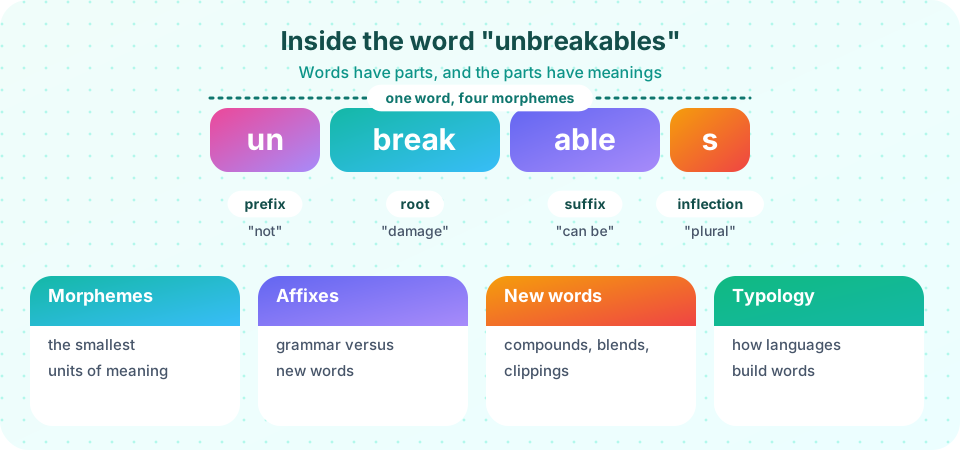
What you will learn
- What morphology studies and why words have internal structure.
- A preview of the four lessons in this chapter.
- How to count morphemes in a word.
Key terms
Morpheme: the smallest unit of language that carries meaning or grammatical function.
Root: the core morpheme of a word that carries its main meaning.
Affix: a morpheme added to a root: a prefix (before) or a suffix (after).
Lexeme: a dictionary word that has many forms (walk, walks, walked).
Word form: a particular shape of a lexeme (walked).
Words are not the smallest units
Beginners often think of the word as the basic unit of language. But words can be broken down further. A morpheme is not the same as a syllable: cat has one morpheme and one syllable, while cats has two morphemes (cat + -s) and still one syllable; banana has three syllables but just one morpheme. A morpheme is a unit of meaning, not of sound.
Morphemes come in two kinds. A free morpheme can stand on its own as a word (break, happy, sun). A bound morpheme must attach to something else (un-, -able, -s). Roots can be free or bound; affixes are always bound.
Three jobs for morphology
- Inflection gives different grammatical forms of the same word: walk, walks, walked, walking.
- Derivation builds new words from old: happy → happiness, teach → teacher.
- Compounding and other word formation combine words or reshape them: sunflower, brunch, exam, laser.
Different languages divide the labor very differently. English words have few parts; a Turkish word can contain half a dozen; some languages pack a whole sentence into one verb. The final lesson of this chapter surveys that variety, which is called morphological typology.
The chapter in slides
Parts of words
Grammar and new words
Other processes and types
What each lesson covers
- Morphemes and word structure: free and bound morphemes, allomorphs, and word trees.
- Inflection and derivation: the eight inflectional suffixes of English and how derivation changes categories.
- Compounding and word formation: compounds, blends, clippings, acronyms, conversion and borrowing.
- Morphological typology: isolating, agglutinative, fusional and polysynthetic languages.
- Chapter 4 review.
Common misconceptions
"A morpheme is a syllable." They are different kinds of units: syllables are about sound, morphemes about meaning.
"Long words are complex words." Banana is long but has one morpheme; unfit is short but has two.
"Affixes always mean the same thing." Many affixes have several meanings or functions: -er can mean "person who does" (teacher) or "more" (taller).
Try it
The first program counts the morphemes in words you list, using a small segmentation dictionary that separates morphemes with plus signs. Add your own entries.
Press Run (or Ctrl + Enter) to see the console output here.
No output.
The second demonstration counts morphemes in a hand-segmented word list and plots how many words have one, two, three or more. Most everyday words have one or two morphemes; long chains are rare but possible. The segmentation is mine and simplified (for example, happiness is treated as happy + -ness).
Press Run (or Ctrl + Enter) to see the result here.
Program input · what you'd type while the program runs
Type the answers before you press Run, one per line. Each time the program reads a line (with input()), it gets the next line from this box.
Check your understanding
Quick check · 4 questions
of 4 answered You scored / 4 · perfect!
-
1. How many morphemes does the word 'unbreakables' have?
un- + break + -able + -s. -
2. Which statement is correct?
Morphemes are units of meaning or function, not units of sound. -
3. Which morpheme is bound?
-able cannot stand alone as a word, so it is bound. -
4. Which process builds a new word such as 'teacher' from 'teach'?
Derivation creates new words, here a noun from a verb.
Summary
- Words have internal structure: they are built from morphemes, the smallest units of meaning or function.
- Morphemes are free (can stand alone) or bound (cannot); roots carry the main meaning and affixes attach to them.
- Morphology covers inflection, derivation and word formation such as compounding.
- Languages differ widely in how many morphemes a word contains.
Track your progress
Create a free account to tick off lessons and pick up where you left off on any device.
of Linguistics lessons completed