


















Lesson 48 of 49 · Projects and Practice
Cheat sheet: chapters 5 to 9
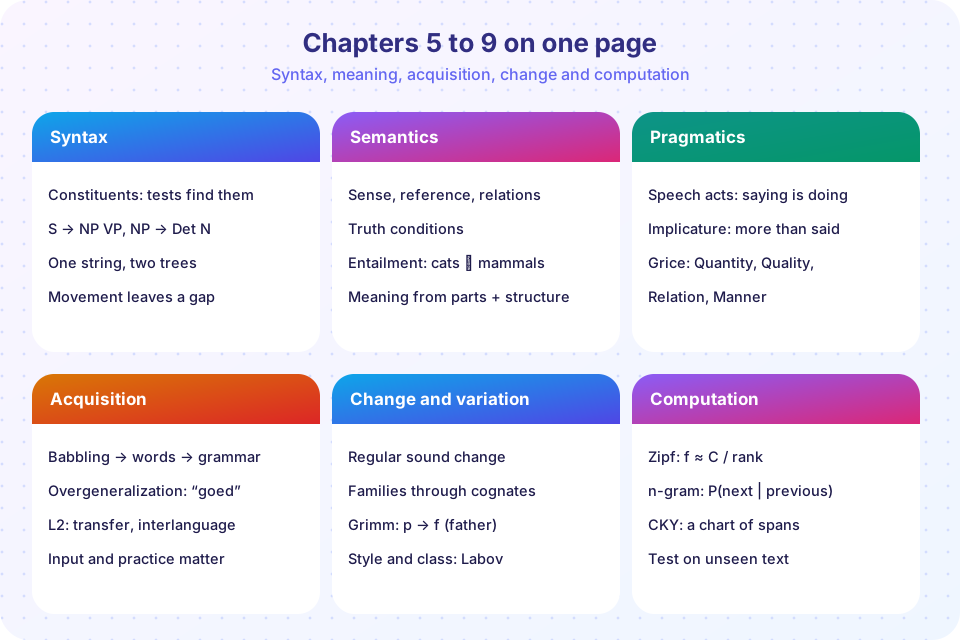
A one-page recap of syntax, semantics, pragmatics, acquisition, language change, variation and computational linguistics, with a summary picture, key formulas and quick calculators.
This page is the whole second half of the course on one screen. Use it before an exam, before a project or whenever you need to remember which tool answers which question. Every item links back to its lesson in the glossary and the chapter reviews.
What you will learn
- The core idea of each area in one line
- The formulas and rules of thumb worth memorising
- Which tool fits which question
Key terms
Constituent: a unit in the tree. Entailment: strict guarantee. Implicature: inferred extra meaning.
Interlanguage: a learner's own rule system. Cognate: a descendant of a shared ancestor word.
Perplexity: how surprised a model is. CKY: a chart parser in cubic time.
Syntax
- Words fall into categories; phrases are built around heads.
- Constituency tests: substitution, movement, coordination, fragment answers.
- Rules:
S → NP VP,NP → Det (Adj) N (PP),VP → V (NP) (PP),PP → P NP. - Recursion:
NP → NP PPandPP → P NPallow unlimited nesting. - Ambiguity: one string, several trees (PP attachment). A string of n words has Catalan(n − 1) binary bracketings: 1, 2, 5, 14, 42...
- Movement: a filler is linked to a gap. Islands (relative clauses, coordination) block it.
- Rival theories: dependency grammar, HPSG, LFG, construction grammar.
Semantics and pragmatics
- Sense is how a word picks out things; reference is what it picks out.
- Sense relations: synonymy, antonymy, hyponymy, meronymy, polysemy, homonymy. Categories have prototypes.
- Truth conditions: to know the meaning is to know when the sentence would be true.
- A entails B: B is true whenever A is. Presuppositions survive negation.
- Quantifiers as set relations: every A ⊆ B; some A ∩ B ≠ ∅; no A ∩ B = ∅; most |A ∩ B| > |A − B|.
- Speech acts: locutionary, illocutionary, perlocutionary; Searle's five types.
- Grice: cooperative principle with four maxims (quantity, quality, relation, manner). Implicatures are calculable and cancellable.
Acquisition, change and variation
- Infants tune perception by about 12 months; statistical learning helps find words.
- Children overgeneralize (goed), showing rules; the wug test checks productivity.
- Nativist, usage-based and social accounts; the critical period looks gradual.
- Second language: interlanguage, transfer, overgeneralization, fossilization; input, interaction and output all matter.
- Sound change is regular (Grimm's law: p → f, t → th, k → h). Cognates with regular correspondences prove kinship.
- Changes spread along S-curves.
- Variation: orderly by class, style, gender and network (Labov). Standards are prestige, not better.
Computational linguistics
| Question | Tool | Formula |
|---|---|---|
| How are words distributed? | Zipf's law | f ≈ C / rank |
| What comes next? | n-gram model | P(w | v) = count(v w) / count(v) |
| What about unseen events? | Smoothing | add-one: (count + 1) / (count(v) + V) |
| How good is the model? | Perplexity | exp(−mean log P) |
| What kind of word is it? | HMM tagger, Viterbi | best path over tags |
| Can the grammar derive it? | CKY | cubic time in sentence length |
Try it
The first demo is a bundle of mini calculators for the formulas on this page. Change the inputs.
Press Run (or Ctrl + Enter) to see the result here.
Program input · what you'd type while the program runs
Type the answers before you press Run, one per line. Each time the program reads a line (with input()), it gets the next line from this box.
The second demo is a small tool chooser: describe a problem and it names the technique from this course. It matches keywords only, but it is a handy summary of what applies where.
Press Run (or Ctrl + Enter) to see the console output here.
No output.
Check your understanding
Quick check · 5 questions
of 5 answered You scored / 5 · perfect!
-
1. How many binary bracketings does a 6-word string have?
That is the Catalan number C(5) = 42. -
2. Which quantifier condition is A ∩ B = ∅?
No A is B means the two sets have no overlap. -
3. Which pattern does Grice's maxim of Relation describe?
Quality is about truth and Manner about clarity. -
4. According to Grimm's law, Latin p corresponds to English:
Pes corresponds to foot. -
5. What does lower perplexity indicate?
The model is less surprised.
Summary
- Syntax: categories, constituents, rules, recursion, ambiguity, movement.
- Meaning: sense and reference, truth conditions, entailment, speech acts, implicature.
- Acquisition, change and variation: rule learning, regular sound laws, S-curves, orderly variation.
- Computation: Zipf, n-grams, smoothing, perplexity, tagging and CKY parsing.
Next: Further study
Track your progress
Create a free account to tick off lessons and pick up where you left off on any device.
of Linguistics lessons completed