


















Lesson 1 of 49 · Getting Started
Course Map: Welcome to Linguistics
Start here: who this free linguistics course is for, what its nine chapters cover, how to study it, and a first hands-on experiment with real language data.
You have been doing linguistics all your life without knowing it. When you notice that "a apple" sounds wrong, or that "the dog bit the man" means something different from "the man bit the dog", you are using detailed knowledge about your language that nobody ever sat down and taught you. Linguistics is the scientific study of that knowledge and of the human languages that carry it.
This course is a complete, friendly introduction. It follows the common core of introductory university courses and upper-secondary language syllabi around the world, so it suits school students (about ages 15 to 18), first-year university students and curious adults. You do not need to speak any language other than the one you are reading. You do need curiosity and a willingness to look closely at things that feel obvious.
What you will learn
- What language is, what makes it different from other kinds of communication, and how linguists study it scientifically.
- How speech sounds are made, described and organized (phonetics and phonology).
- How words are built from smaller meaningful pieces (morphology).
- How words combine into sentences (syntax) and how sentences and speakers create meaning (semantics and pragmatics).
- How children acquire language, how languages change and vary, and how computers process language.
Key terms
Language: a structured system of signs, made of sounds, signs or written symbols, that people use to express an unlimited range of meanings.
Linguistics: the scientific study of language and its structure, use, acquisition and change.
Grammar (in the linguist's sense): all the unconscious knowledge a speaker has about their language, not just school rules.
Data: the recordings, texts and speaker judgments that linguists collect to test ideas.
Corpus: a large, organized collection of real text or speech that can be searched and counted.
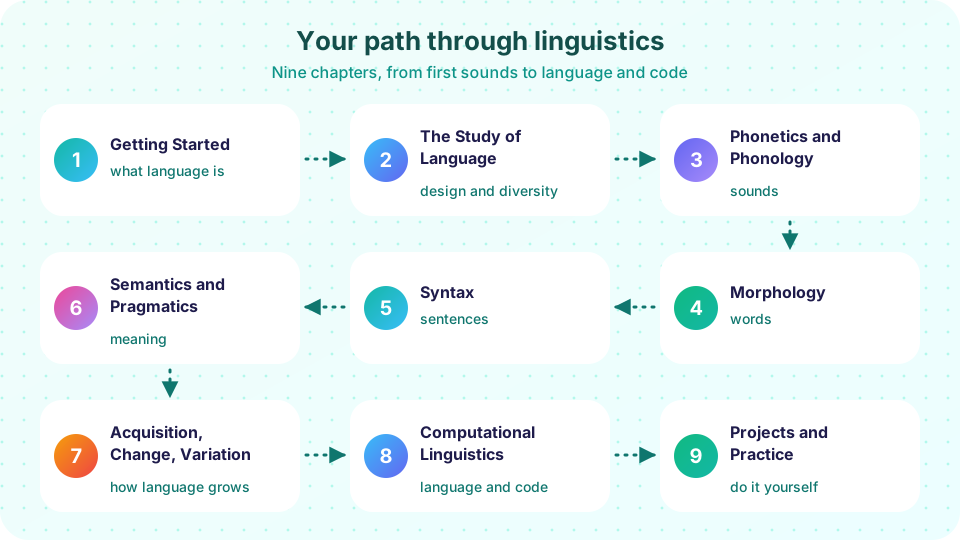
The nine chapters at a glance
Chapters 1 to 3: the foundations
- Getting Started
- The Study of Language
- Phonetics and Phonology
Chapters 4 to 6: words, sentences, meaning
- Morphology
- Syntax
- Semantics and Pragmatics
Chapters 7 to 9: change, computers, practice
- Acquisition, Change, Variation
- Computational Linguistics
- Projects and Practice
Chapters 1 to 4 (the first half of the course) give you the tools: the scientific attitude, the idea of a linguistic system, and the two lowest levels of structure, sounds and words. Chapters 5 to 9 climb upward to sentences and meaning, then widen out to children, history, social variation and computers.
How to study this course
- Read actively. Each lesson starts with "What you will learn". Check it again at the end.
- Run the examples. Every lesson has live code boxes. They are small demonstrations: change a word, press Run and see what happens.
- Use your own language. When a lesson shows an English pattern, ask yourself what happens in the language you speak at home. Comparing languages is the heart of the subject.
- Say things out loud. Phonetics in particular only makes sense when you feel where your tongue is.
- Take the quizzes seriously. The explanations teach as much as the lessons do.
Common misconceptions
"A linguist is someone who speaks many languages." That person is a polyglot. Many linguists speak one or two languages; what they share is a method for analyzing languages, including ones they cannot speak.
"Linguists correct grammar." Mostly they do the opposite: they describe how people actually speak. You will meet this distinction in lesson 3.
"Some languages are primitive." No known language is simple in every respect. Every community's language handles the full range of human thought, and each has complexity somewhere.
Try it
The first experiment treats a few sentences as data. This JavaScript program splits a text into words and counts tokens (every word occurrence) and types (different words). Edit the text and run it again.
Press Run (or Ctrl + Enter) to see the console output here.
No output.
The second demonstration counts word lengths in a short original paragraph and draws a bar chart. Real texts tend to have many short words and few very long ones.
Press Run (or Ctrl + Enter) to see the result here.
Program input · what you'd type while the program runs
Type the answers before you press Run, one per line. Each time the program reads a line (with input()), it gets the next line from this box.
Check your understanding
Quick check · 4 questions
of 4 answered You scored / 4 · perfect!
-
1. What do linguists mean by the word grammar?
In linguistics, grammar covers sounds, word building, sentence structure and meaning, all the knowledge speakers use without being taught. -
2. A text has 10 word occurrences, and 6 of them are different words. How many tokens and types does it have?
Tokens count every occurrence (10). Types count distinct words (6). -
3. Which statement about linguists is accurate?
Linguistics is a method, not a skill at speaking many languages, and most of its work is descriptive. -
4. Which chapter of this course deals with how words are built from smaller meaningful parts?
Morphology is the study of word structure and is Chapter 4.
Summary
- Linguistics is the scientific study of language; its subject is the knowledge speakers already have.
- The course moves from sounds and words (Chapters 3 and 4) to sentences and meaning (Chapters 5 and 6), then to children, change, variation and computers.
- Linguists use data: recordings, corpora, counted words and speaker judgments.
- A type is a distinct word; a token is one occurrence of a word.
- Read actively, run the examples, compare languages and say sounds out loud.
Next: What Is Language?
Track your progress
Create a free account to tick off lessons and pick up where you left off on any device.
of Linguistics lessons completed