


















Lesson 5 of 49 · Getting Started
Chapter 1 Review: Getting Started
Review Chapter 1 of the linguistics course with a one-picture summary, a recap table, two practice tools and a ten-question quiz on language, description and data.
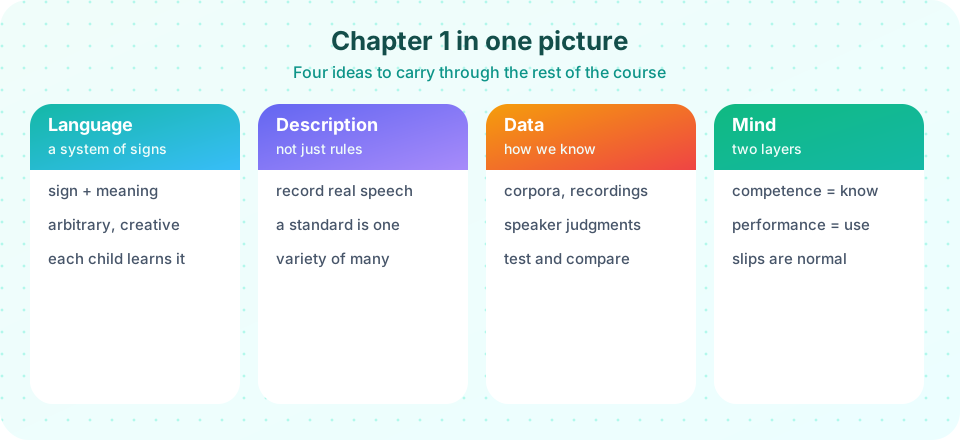
You have finished the first chapter. Before you move on to the study of language itself in Chapter 2, take a few minutes to pull the ideas together. This lesson gives you the whole chapter in one picture, a recap table, two small practice tools and a longer quiz.
What you will learn
- To connect the key ideas of Chapter 1 into one picture.
- To sort statements into descriptive and prescriptive.
- To test yourself on the vocabulary of the chapter.
Recap table
| Lesson | Big idea | Key terms |
|---|---|---|
| Course map | Linguistics is the scientific study of language; the course climbs from sounds to sentences | grammar, corpus, type, token |
| What is language? | A shared system of arbitrary signs that is endlessly creative; speech and sign are primary, writing is derived | sign, arbitrariness, productivity, recursion, modality |
| Descriptive and prescriptive grammar | Linguists describe real usage first; all varieties have rules | prescriptive, descriptive, standard, dialect, register |
| How linguists think | Claims are tested on data; knowledge differs from use | competence, performance, langue, parole, signifier, signified |
Key terms
Sign: a form paired with a meaning.
Productivity: the ability to make and understand unlimited new sentences.
Descriptive: reporting what speakers do.
Competence: what a speaker knows about their language.
Corpus: a searchable collection of authentic language.
Common misconceptions
"Language is writing." Writing records language; speech and sign come first.
"Descriptive means no standards." It means starting from facts; standards remain useful in the right register.
"Mistakes in speech show that people do not know grammar." Many are performance slips.
Try it
First, sort statements into the two stances. Edit the list called my_answers, using "D" for descriptive and "P" for prescriptive, then run the code. It is a self-check tool; the answer key is in the code, so try before you peek.
Press Run (or Ctrl + Enter) to see the console output here.
No output.
Second, a concept map draws the chapter's ideas and how they link. It is a plain matplotlib drawing; edit the links list to add your own connections.
Press Run (or Ctrl + Enter) to see the result here.
Program input · what you'd type while the program runs
Type the answers before you press Run, one per line. Each time the program reads a line (with input()), it gets the next line from this box.
Check your understanding
Quick check · 9 questions
of 9 answered You scored / 9 · perfect!
-
1. Which of these is most clearly a property of human language rather than of most animal call systems?
Productivity, the unlimited combination of parts by rules, is a hallmark of human language. -
2. Why are sign languages considered full languages?
Sign languages meet every criterion for language; the channel is different, the system is complete. -
3. A text has 20 word occurrences and 12 distinct words. Its type/token ratio is
Types divided by tokens: 12 / 20 = 0.6. -
4. Which statement is prescriptive?
'One should' gives a rule about how to write; the others report observations. -
5. 'I didn't see nothing' is an example of
Negative concord is regular in many varieties of English and in languages such as Spanish. -
6. Which pair correctly matches the term and its description?
Performance is use in real situations; competence is the underlying knowledge. -
7. In Saussure's model, which is the signified?
The signified is the concept; the signifier is the form. -
8. Why does a corpus fail to prove that a sentence is impossible?
Absence from a finite sample is weak evidence; judgments and experiments are needed for impossibility. -
9. A very long sentence with several nested clauses is hard to understand even though it follows English rules. Which idea explains this best?
Center-embedded sentences strain working memory, a performance factor.
Summary
- Language is a shared, arbitrary, productive system of signs, found in speech and sign; writing records it.
- Linguists describe real usage first and treat every variety as rule-governed.
- Evidence comes from corpora, fieldwork, experiments and speaker judgments.
- Competence (knowledge) is different from performance (use).
- A sign pairs a form with a concept, and the pairing is arbitrary.
Track your progress
Create a free account to tick off lessons and pick up where you left off on any device.
of Linguistics lessons completed