


















Lesson 29 of 49 · Semantics and Pragmatics
Chapter overview: Meaning
An overview of semantics and pragmatics: how words, sentences and speakers carry meaning, from sense and reference to implicature, with a map of the chapter.
What does dog mean? You could point to a dog, describe one, or give a dictionary definition, and each answer captures something different. Meaning has layers, and linguists study them in two connected fields. Semantics asks what words and sentences mean by themselves. Pragmatics asks what speakers mean by using them in a particular situation. This chapter walks up from single words to whole conversations.
What you will learn
- The difference between a word, the idea it evokes and the thing it picks out
- Why sense and reference are different (Frege)
- How semantics and pragmatics divide the work
- What the four lessons of this chapter will teach you
Key terms
Sense: the idea or condition by which a word picks out things (what you grasp when you understand dog).
Reference: the actual thing a word or phrase points to in a context.
Denotation: the core, literal meaning; connotation: the associations and feelings attached to it.
Semantics: meaning from words and structure, independent of who says it.
Pragmatics: meaning that depends on context and the speaker's intentions.
Three corners of the triangle
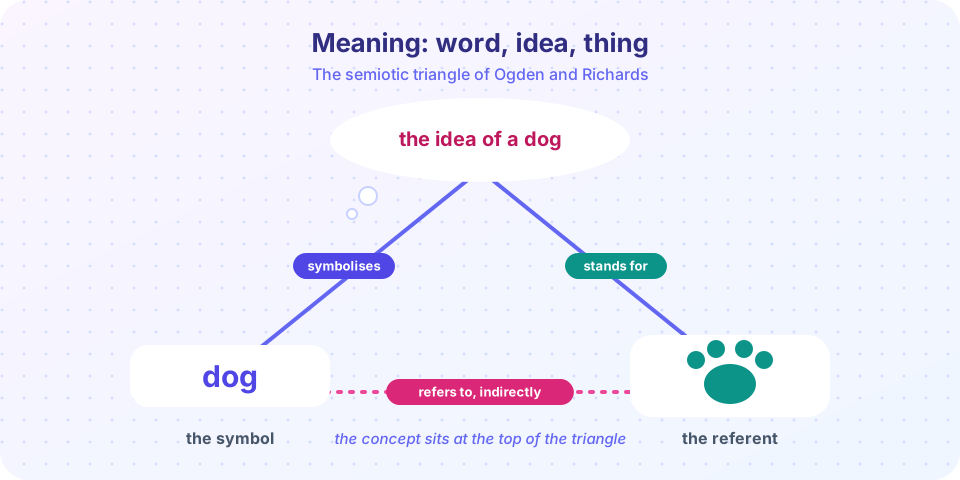
In 1923 C. K. Ogden and I. A. Richards drew a triangle to show that a word does not connect directly to a thing. A speaker first has a concept, and the word expresses the concept. The concept applies to things in the world. The dashed line along the base marks that the link from word to thing is indirect. The Swiss linguist Ferdinand de Saussure had earlier described the sign as a pairing of a sound pattern (the signifier) with a concept (the signified), and stressed that the pairing is arbitrary: nothing about the sounds of dog resembles a dog, which is why other languages say perro, Hund, inu or kutta.
Sense and reference
The German philosopher Gottlob Frege asked in 1892 how the morning star is the evening star can be informative if both phrases name the same planet, Venus. His answer was that they have the same reference but different senses: two ways of picking out the same object. Sense is what a speaker grasps; reference is what in the world the speaker thereby talks about. Some expressions have sense but no reference (the present king of France), and some have reference with very little descriptive sense (a proper name such as Ada). This distinction will return in the lessons on word meaning and truth.
Semantics and pragmatics: dividing the labour
Consider It's cold in here. Semantics tells us that the sentence is true if the temperature in the place of speaking is low. Pragmatics tells us that a speaker who says this at a window may be asking you to close it. The first part comes from the words and structure; the second from what the speaker plausibly intends.
Meaning has layers
Word meaning
Sentence meaning
Speaker meaning
The lessons in this chapter
| Lesson | What it covers |
|---|---|
| Word senses and relations | Synonymy, antonymy, hyponymy, polysemy, prototypes |
| Truth conditions and composition | Sentence meaning, entailment, presupposition, compositionality |
| Speech acts and implicature | Austin, Searle and Grice |
| Chapter review | One picture and a ten-question quiz |
Common misconceptions
"A word has exactly one meaning, which the dictionary gives." Dictionaries record typical senses; real use is flexible. Run has dozens of senses, and speakers extend words creatively.
"Meaning is the thing a word points to." Frege's morning star and evening star show that two expressions can point to the same thing and still differ in meaning.
"Pragmatics is the leftover bin." Pragmatics has its own principles, such as Grice's maxims, and makes testable predictions.
Try it
The first demo models Frege's puzzle. Two descriptions have different senses (their descriptions) but the same reference (the object they pick out in the model). It is a small illustration of the idea, not a real theory of reference.
Press Run (or Ctrl + Enter) to see the console output here.
No output.
The second demo sorts utterances into what the words say and what a hearer may infer. The readings are hand-written examples for the demonstration, not output of a pragmatic theory.
Press Run (or Ctrl + Enter) to see the console output here.
No output.
Check your understanding
Quick check · 4 questions
of 4 answered You scored / 4 · perfect!
-
1. In the semiotic triangle, which link is only indirect?
A word reaches things only through the concept; the base of the triangle is dashed. -
2. Who distinguished sense from reference in 1892?
Gottlob Frege used the morning star and evening star to show the difference. -
3. Which belongs to pragmatics?
The request depends on the speaker's intention in context, which is what pragmatics studies. -
4. What is the signifier in Saussure's account?
The signifier is the form (sound or letters); the signified is the concept.
Summary
- Meaning has layers: words, sentences, speakers.
- Words link to things through concepts, and sense differs from reference.
- Semantics covers what expressions mean in themselves; pragmatics what speakers mean by using them.
- The chapter moves from word relations to truth conditions to conversation.
Track your progress
Create a free account to tick off lessons and pick up where you left off on any device.
of Linguistics lessons completed