


















Lesson 15 of 49 · Phonetics and Phonology
Phonemes and Allophones
Learn how languages organize sounds into phonemes and allophones, how minimal pairs and complementary distribution reveal them, with the English t and Hindi aspiration.
Phonetics tells you that a speaker can make hundreds of different sounds. Phonology tells you something surprising: speakers of any one language hear only a few dozen of them as different. The rest are variants that listeners barely notice, or cannot hear at all without training.
This is the key idea of phonology: sounds have functions in a system, not just physical properties. In this lesson you will learn to find a language's phonemes (the sounds that distinguish words) and its allophones (the predictable variants of one phoneme), using methods that work on any language.
What you will learn
- The difference between a phone, a phoneme and an allophone.
- How minimal pairs prove that two sounds are separate phonemes.
- How complementary distribution shows that two sounds are allophones.
- Why different languages draw the lines in different places.
Key terms
Phoneme: a sound category that can distinguish words in a language, written between slashes, /t/.
Allophone: a variant pronunciation of a phoneme, written in square brackets, [tʰ].
Minimal pair: two words that differ in exactly one sound in the same position, such as pin and bin.
Complementary distribution: two sounds that never occur in the same environment.
Free variation: two sounds that can occur in the same environment without changing the meaning.
Minimal pairs: sounds that make a difference
Consider pin and bin. They differ in one sound, /p/ versus /b/, and that difference changes the meaning. A pair like this is a minimal pair, and it proves that /p/ and /b/ are separate phonemes in English. Other minimal pairs in English: pin / tin / kin / fin / sin / shin; bit / bet / bat / but / boot; thin / this. Linguists use minimal pairs the way a chemist uses a test: if swapping two sounds changes the word, the sounds contrast.
Phonemes are not sounds themselves but categories. When you say pin many times, no two pronunciations are physically identical, yet your listeners hear the same /p/ every time. The phoneme is the category; the actual sounds produced are its members.
Allophones: variants that do not change the word
Now compare the p in pin and in spin. In pin the p is aspirated: a puff of air follows the release, [pʰ]. In spin there is no puff, [p]. Hold a tissue in front of your mouth and say both. But no English speaker would say that pin and spin contain "different p-sounds", and the difference never separates words. [pʰ] and [p] are allophones of the phoneme /p/.
The reason is that their appearance is predictable. English voiceless plosives are aspirated at the beginning of a stressed syllable and unaspirated after /s/. In other words, [pʰ] and [p] are in complementary distribution: wherever one can occur, the other cannot, so the two never contrast.
To decide whether two sounds are separate phonemes or allophones, phonologists use a short procedure:
- Collect words containing both sounds, written phonetically.
- Look for a minimal pair. If one exists, the sounds are separate phonemes.
- If not, list the environments (the surrounding sounds) of each sound. If they never overlap (complementary distribution), the sounds are allophones of one phoneme.
- If they can occur in the same environment but do not change the meaning, they are in free variation (also allophones).
The many faces of English /t/
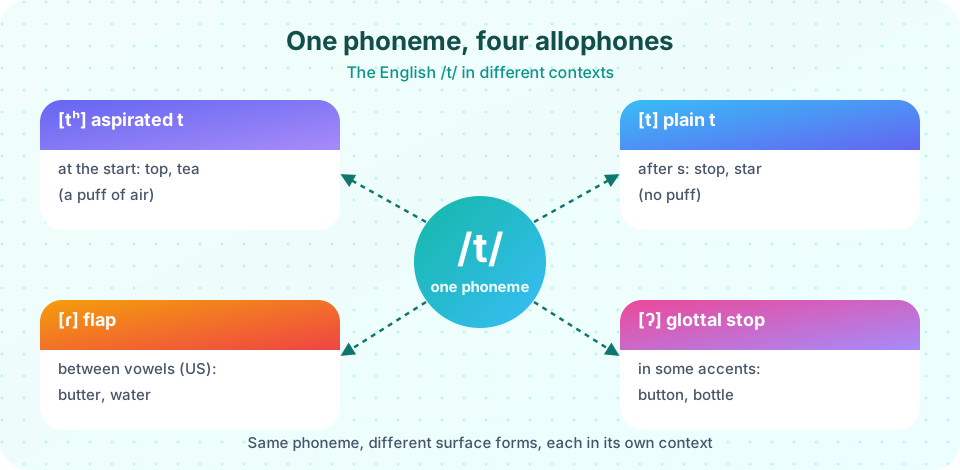
The picture at the top shows English /t/ at work. Say these words naturally and notice what your tongue does with the t.
- top, tea: aspirated [tʰ], with a puff of air.
- stop, star: plain [t], no puff.
- butter, water: in North American accents, a flap [ɾ], a quick tap of the tongue, so butter sounds a little like budder.
- button, bottle: in many accents a glottal stop [ʔ] (the catch in your throat in "uh-oh"), as the tongue stays silent and the vocal folds close.
All are heard as "the sound t". Another English example is dark l: the l in leaf is "light" [l], while the l in feel is "dark" [ɫ], made with the back of the tongue raised. And vowels before nasal consonants in English are nasalized, as in ban [bæ̃n], but speakers never notice, because it is predictable.
The same sounds, different systems
The key insight: what is a phoneme depends on the language.
- Aspiration is allophonic in English but phonemic in Hindi: pal ("moment") and phal ("fruit") are a minimal pair based on the puff of air. Hindi speakers hear two different sounds where English speakers hear one.
- /b/ and /v/ are separate phonemes in English (ban versus van). In Spanish, the letters b and v both stand for the same phoneme, so vaca ("cow") begins with the same sound as baca would. Spanish /b/ also has two allophones, a plosive [b] after a pause or a nasal and a softer, fricative-like [β] between vowels, such as in lobo.
- Nasal vowels are allophonic in English but phonemic in French: beau [bo] ("beautiful") and bon [bɔ̃] ("good") are a minimal pair based on nasality.
- Japanese has a single liquid phoneme /r/ where English has both /ɹ/ and /l/, which is one reason rock and lock can be hard for learners to hear at first.
The Prague School linguist Nikolai Trubetzkoy, in his Principles of Phonology (published in 1939 after his death), set out the modern theory that a language's sounds form a system of oppositions: what matters is not the sound itself but what it contrasts with.
Learning to hear: infants and phonemes
The phoneme is not only a linguist's tool; it describes how listeners perceive. In the 1980s Janet Werker and Richard Tees found that babies of about six to eight months can distinguish speech contrasts from languages they have never heard, but by about ten to twelve months they have become better at their own language's contrasts and worse at foreign ones that do not matter in it. Later work has refined the details, but the broad picture holds: early experience tunes the perception of sounds to the phonemes of the ambient language. This is one reason that learning a new language's sounds is hardest in adulthood, a topic you will return to when you study how children and adults learn languages.
Common misconceptions
"Phonemes are the sounds we hear." Phonemes are categories. The actual sounds, the phones, vary around them, and listeners ignore many differences.
"Allophones are sloppy mistakes." Allophones follow regular rules and are produced correctly by every native speaker.
"A sound is either a phoneme or an allophone." It depends on the language and the sound pair: aspiration is allophonic in English and phonemic in Hindi.
Try it
The first program works like a phonologist's notebook. It lists words with their phonetic transcriptions, finds the environment of each [pʰ] and [p], and checks whether the two are in complementary distribution. The word list is small and simplified, and the transcriptions are for General American.
Press Run (or Ctrl + Enter) to see the console output here.
No output.
The second demonstration finds minimal pairs automatically. It takes a word list written as phoneme sequences, finds every pair that differs in exactly one position, and counts which contrasts occur. Each such pair is evidence that two sounds are separate phonemes.
Press Run (or Ctrl + Enter) to see the result here.
Program input · what you'd type while the program runs
Type the answers before you press Run, one per line. Each time the program reads a line (with input()), it gets the next line from this box.
Check your understanding
Quick check · 5 questions
of 5 answered You scored / 5 · perfect!
-
1. Which pair is a minimal pair?
Pin and bin differ in one sound in the same position, /p/ versus /b/. -
2. Aspirated [pʰ] and unaspirated [p] in English are
They never contrast: [pʰ] is stressed-syllable-initial and [p] occurs after /s/. -
3. Why is aspiration phonemic in Hindi but not in English?
Whether a difference is phonemic depends on whether it distinguishes words in that language. -
4. What does complementary distribution mean?
If two sounds are in complementary distribution, one appears where the other cannot, so they cannot contrast. -
5. The flap [ɾ] in North American 'butter' is
The flap is a predictable variant of /t/ between vowels in this accent.
Summary
- A phoneme is a sound category that distinguishes words; allophones are predictable variants of one phoneme.
- Minimal pairs show contrast; complementary distribution shows that two sounds are allophones.
- English /t/ has several allophones (aspirated, plain, flap, glottal stop), and /l/ has light and dark variants.
- Phoneme systems vary across languages: aspiration, nasal vowels and the b/v distinction are phonemic in some languages and allophonic in others.
- Infants' perception becomes tuned to the phonemes of their language during the first year.
Track your progress
Create a free account to tick off lessons and pick up where you left off on any device.
of Linguistics lessons completed