


















Lesson 3 of 49 · Getting Started
Descriptive and Prescriptive Grammar
Learn the difference between telling people how to speak and describing how they do, with examples like split infinitives, double negatives and dialect rules.
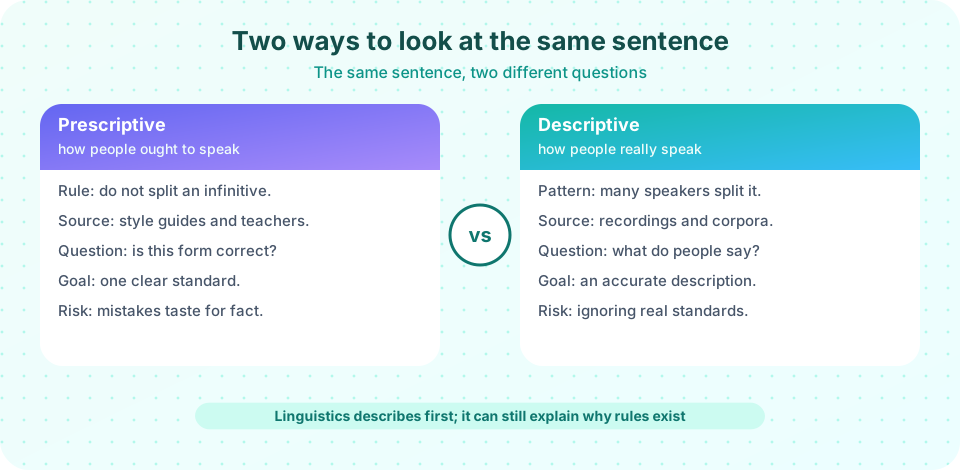
Somewhere in school you probably heard rules such as "never end a sentence with a preposition", "don't split infinitives" and "say fewer for things you can count". These rules come from prescriptive grammar: advice about how people should speak and write. Linguists mostly work in a different mode, descriptive grammar, which records how people do speak and tries to explain the patterns.
This is one of the most important ideas in the whole subject, and one of the most misunderstood. It does not say that anything goes. It says that a scientist studying language must first find out what speakers actually do, just as a biologist studies a bird before telling it how to fly.
What you will learn
- The difference between prescriptive and descriptive approaches, and why linguistics starts with description.
- Where many familiar school rules came from.
- Why non-standard varieties follow rules too.
- Why standard languages still matter.
Key terms
Prescriptive: giving rules about how a language should be used.
Descriptive: reporting and explaining how a language is actually used.
Standard variety: the form of a language promoted in education, publishing and government.
Dialect: a variety of a language tied to a region or social group; every speaker speaks a dialect.
Register: the style of language that fits a situation (a job interview versus a chat with friends).
Two different questions
Take the sentence Who did you give it to? A prescriptive grammarian asks: is this correct? Some style guides prefer To whom did you give it? A descriptive linguist asks different questions: Do speakers say this? In which situations? Do they treat it as normal? Which structure is it, and how does it relate to other sentences? The answers are about the language, not about anybody's taste.
Neither question is silly. Prescriptive advice has real uses in editing, teaching writing and exams. But as a way of finding out how language works it is a bad method, for the same reason that a doctor who only listed how bodies should be would learn nothing about illness.
Where the rules come from
Many rules are younger and shakier than people think.
- During the 18th century, writers worried that English was changing too quickly and had no authority like the Académie française (founded in 1635 to guard French). Grammarians such as Robert Lowth (his Short Introduction to English Grammar appeared in 1762) wrote rule books that shaped later school teaching.
- Some rules were borrowed from Latin. In Latin an infinitive is a single word (amare, "to love"), so it cannot be split. English has a two-word infinitive (to love), and splitting it (to truly love) has been natural English for centuries. The rule against it grew popular in the 19th century and was repeated for generations; today most style guides accept it when it improves clarity. The famous phrase to boldly go is a split infinitive.
- The rule against ending a sentence with a preposition (What are you looking at?) also has a shaky history. Everyday English very often strands prepositions, and rewriting can sound stiff (At what are you looking?).
A rule's age or its pedigree does not tell you whether it describes how people speak. That is why linguists check against data.
Non-standard varieties are rule-governed
A key finding of 20th-century sociolinguistics is that every variety of a language has systematic grammar, including varieties that carry little prestige. The American linguist William Labov showed this in studies of African American English from the 1960s; his 1969 essay "The Logic of Nonstandard English" argued that such speech is rule-governed. One example: He be working in many varieties of African American English marks a habitual action ("he usually works"), a meaning that He is working does not have. That is a grammatical distinction, not a slip.
Another example is negative concord (double negatives). Standard English avoids I didn't see nothing, but the same pattern is the normal, correct rule in Spanish (No vi nada) and in earlier English, including Chaucer. In a variety where it is the rule, it is as regular as any other grammar rule.
So the descriptive finding is not "nothing is wrong". It is: what looks like an error from one variety is a rule from another.
A rule nobody taught you
Descriptive grammar can also reveal rules that you obey without ever having been told. Say a big red balloon, then try a red big balloon. The second sounds off. English speakers consistently order adjectives by a loose scale from opinion to purpose, as the illustration shows.
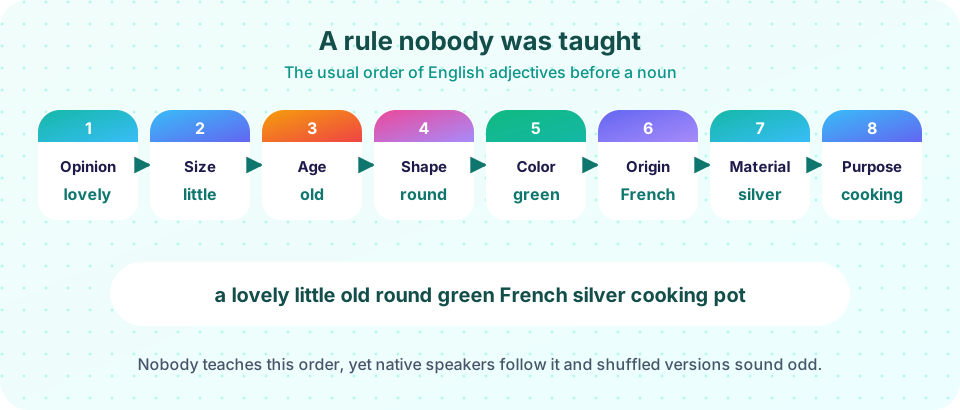
No teacher gave you this rule, and no style guide needs to. That is the kind of knowledge linguists mean by grammar, and it is also why "grammar" and "school rules" are not the same thing.
Why standards still matter
Describing is not the same as saying that every choice works in every context. A standard variety has real social jobs: it lets a country run exams and courts, lets a newspaper reach readers across regions, and gives learners one target. Choosing a register that suits the situation is itself a skill, and good writers have it.
What linguists object to is the myth that the standard is intrinsically more logical, and the prejudice that judges speakers' intelligence or character by their dialect. Research on language attitudes shows that such judgments are common and unfair, which is one reason linguists care about the topic.
A balanced position, then, is:
- Describe first: find out what speakers do.
- Explain the pattern: what does it mean, where did it come from, who uses it?
- If advice is needed, give it as advice about a purpose ("in a formal letter, the following is expected"), not as a claim of logic or moral worth.
Common misconceptions
"Descriptivists think there are no rules." There are many rules; the question is where they come from and which speakers follow them.
"Non-standard English is lazy or illogical." Varieties have their own regular grammars; their features can be as systematic as standard ones.
"The standard form is the real language." The standard is one variety, historically often the dialect of a powerful region or social group, promoted through schools and print.
Try it
The first tool is a toy "rule checker". It spots a few classic school-grammar targets and shows two readings of the same hit: the prescriptive verdict and the descriptive note. It uses simple text matching, so it is a demonstration, not a grammar checker.
Press Run (or Ctrl + Enter) to see the console output here.
No output.
The second demonstration finds a pattern by counting. There are 24 possible orders for the four adjectives big, old, red and wooden in front of table. Using a size, age, color, material scale, the code counts how many pairs of adjectives are "out of order" in each arrangement.
Press Run (or Ctrl + Enter) to see the result here.
Program input · what you'd type while the program runs
Type the answers before you press Run, one per line. Each time the program reads a line (with input()), it gets the next line from this box.
Check your understanding
Quick check · 5 questions
of 5 answered You scored / 5 · perfect!
-
1. Which question is typical of a descriptive linguist?
Descriptive work records and explains actual usage. -
2. Why was the rule against split infinitives popular in the 19th century?
The rule borrowed from Latin; English had split infinitives for centuries. -
3. What does the negative concord in Spanish (No vi nada) show?
Whether two negatives cancel or reinforce each other is a rule of a particular grammar, not a law of logic. -
4. Which is the best summary of the descriptive position?
Description comes first; advice about register and audience can follow without claiming one variety is more logical. -
5. Why is knowing the adjective order in 'a lovely little old round green French silver cooking pot' an example of grammar in the linguist's sense?
Grammar means the unconscious knowledge speakers use, including patterns that nobody ever teaches.
Summary
- Prescriptive grammar says how people should speak; descriptive grammar records and explains how they do.
- Many classic school rules have short or doubtful histories; check them against actual usage.
- Every variety, standard or not, has systematic rules; what is an error in one variety can be the rule in another.
- Speakers follow patterns nobody taught them, such as adjective order.
- Standards and registers matter socially, but they are not more logical than other varieties.
Next: How Linguists Think
Track your progress
Create a free account to tick off lessons and pick up where you left off on any device.
of Linguistics lessons completed