


















Lesson 12 of 49 · Phonetics and Phonology
Chapter 3 Overview: Phonetics and Phonology
Preview Chapter 3: how speech sounds are made, measured and heard (phonetics) and how languages organize them into patterns (phonology), with a waveform of a real word.
Say the word speech slowly. In under a second, your lungs, throat, tongue and lips performed a precise sequence of movements, the air around you filled with a changing pattern of pressure, and a listener's ear turned that pattern back into a word. Chapter 3 follows that sequence from start to finish.
The chapter has two halves. Phonetics is the physical study of speech sounds: how they are made, what they look like as sound waves, and how they are heard. Phonology is the study of how a language organizes those sounds into a system: which differences matter, which are ignored, and what patterns the sounds follow.
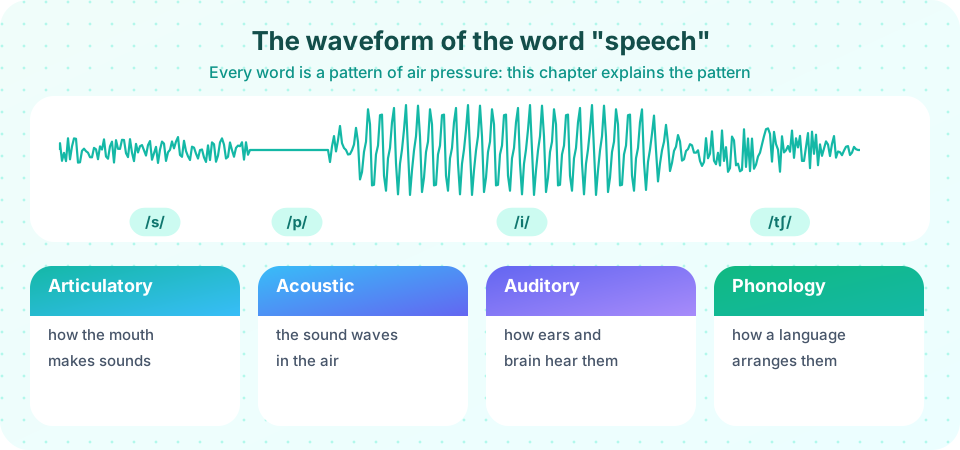
What you will learn
- The difference between phonetics and phonology, and the three branches of phonetics.
- How a sound wave carries speech and why voiced and voiceless sounds look different.
- A preview of the four lessons in this chapter.
Key terms
Phone: a speech sound as a physical event.
Phoneme: a sound category that distinguishes words in a language (for example /p/ versus /b/).
Voiced / voiceless: with or without vibration of the vocal folds.
Frequency: how many times per second a wave repeats, measured in hertz (Hz); it is heard as pitch.
IPA: the International Phonetic Alphabet, a system with one symbol for each sound.
Three branches of phonetics
- Articulatory phonetics studies how speakers produce sounds with the lungs, the larynx (voice box) and the tongue, lips and other articulators. The next lesson covers it.
- Acoustic phonetics studies the physical sound wave: its frequencies, intensity and duration. You can see an acoustic record in the waveform above.
- Auditory phonetics studies how the ear and brain perceive sounds.
Speech sounds divide into two broad families. Vowels are made with an open vocal tract and a regular, periodic wave: the vowel in speech produces the regular wave in the picture. Consonants involve constriction. A fricative such as /s/ produces turbulent air and an irregular "noisy" wave; a plosive such as /p/ blocks the air completely (silence) and then releases it in a burst.
Why we need a phonetic alphabet
English spelling is a poor guide to sound: though, through and tough share letters but not sounds, while fish could be "spelled" ghoti with unlikely spellings from other words. Linguists needed a precise notation, and in 1886 a group of language teachers founded the International Phonetic Association, which developed the International Phonetic Alphabet (IPA). Each symbol stands for exactly one sound, whichever language it occurs in. Transcriptions go in square brackets for exact sounds ([pʰɪn]) and in slashes for phonemes (/pɪn/). You will learn the IPA symbols for English as you go.
Phonology: from sounds to a system
Phonology begins with a puzzle. English speakers hear the p in pin and the p in spin as the same sound, even though pin has a puff of air after the p and spin does not. In Hindi, the puffed and unpuffed versions are different sounds that distinguish words. So the same physical difference is meaningful in one language and ignored in another. Phonology studies such systems: which sounds count as different, in which environments they appear, how they combine into syllables, and how they change when words are put together.
The chapter in slides
Phonetics: making and hearing sounds
Phonology: the sound system
What each lesson covers
- Articulatory phonetics: the vocal tract, voicing, place and manner, and the English consonants.
- Vowels and acoustics: the vowel chart, formants and what a spectrogram shows.
- Phonemes and allophones: minimal pairs, complementary distribution and the English /t/.
- Phonological rules and syllables: assimilation, syllable structure and sonority.
- Chapter 3 review.
Common misconceptions
"Letters are sounds." Spelling and sound differ; English has about 26 letters but roughly 40 phonemes (the exact number depends on the accent).
"Phonetics and phonology are the same." Phonetics describes the physical sounds; phonology describes how a language organizes them.
"Accents are a sign of poor pronunciation." Every accent follows consistent sound patterns.
Try it
First, a waveform you can control. The picture shows 40 milliseconds of a pure tone. Slide the pitch (frequency) and the loudness (amplitude). The Play button uses your browser's audio; if sound is blocked in this preview, the picture still works.
Second, a voiced and a voiceless signal compared. A voiced sound has a regular, repeating wave (the vocal folds vibrate about 100 times a second here); a voiceless sound such as /s/ is random noise. This is a simplified synthetic demonstration, not a recording.
Press Run (or Ctrl + Enter) to see the result here.
Program input · what you'd type while the program runs
Type the answers before you press Run, one per line. Each time the program reads a line (with input()), it gets the next line from this box.
Check your understanding
Quick check · 4 questions
of 4 answered You scored / 4 · perfect!
-
1. Which statement best distinguishes phonetics from phonology?
Phonetics describes sounds as physical events; phonology is about the sound system of a language. -
2. Which branch of phonetics deals with the sound wave itself?
Acoustic phonetics measures frequency, amplitude and duration of the wave. -
3. What does a voiceless sound lack compared with a voiced one?
Voiceless sounds are made with the vocal folds apart and not vibrating. -
4. Why was the IPA created?
Spelling is inconsistent; the IPA gives a consistent notation for sounds.
Summary
- Phonetics studies the production (articulatory), physical form (acoustic) and perception (auditory) of speech sounds; phonology studies how languages organize them.
- Voiced sounds have a regular wave from vocal fold vibration; voiceless fricatives are noisy.
- The IPA gives one symbol to each sound; square brackets show phones, slashes show phonemes.
- The same physical difference can be meaningful in one language and ignored in another.
Next: Articulatory Phonetics
Track your progress
Create a free account to tick off lessons and pick up where you left off on any device.
of Linguistics lessons completed