


















Lesson 22 of 49 · Morphology
Morphological Typology
Compare how languages build words: isolating, agglutinative, fusional and polysynthetic types, with examples from Mandarin, Turkish, Latin and Inuktitut, and how types change.
English builds the sentence "We stayed in our houses" from six words. Turkish says it in two: Evlerimizde kaldık. A language like Inuktitut can pack an entire sentence into one long verb. They all express similar ideas, but they divide the work between words and word parts in very different ways.
Typology is the comparison of languages by their structure rather than by their ancestry. In this lesson you will meet the classic four morphological types, learn two measurements that make the comparison precise, and see why most languages are a mixture and why a language's type can change over time.
What you will learn
- The four classic morphological types and their examples.
- Two indices: how many morphemes per word, and how fused they are.
- Why no language is a pure type.
- How a language can drift from one type to another.
Key terms
Typology: classifying languages by structural features.
Analytic / synthetic: using separate words for grammatical meanings / combining several morphemes in a word.
Agglutination: stringing together affixes, each with one clear meaning.
Fusion: one affix that packs several meanings together.
Polysynthesis: very complex words in which a verb can hold objects, adverbs and more.
The four types
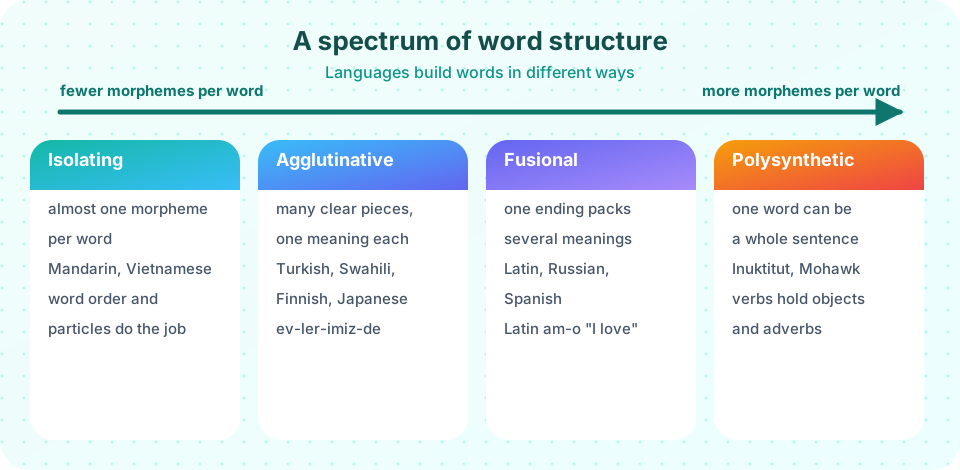
Isolating (analytic) languages use mostly one morpheme per word. Grammar is expressed by word order and separate function words and particles, not by endings. Mandarin and Vietnamese are classic examples. In Mandarin, wǒ mǎi shū ("I buy book(s)") has three words and three morphemes; to say it happened, you can add a time word or an aspect particle (wǒ zuótiān mǎi le shū, "I yesterday buy [perfective] book") rather than changing the verb. English is relatively analytic too, which is why it relies on word order: dog bites man versus man bites dog.
Agglutinative languages attach long chains of affixes to a root, each affix having one clear meaning, with clean boundaries between them. Turkish is the textbook case:
| Form | Pieces | Meaning |
|---|---|---|
| ev | house | a house |
| ev-ler | house-PLURAL | houses |
| ev-ler-imiz | house-PLURAL-our | our houses |
| ev-ler-imiz-de | house-PLURAL-our-in | in our houses |
Each step adds one piece of meaning, and you can read the pieces off in order. Swahili (ni-na-ku-penda, "I-present-you-love", "I love you"), Finnish (talo-ssa-ni, "house-in-my", "in my house"), Hungarian and Japanese are also strongly agglutinative; Japanese has verb chains such as tabe-sase-rare-ta ("eat-cause-passive-past", "was made to eat").
Fusional (inflecting) languages also use affixes, but a single affix often packs several meanings together, and the boundaries are less clear. Take Latin amo "I love": the ending -o tells you at the same time first person, singular, present tense, indicative mood and active voice. You cannot split it into five pieces. In Russian, the ending -a in kniga ("book") encodes nominative case, singular number and a feminine noun class at once. Spanish, Greek, Arabic, German and most Indo-European languages are fusional to some degree. English has only remnants: the -s of walks means third person, singular, present, all at once.
Polysynthetic languages build extremely long words, often with the verb carrying the information that other languages spread across the whole sentence: subject, object, location, manner, negation, tense. Inuktitut, Mohawk and Yup'ik are examples. A commonly cited Inuktitut word, tusaatsiarunnanngittualuujunga, is glossed as roughly "I can't hear very well". In many polysynthetic languages a noun can be incorporated into the verb, so that "she hunts deer" can become a single word like "she deer-hunts". Such words are not just long; they work as complete sentences.
Measuring the differences
Typologists do not just point to examples. In 1960 Joseph Greenberg proposed counting. Take a sample text, count the words and the morphemes, and compute:
- Index of synthesis = morphemes ÷ words. Mandarin is close to 1; English is somewhat above 1; Turkish and Swahili are much higher; polysynthetic languages are highest of all.
- Index of fusion (roughly) = how many meanings sit in one morpheme, or how hard it is to find the boundaries between them. Turkish is low, Latin and Russian are high.
These are tendencies. Every language mixes types. English is mostly analytic in its grammar, fusional in its few inflections (walks, went), agglutinative in derivation (un-friend-li-ness) and polysynthetic in nothing. Mandarin has some compounding and suffixes. Turkish has some fused forms. The labels describe the center of gravity of a language, not a pure case.
Why do types change?
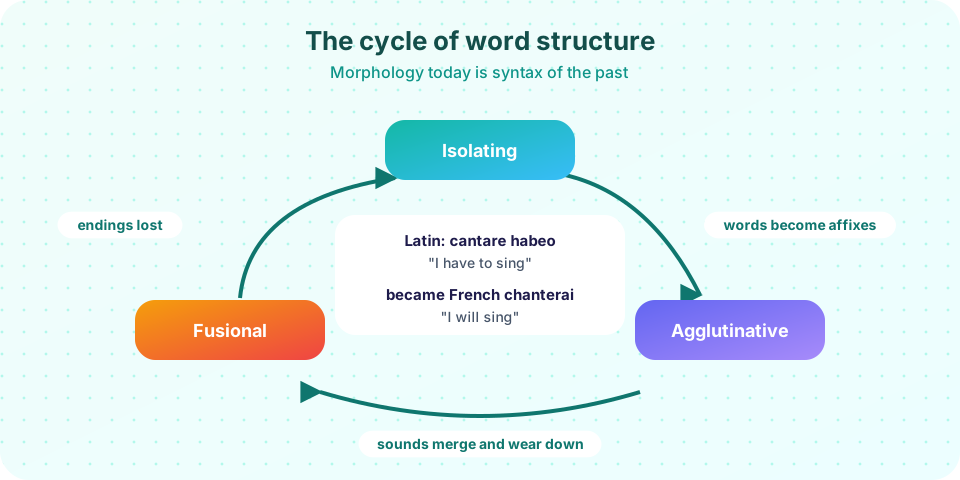
A famous slogan of the linguist Talmy Givón says: today's morphology is yesterday's syntax. Over centuries, words that frequently appear together fuse into one. The Romance future tense shows the process. In late Latin, people said cantare habeo ("I have to sing", literally "to-sing I-have"). The verb habeo gradually shrank to an ending attached to the infinitive and the construction came to mean just "I will sing". The result in modern French is chanterai; the ending -ai is the descendant of Latin habeo. In English the same thing is happening now: will has shrunk to 'll in she'll sing, and going to to gonna.
This process, grammaticalization, turns words into affixes (isolating toward agglutinative). Later, sounds wear down and merge, and boundaries blur (agglutinative toward fusional). Finally, endings can be lost altogether (as Old English lost most of its case endings), and speakers use word order and function words instead (fusional toward isolating), after which the cycle can begin again. The 19th-century linguist Georg von der Gabelentz described this as a spiral. It is a tendency and not a law, and not every language completes the cycle.
A note on "complexity"
None of the types is simpler or more primitive. A language with few morphemes per word, such as Mandarin, makes up for it with word order, particles and tones; a polysynthetic language has complex words but may use less rigid word order. Some researchers have proposed that large, widely spread languages tend to lose complicated morphology compared with small, close-knit communities, but this hypothesis is debated and the evidence is mixed. What is clear is that children acquire any of these systems at similar ages: there is no evidence that learning a polysynthetic language is slower than learning an isolating one.
Common misconceptions
"Languages with fewer endings are simpler." Complexity moves around: less morphology often means more reliance on word order and particles.
"Each language belongs to exactly one type." Types describe tendencies; most languages mix them.
"Polysynthetic words are just long compounds." They contain grammatical relations (subject, object) and work as full sentences.
Try it
The first program computes Greenberg's index of synthesis from glossed examples: words are separated by spaces and morphemes within a word by hyphens. Edit the samples or add your own. The examples are single sentences, so the numbers are only illustrations; real indices use long texts.
Press Run (or Ctrl + Enter) to see the console output here.
No output.
The second demonstration places languages on a map with two axes: synthesis (morphemes per word) horizontally and fusion (how much meaning is packed into each morpheme) vertically. The positions are rough, schematic placements to show the idea, not measurements.
Press Run (or Ctrl + Enter) to see the result here.
Program input · what you'd type while the program runs
Type the answers before you press Run, one per line. Each time the program reads a line (with input()), it gets the next line from this box.
Check your understanding
Quick check · 5 questions
of 5 answered You scored / 5 · perfect!
-
1. Which language is the classic example of agglutination?
Turkish strings affixes, each with one meaning: ev-ler-imiz-de. -
2. What does it mean that the Latin ending -o in amo is fusional?
Several meanings are fused into one morpheme. -
3. What does Greenberg's index of synthesis measure?
Index of synthesis = morphemes divided by words. -
4. What is grammaticalization?
Frequent word combinations fuse and words lose their independent meaning. -
5. Which statement about morphological types is best?
Languages mix types, and none of the types is more primitive.
Summary
- Isolating languages use mostly one morpheme per word; agglutinative languages chain affixes with one meaning each; fusional languages fuse several meanings into one affix; polysynthetic languages build whole sentences in a word.
- Greenberg's indices of synthesis and fusion turn the comparison into numbers, but every language mixes types.
- Languages drift between types: grammaticalization turns words into affixes, sound change blurs them, and lost endings can start the cycle again.
- None of the types is simpler or more primitive.
Next: Chapter 4 Review
Track your progress
Create a free account to tick off lessons and pick up where you left off on any device.
of Linguistics lessons completed