


















Lesson 4 of 49 · Getting Started
How Linguists Think: Data, Competence and Signs
Meet the working tools of linguistics: corpora, speaker judgments, experiments, competence versus performance, and Saussure's idea of the linguistic sign.
Linguistics is an empirical science. That means its claims are supposed to be tested against evidence, not decided by authority or by what sounds nice. The evidence is language itself: what people say, write, sign and understand, and what they feel is natural or odd.
In this lesson you will meet the basic toolkit: kinds of linguistic data, the habit of marking odd sentences with an asterisk, the difference between what speakers know and what they produce, and the idea of the linguistic sign.
What you will learn
- The main sources of linguistic data and their strengths and weaknesses.
- How to read acceptability judgments (*, ?, #).
- The difference between competence and performance (Chomsky) and between langue and parole (Saussure).
- What a signifier and a signified are.
Key terms
Corpus: a large, organized collection of authentic text or speech that can be searched and counted.
Acceptability judgment: a speaker's reaction to a sentence ("sounds fine" or "sounds wrong").
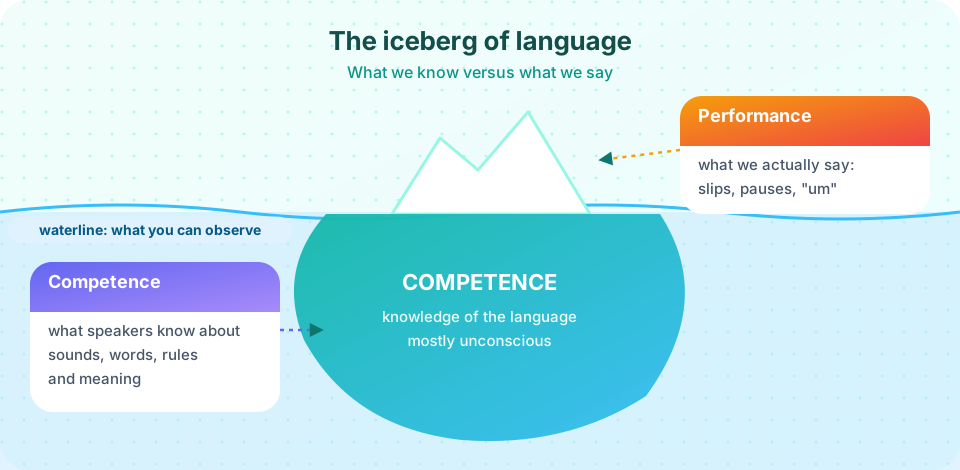
Competence: the unconscious knowledge a speaker has of their language.
Performance: the actual use of language in real situations, including slips, pauses and restarts.
Synchronic / diachronic: describing a language at one point in time versus describing how it changes over time.
Where the evidence comes from
Corpora. A corpus lets you count real usage. One famous early example is the Brown Corpus, compiled at Brown University in the early 1960s by W. Nelson Francis and Henry Kučera: about a million words of American English from many kinds of text. Modern corpora hold billions of words. Their strength is that they show what people really write or say, including frequencies. Their weakness: a corpus cannot show that a sentence is impossible, only that it did not occur in the sample.
Fieldwork and elicitation. When describing an under-documented language, a linguist works with native speakers, recording stories and conversations and asking questions such as "How would you say the woman saw the child?". This is how many of the world's languages have been described.
Acceptability judgments. Speakers can tell whether a sentence sounds like their language even if they cannot say why. Linguists mark the results:
| Mark | Meaning | Example |
|---|---|---|
| (none) | Fine | The children are playing. |
* |
Unacceptable | *The children is playing. |
? |
Doubtful | ?Whom did you see? (in casual speech) |
# |
Fine as grammar but odd in context or meaning | #The silence was loudly green. |
A classic pair comes from Noam Chomsky's Syntactic Structures (1957): Colorless green ideas sleep furiously (grammatical but meaningless) and *Furiously sleep ideas green colorless (a scramble). The pair shows that judging grammar is not the same as judging meaning.
Judgments from a single linguist's intuition can be biased, so researchers increasingly collect ratings from many speakers. Studies that compared judgments reported in the literature with large-scale rating experiments have found that most clear contrasts hold up, while borderline cases are less reliable. That is a good example of a scientific field checking its own methods.
Experiments and observation. Psycholinguists measure reaction times and eye movements. Sociolinguists observe speech in the wild. In 1962 William Labov asked staff in New York department stores a question whose natural answer was fourth floor, and noted whether they pronounced the r sounds. Staff in the more prestigious stores used the r more often, evidence that pronunciation patterns with social class.
Competence and performance
If you recorded an hour of ordinary conversation, you would find hesitations, restarts, interruptions and sentences that trail off. If the recording were your only evidence, you might conclude that speakers know very little grammar.
Chomsky's Aspects of the Theory of Syntax (1965) drew a distinction to deal with this:
- Competence is what a speaker knows: the system of sounds, words, structures and meanings that allows them to produce and understand sentences.
- Performance is what a speaker does with that knowledge in real time, subject to memory, attention, tiredness, noise and nerves.
A slip such as "I'd like a cuff of coffee" shows a performance error, not missing competence. The distinction is also useful for sentences that are grammatical but hard: The cat the dog the rat bit chased escaped follows English rules, yet most people struggle to understand it because of memory limits. Some linguists criticize the competence/performance split as too sharp (usage-based approaches argue that knowledge is built up from experience of use), and you will see both views later in the course. As a working distinction it is a helpful first step.
Langue and parole
Earlier, the Swiss linguist Ferdinand de Saussure (in lectures published after his death as the Course in General Linguistics, 1916) had made a similar contrast between langue (the shared system of a language as a social institution) and parole (individual acts of speaking). Chomsky's competence is individual and mental; Saussure's langue is social. The two ideas overlap but are not the same.
The linguistic sign
Saussure also gave us the idea that a linguistic sign has two sides, like a coin:
- the signifier: the form (a sound pattern, a handshape, written letters);
- the signified: the concept it evokes.
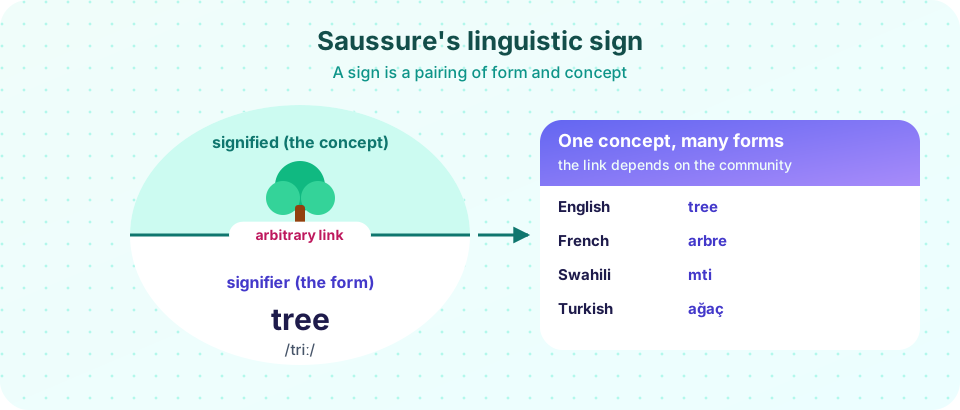
The English form tree and the French form arbre attach to the same kind of concept. Because the link is arbitrary, different communities can choose different forms. Saussure also stressed that signs get their value from their relations to other signs in the system: tree contrasts with bush and forest.
Linguistics at several levels
Language can be studied at different levels, and later chapters walk up them:
- Phonetics and phonology: sounds and sound patterns.
- Morphology: the structure of words.
- Syntax: the structure of sentences.
- Semantics and pragmatics: meaning, and meaning in context.
Each level has its own units, rules and tests, but they all interact. And we can study each synchronically (as the language is now) or diachronically (as it changes through time).
Common misconceptions
"If speakers say it, it must be part of their grammar." Slips and false starts are performance errors; native speakers usually recognize and correct them.
"A sentence that sounds strange must be ungrammatical." It might be grammatical but meaningless (Colorless green ideas...), hard to process (center embedding) or strange in context.
"Intuitions are unscientific." Used carefully, and checked with many speakers, judgments are a reliable and cheap source of data; they are one tool among several.
Try it
This mini-survey collects acceptability ratings. Rate each sentence from 1 (sounds wrong) to 5 (sounds natural), press the button, and look at how a grammatical but strange sentence compares with a scramble. It is a classroom demonstration with one rater; real studies use many speakers and many sentences.
The second demonstration treats a short, invented transcript as performance data. It counts fillers, repeated words and restarts, then shows that the "cleaned" sentence is perfectly grammatical, which is competence shining through the performance.
Press Run (or Ctrl + Enter) to see the result here.
Program input · what you'd type while the program runs
Type the answers before you press Run, one per line. Each time the program reads a line (with input()), it gets the next line from this box.
Check your understanding
Quick check · 5 questions
of 5 answered You scored / 5 · perfect!
-
1. What is a corpus?
A corpus is authentic language data stored for analysis; it shows what occurs, not what is impossible. -
2. What does an asterisk before a sentence normally mean in linguistics?
- marks a sentence that speakers judge ungrammatical or unacceptable.
-
3. A speaker says 'I'd like a cuff of coffee' and immediately corrects it to 'a cup'. This is best described as
Speakers know the right form; the slip happened while producing it. -
4. Colorless green ideas sleep furiously illustrates that
The sentence has grammatical structure but no sensible meaning, so grammaticality is not the same as sense. -
5. In Saussure's terms, the written or spoken form 'tree' is the
The signifier is the form; the signified is the concept it evokes.
Summary
- Linguistics tests ideas against data: corpora, fieldwork, experiments, observation and speaker judgments.
- Marks such as * and ? record acceptability; grammatical, meaningful and processable are different things.
- Competence is what speakers know; performance is what they do under real conditions (Chomsky). Saussure's langue and parole are a related but social contrast.
- A linguistic sign pairs a signifier (form) with a signified (concept), arbitrarily.
- Language is studied at levels (sounds, words, sentences, meaning), synchronically and diachronically.
Next: Chapter 1 Review
Track your progress
Create a free account to tick off lessons and pick up where you left off on any device.
of Linguistics lessons completed