


















Lesson 14 of 49 · Phonetics and Phonology
Vowels and Acoustics
Learn how vowels are described by tongue height, backness and rounding, how formants make each vowel sound different, and how to read a spectrogram.
Consonants are made by blocking or squeezing the air. Vowels are different: the air flows freely, and the shape of the mouth alone decides which vowel you hear. Try saying ee, ah and oo in a row without stopping and notice what your tongue, jaw and lips do. That movement is the whole secret of vowels.
In this lesson you will describe vowels with three features, learn the vowel chart, and then see what a vowel looks like as a sound wave. The acoustic view explains why different mouth shapes produce different vowels: each shape amplifies certain frequencies called formants.
What you will learn
- How to describe a vowel by height, backness and rounding.
- How to read the vowel chart and what a diphthong is.
- What formants are and how they relate to tongue position.
- How to read a spectrogram.
Key terms
Vowel height: how high the tongue is (high or close, mid, low or open).
Backness: how far forward or back the tongue is (front, central, back).
Rounding: whether the lips are rounded, as in boot.
Diphthong: a vowel that glides from one quality to another in one syllable, as in price.
Formant: a band of frequencies amplified by the vocal tract, labeled F1, F2, F3 from low to high.
Describing vowels
Vowels are described by three features.
- Height: Say bee and then bah. Your jaw opens and your tongue lowers. In bee the tongue is high (close); in bah it is low (open).
- Backness: Say bee then boo. For bee the tongue bunches toward the front; for boo it pulls back. Front, central and back.
- Rounding: Say bee then boo in front of a mirror. For boo the lips round and protrude.
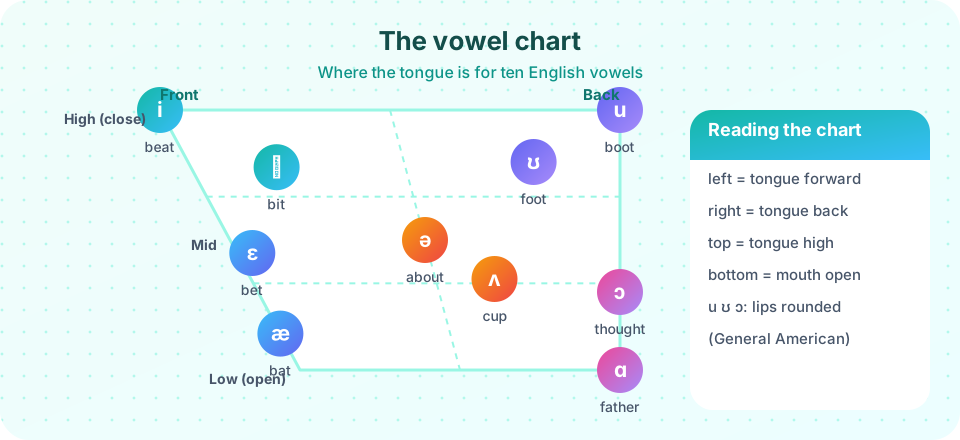
So [i] (beat) is a high front unrounded vowel, [u] (boot) is a high back rounded vowel, and [ɑ] (father) is a low back unrounded vowel.
The vowel chart (shown above) plots these two dimensions: height vertically, backness horizontally. The trapezoid shape reflects the fact that the mouth has less room when the tongue is high and back. The chart is a conventional map, not an x-ray: it was first systematized by the British phonetician Daniel Jones, who proposed the cardinal vowels in the 1910s as fixed reference points that phoneticians learn to pronounce.
The ten vowels in the chart are common to many American English accents. Words for each are in the diagram: beat [i], bit [ɪ], bet [ɛ], bat [æ], about [ə], cup [ʌ], foot [ʊ], boot [u], thought [ɔ] and father [ɑ]. English vowels vary widely between accents. In many American accents cot and caught sound the same (the "cot-caught merger"), while in others they differ; British accents have a different set again. That is why we say "General American" or "Received Pronunciation" when we want to be precise.
Diphthongs
A diphthong starts at one vowel position and glides toward another within a single syllable. English diphthongs include [aɪ] (price), [aʊ] (mouth), [ɔɪ] (choice), [eɪ] (face) and [oʊ] (goat). You can feel the movement: in price the tongue moves from low toward high front. A monophthong keeps the same quality throughout.
The source-filter model
How do different mouth shapes give different vowels? The source-filter model, developed in the 20th century by Gunnar Fant and others, answers it in two parts.
- The source is the buzz from the vocal folds: a periodic wave that contains the fundamental frequency (F0, heard as pitch) and a series of harmonics above it, getting weaker as they go up.
- The filter is the vocal tract above the larynx. Like an organ pipe, a tube of a particular shape resonates strongly at certain frequencies and weakly at others. These strongly amplified bands are the formants.
When you change the shape of your mouth, you change the tube, and so the formants. Pitch comes from the source, vowel identity from the filter. That is why you can sing the same note on different vowels, or say the same vowel at different pitches.
What the formants tell you
Two formants matter most.
- F1 is related to tongue height (and jaw opening): the higher the tongue, the lower the F1. High vowels such as [i] and [u] have low F1; the low vowel [ɑ] has a high F1.
- F2 is related to backness (and rounding): the further forward the tongue, the higher the F2. [i] has a very high F2; [u] has a low F2.
Average values published by Gordon Peterson and Harold Barney in 1952 for adult male American English speakers give a feeling for it: [i] has F1 about 270 Hz and F2 about 2,290 Hz; [ɑ] has F1 about 730 Hz and F2 about 1,090 Hz; [u] has F1 about 300 Hz and F2 about 870 Hz. Women and children have shorter vocal tracts and so higher formants, which is one reason that recognizing vowels across speakers is a hard problem for both brains and speech-recognition software.
Plotted with F2 reversed on the horizontal axis and F1 reversed on the vertical axis, the vowels line up in a pattern that looks very like the articulatory vowel chart. This is a beautiful finding: the chart that phoneticians drew from how vowels feel matches the chart you get from how they sound.
Reading a spectrogram
A spectrogram displays sound as an image: time runs left to right, frequency runs bottom to top, and the darkness of a point shows the energy at that moment and frequency. Vowels show up as dark horizontal bands: the formants. Fricatives such as /s/ appear as a fuzzy cloud of energy at high frequencies; plosives appear as a gap of silence followed by a vertical spike; voiced sounds show fine vertical striations from each vibration of the vocal folds.
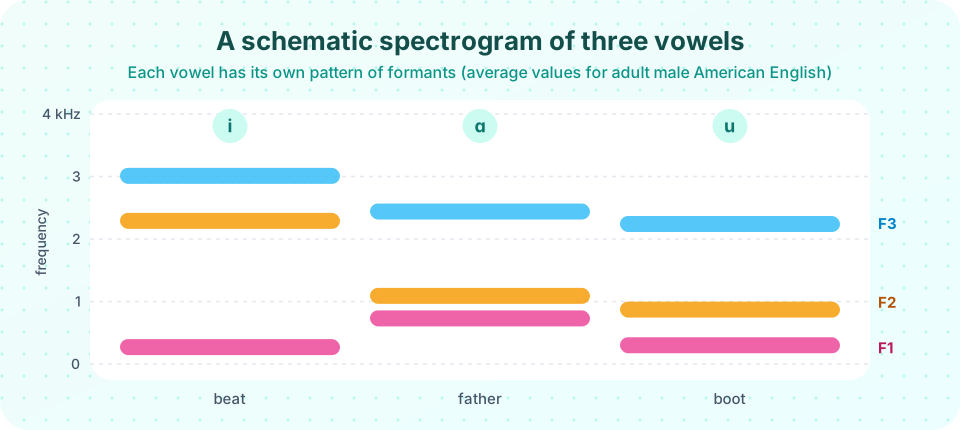
Phoneticians read spectrograms the way radiologists read X-rays: to measure durations, find formants, identify voicing, and compare accents or languages. Free programs such as Praat can display and measure them for any recording.
Beyond English
Languages differ in the vowels they use. Spanish and Japanese have just five (/a e i o u/), whereas some languages have many more. French has nasal vowels (air flows through the nose, as in vin), German has front rounded vowels such as [y] (über), and many languages distinguish long and short vowels. Some languages use tone, in which pitch changes the meaning of a word, as in Mandarin and Yoruba; you will meet tone again later in the course.
Common misconceptions
"English has five vowels." It has five vowel letters; most accents have roughly 12 or more vowel sounds, including diphthongs.
"The vowel chart shows exactly where the tongue is." It is an approximate, conventional map of the tongue's highest point and is also reflected in sound.
"Vowels differ by pitch." Pitch comes from the vocal folds (F0). Vowels differ by formants, which come from the shape of the tract.
Try it
The first demonstration is a vowel explorer. The picture plots average formant values (F2 reversed horizontally, F1 reversed vertically, in the layout you see in phonetics papers). Move the mouse over the plot and the nearest vowel is named with its description.
The second demonstration builds the source-filter model in code. A buzz at 120 Hz has harmonics at every multiple of 120. A filter with three resonances (formants) boosts some of them. Using the formant values for [i] and [ɑ], the plot shows how the same source gives two different spectra. It is a simplified model for teaching, not a speech synthesizer.
Press Run (or Ctrl + Enter) to see the result here.
Program input · what you'd type while the program runs
Type the answers before you press Run, one per line. Each time the program reads a line (with input()), it gets the next line from this box.
Check your understanding
Quick check · 5 questions
of 5 answered You scored / 5 · perfect!
-
1. How is the vowel [u] in 'boot' described?
[u] has the tongue high and pulled back, with the lips rounded. -
2. In the source-filter model, which part of the system determines which vowel you hear?
The source supplies the buzz and the pitch; the tract shape creates the formants that identify the vowel. -
3. A high vowel such as [i] has
F1 goes down as the tongue goes up. -
4. What is a diphthong?
Examples: [aɪ] in price and [oʊ] in goat. -
5. On a spectrogram, vowel formants appear as
Formants are bands of strong energy; their frequencies identify the vowel.
Summary
- Vowels are described by tongue height, backness and lip rounding; the vowel chart maps height and backness.
- Diphthongs glide between two qualities within one syllable; accents differ greatly in their vowels.
- The source-filter model: the vocal folds give the buzz (pitch), and the tract shape gives the formants (vowel identity).
- F1 falls as the tongue rises; F2 rises as the tongue moves forward; formant charts mirror the articulatory chart.
- A spectrogram shows time, frequency and energy; vowels appear as formant bands.
Next: Phonemes and Allophones
Track your progress
Create a free account to tick off lessons and pick up where you left off on any device.
of Linguistics lessons completed