


















Lesson 13 of 49 · Phonetics and Phonology
Articulatory Phonetics: How Consonants Are Made
Learn how speech sounds are produced: the vocal tract, voicing, places and manners of articulation, and how to describe any English consonant with IPA.
Every consonant in English can be described by answering three questions: Do the vocal folds vibrate? Where in the mouth is the airflow constricted? How is it constricted? These are the voicing, place and manner of articulation, and together they give each consonant a unique label such as "voiceless alveolar fricative".
This lesson teaches that system. You will need your own mouth: nearly every idea here can be felt by saying the sounds slowly and paying attention to your tongue, lips and throat.
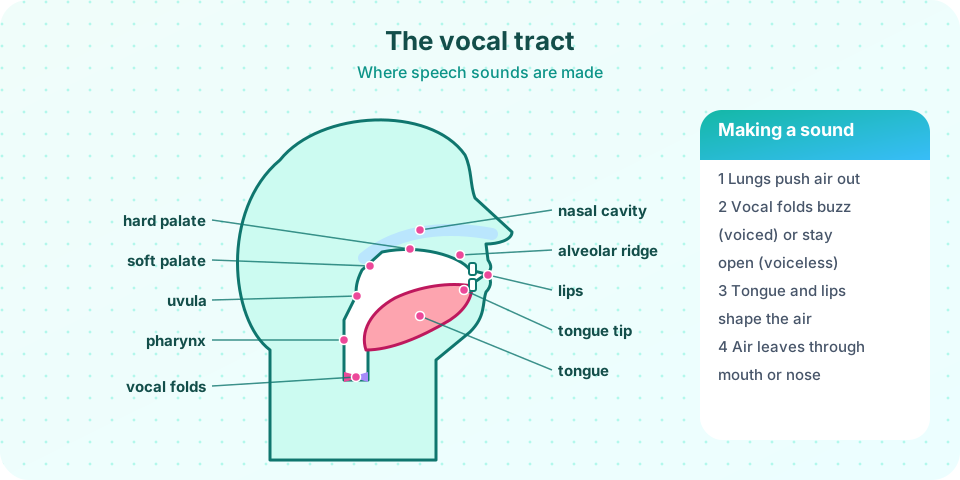
What you will learn
- How air, the larynx and the mouth work together to make speech.
- How to describe a consonant by voicing, place and manner.
- How to read the English consonant chart in IPA.
- A few sounds beyond English.
Key terms
Articulator: a movable part of the vocal tract (tongue, lips, jaw, soft palate) that shapes sound.
Place of articulation: where the constriction happens.
Manner of articulation: how the airflow is constricted (blocked, squeezed, released).
Voicing: vibration of the vocal folds during a sound.
Aspiration: a puff of breath after a plosive is released.
From lungs to lips
Nearly all speech sounds in the world's languages use air pushed out from the lungs. That flow passes through the larynx, where the vocal folds (two flexible bands of tissue, often called vocal cords) sit. When the folds are held close together, airflow makes them vibrate rapidly, about 100 to 250 times per second in most adult speech, producing a buzz. That is voicing.
You can feel it. Put your fingertips on your throat and say a long sssss, then a long zzzzz. The two sounds are identical in the mouth; the only difference is that /z/ is voiced and you can feel the vibration. Vowels are normally voiced, and consonants come in voiced and voiceless pairs: /p b/, /t d/, /k g/, /f v/, /s z/.
Above the larynx, the air passes through the pharynx into the mouth (the oral cavity) and sometimes through the nose (the nasal cavity). The velum, or soft palate, acts as a valve: raised, it closes off the nose (oral sounds); lowered, it lets air pass through the nose (nasal sounds). Your tongue and lips do the rest.
Place of articulation
The chart lists the places used in English, from front to back:
| Place | What touches what | English example |
|---|---|---|
| Bilabial | both lips | /p b m/, also /w/ |
| Labiodental | lower lip and upper teeth | /f v/ |
| Dental | tongue tip and upper teeth | /θ ð/ (thin, this) |
| Alveolar | tongue tip or blade and the ridge behind the teeth | /t d s z n l ɹ/ |
| Postalveolar | tongue just behind the alveolar ridge | /ʃ ʒ tʃ dʒ/ (ship, measure, chip, judge) |
| Palatal | tongue body and hard palate | /j/ (yes) |
| Velar | back of the tongue and soft palate | /k g ŋ/ |
| Glottal | the vocal folds themselves | /h/ |
A good drill: say p, t, k over and over and feel the contact point move from your lips, to the ridge behind your teeth, to the back of your mouth.
Manner of articulation
- Plosive (stop): the air is completely blocked and then released: /p b t d k g/.
- Nasal: the mouth is blocked but the velum is lowered, so air flows through the nose: /m n ŋ/. Hold your nose while saying mmm and the sound stops.
- Fricative: the air is squeezed through a narrow gap, producing friction: /f v θ ð s z ʃ ʒ h/.
- Affricate: a plosive followed immediately by a fricative: /tʃ/ (as in church) and /dʒ/ (as in judge).
- Approximant: the articulators come close but not enough to cause friction: /ɹ j w/. The lateral approximant /l/ lets air pass around the sides of the tongue.
Other languages use more manners. Spanish and Italian have a trill (rolled rr), in which the tongue tip vibrates. American English has a flap [ɾ], the quick tap in butter. Many languages of southern Africa, such as Xhosa and Zulu, have clicks, made by trapping air between two closures and releasing it inward; English speakers make a click when they say a "tsk-tsk" of disapproval, though it is not a speech sound in English.
Putting it together: describing a sound
The chart pairs symbol with description. Each cell combines place (columns), manner (rows) and voicing (left voiceless, right voiced).
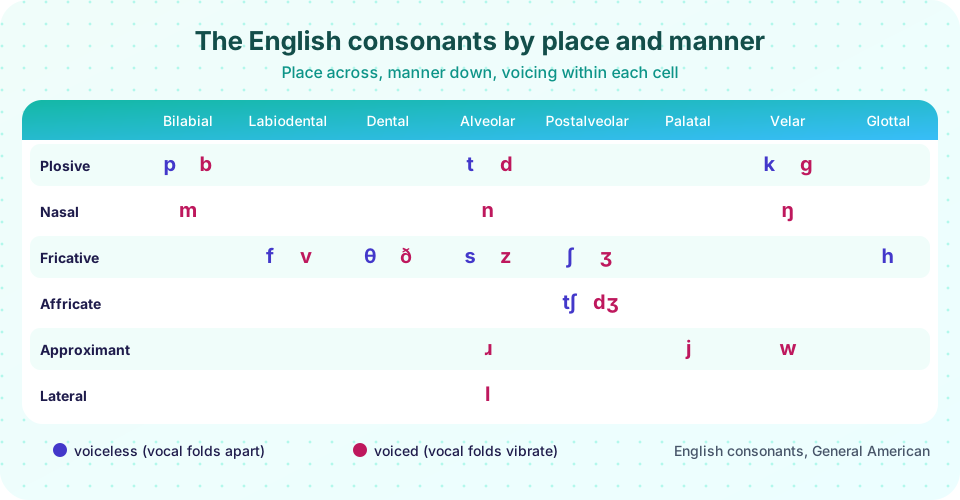
Some examples:
- [p]: voiceless bilabial plosive.
- [z]: voiced alveolar fricative.
- [ŋ]: voiced velar nasal (the end of sing, which has no /g/ sound in most accents).
- [tʃ]: voiceless postalveolar affricate.
- [l]: voiced alveolar lateral approximant.
The sound [w] is made with the lips rounded and the back of the tongue raised, so it is called a labial-velar approximant; the chart puts it in the velar column and adds a note.
Aspiration and voice onset time
A fine detail with big consequences: English voiceless plosives at the start of a stressed syllable are aspirated. The p in pin is followed by a puff of air, written [pʰ], while the p in spin is not. The timing difference between the release of the plosive and the start of voicing is called voice onset time (VOT). Different languages divide the VOT scale differently, which is why a French speaker's p can sound "unaspirated" to English ears and an English speaker's p can sound "puffy" to a French listener. In the next chapters you will see how aspiration matters in the English sound system.
Test it: hold a small piece of tissue in front of your mouth and say pin and then spin. The tissue should flutter more with pin.
How many sounds are there?
The IPA chart contains well over a hundred consonant and vowel symbols plus diacritics, but each language uses only a subset. Hawaiian has just eight consonants (/p k ʔ h m n l w/) and five vowels, while some languages of southern Africa have more than a hundred consonants when clicks and other contrasts are counted. English has about 24 consonants. Human languages choose their inventory from the same biological toolkit, which is why any child can learn any language.
Common misconceptions
"Voiceless means silent." A voiceless sound like /s/ is easily heard; it just lacks vocal fold vibration.
"The letter tells you the sound." The letter c stands for /k/ in cat and /s/ in city; th stands for two different sounds in thin and this. Always think in sounds.
"Nasals are made in the nose." They are made at the same places as plosives; the nose just lets the air out.
Try it
The first tool looks up the features of English consonants and goes the other way, from a description to a symbol. Add more symbols to the lists and run it.
Press Run (or Ctrl + Enter) to see the console output here.
No output.
The second demonstration counts the English consonants in each place and manner cell and draws the result as a heat map. Darker cells hold more sounds; empty cells show gaps in the English system (for example no palatal or velar fricative).
Press Run (or Ctrl + Enter) to see the result here.
Program input · what you'd type while the program runs
Type the answers before you press Run, one per line. Each time the program reads a line (with input()), it gets the next line from this box.
Check your understanding
Quick check · 5 questions
of 5 answered You scored / 5 · perfect!
-
1. How would you describe the sound [s]?
[s] has no vocal fold vibration, is made at the alveolar ridge, and uses friction. -
2. What is the only difference between [s] and [z]?
Both are alveolar fricatives; [z] has vocal fold vibration and [s] does not. -
3. In which sound is the velum lowered so air passes through the nose?
[m] is a nasal: the lips are closed but air flows through the nose. -
4. A plosive followed by a fricative as in 'church' is called
The affricate [tʃ] combines a stop closure with a fricative release. -
5. What does it mean that the p in 'pin' is aspirated?
Aspiration is a delay of voicing after the release, heard as a puff of breath.
Summary
- Speech uses outgoing lung air; the vocal folds in the larynx create voicing; the velum directs air through the mouth or the nose.
- A consonant is described by voicing, place and manner: [z] is a voiced alveolar fricative.
- Manners include plosive, nasal, fricative, affricate, approximant and lateral; other languages add trills, flaps and clicks.
- English voiceless plosives are aspirated at the start of stressed syllables.
- Languages use different subsets of the possible sounds: from eight consonants in Hawaiian to over a hundred in some southern African languages.
Next: Vowels and Acoustics
Track your progress
Create a free account to tick off lessons and pick up where you left off on any device.
of Linguistics lessons completed