


















Lesson 27 of 49 · Syntax
Movement and dependencies
Understand wh-movement, passives, gaps and long-distance dependencies, plus the island constraints that block some questions, and how rival theories explain them.
What did you buy? The verb buy needs something to be bought, but after it there is nothing: the thing you bought appears at the front, as what. Compare You bought a bike. In the question, the object is "missing" from its normal place, and yet every English speaker knows exactly what the gap stands for. Phenomena like this made syntacticians propose that phrases can move, or at least that some words are linked to distant gaps. This lesson explains the idea and the surprising limits on it.
What you will learn
- What wh-movement, gaps and filler-gap dependencies are
- How the passive and subject-auxiliary inversion are described
- What islands are and why some questions are impossible
- How non-movement theories describe the same data
Key terms
Movement: in generative theory, a phrase appears in a position different from where it is interpreted.
Gap (trace): the empty position a moved phrase leaves behind, often written __ or t.
Filler-gap dependency: a link between a displaced phrase (the filler) and its gap.
Island: a structure from which nothing can be extracted.
Wh-word: who, what, which, where, when, why, how.
Wh-questions
In English a question about an object puts the wh-word first and also needs an auxiliary verb before the subject:
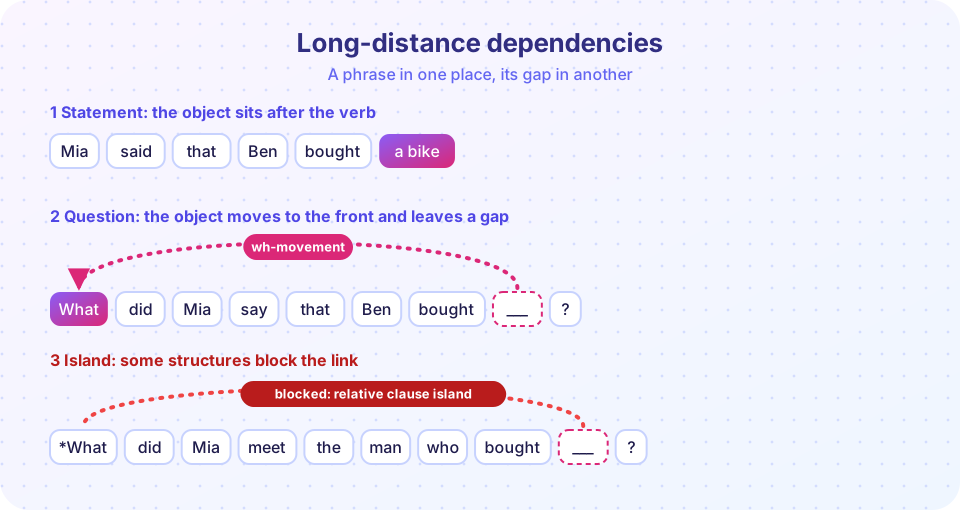
- Statement: Mia said that Ben bought a bike.
- Question:
What did Mia say that Ben bought __ ?
Three things changed. The object a bike was replaced by what, what moved to the front, and do-support added did before the subject (with say returning to its base form). The gap sits where the object would be, after bought, six words from its filler. Nothing in the grammar limits the distance: What did you think that Mia said that Ben bought __ ? is fine, if tiring. This is a long-distance dependency, and it is what makes structure matter: the gap is found by position in the tree, not by counting words.
Evidence for the gap is indirect but strong. Where the gap is, the verb's requirements are still met (bought has its object), and the contraction facts agree: Who do you want to see __? can reduce to wanna, but Who do you want __ to win? cannot (*Who do you wanna win?), because the gap sits between want and to. Linguists since the 1970s have used such facts as signs of an unpronounced element.
The passive
A second famous alternation is the passive:
- Active: The cat chased the mouse.
- Passive: The mouse was chased by the cat.
The object of the active becomes the subject of the passive; the original subject appears in a by-phrase or disappears (The mouse was chased.). Early transformational grammar derived one from the other. Modern theories describe it as a movement of the object to the subject position, or, in frameworks such as LFG and HPSG, as a lexical rule that changes the verb's argument pattern. The data are shared; the machinery differs.
Islands
If any phrase could be linked to any gap, we could ask:
What did Mia meet the man who bought __ ?✗What did Mia say that Ben bought __ ?✓
The first is bad even though it is as easy to understand as the second. John Robert Ross showed in his 1967 dissertation that some structures are islands: you cannot link a filler to a gap inside them. The best-known are:
| Island | Example of a bad question |
|---|---|
| Complex noun phrase | What did you hear the rumor that Ben bought __? |
| Relative clause | What did Mia meet the man who bought __? |
| Wh-island | What did Mia wonder who bought __? |
| Coordinate structure | What did Ben buy a bike and __? |
| Adjunct clause | What did Ben cry after he broke __? |
Chomsky unified several of these under subjacency (1973), a limit on how far a phrase can move in one step. The idea is that long-distance movement goes through intermediate steps and some structures have no escape hatch.
Are islands grammar or processing?
This is a live debate. Some researchers (for example Phillip Hofmeister and Ivan Sag, 2010) argue that many island effects come from difficulty of processing a hard dependency, not from a grammatical ban. Others, such as Jon Sprouse and colleagues, ran acceptability experiments that found effects consistent with grammatical constraints, since the badness persists even when processing demands are equalised. Cross-language data add more nuance: some languages allow extraction from structures English forbids.
Rival accounts of the same data
- Movement (generative grammar): the phrase really moves, leaving a trace.
- Slash features (GPSG and HPSG): the tree has no movement, but a feature records "a phrase is missing here" and is passed up the tree until the filler is found.
- Construction grammar: question patterns are stored constructions, with a slot for the filler and a gap.
- Wh-in-situ languages: in Mandarin, wh-words often stay where they are (Ni mai-le shenme?, literally "You bought what?"). Whether they also move abstractly is a long-running debate.
Common misconceptions
"The brain really moves words around." Movement is a description in a theory. Whether sentence processing involves anything like it is a separate empirical question.
"Islands are impossible to understand." The island sentences are usually easy to understand; they are simply judged unacceptable. That contrast is exactly what the constraints explain.
"Questions like What did you say? are the only dependencies." Relatives (the book that I read __), topicalisation (That book I read __) and passives show similar links.
Try it
This toy generator builds wh-questions from a base verb and a complement, marks the gap, and flags relative-clause islands. It demonstrates the pattern; it is not a full grammar of English.
Press Run (or Ctrl + Enter) to see the result here.
Program input · what you'd type while the program runs
Type the answers before you press Run, one per line. Each time the program reads a line (with input()), it gets the next line from this box.
The second demo measures the filler-gap distance in words for questions with more and more embedding, and plots it. The distance grows without limit, which is why dependencies must be defined on structure, not on position.
Press Run (or Ctrl + Enter) to see the result here.
Program input · what you'd type while the program runs
Type the answers before you press Run, one per line. Each time the program reads a line (with input()), it gets the next line from this box.
Check your understanding
Quick check · 5 questions
of 5 answered You scored / 5 · perfect!
-
1. In What did Mia buy __ ?, what does the gap stand for?
The gap marks the object position that what is linked to. -
2. Who first described island constraints in his 1967 dissertation?
Ross identified structures such as complex noun phrases and coordinate structures from which extraction fails. -
3. Which question is blocked by a relative-clause island?
The gap is inside the relative clause who bought __, an island. -
4. How do HPSG and GPSG describe long-distance dependencies?
A slash feature records the missing phrase until it is matched with its filler. -
5. What is a fair summary of the debate on islands?
Both grammatical and processing accounts have experimental support, and the question is still open.
Summary
- Wh-questions link a front-placed word to a gap, possibly many words away.
- Passives and inversion are further alternations that theories describe by movement or by lexical rules.
- Islands show that not every link is allowed; whether they are grammar or processing is debated.
- Different frameworks account for the same facts in different ways.
Next: Chapter review: Syntax
Track your progress
Create a free account to tick off lessons and pick up where you left off on any device.
of Linguistics lessons completed