


















Lesson 17 of 49 · Phonetics and Phonology
Chapter 3 Review: Phonetics and Phonology
Review Chapter 3 of the linguistics course: consonants, vowels and formants, phonemes and allophones, rules and syllables, with a one-picture recap and a ten-question quiz.
You now have a toolkit for talking about speech sounds precisely: you can describe a consonant by voicing, place and manner, a vowel by height, backness and rounding, and you know that a language's sounds form a system of contrasts and rules. This review brings the chapter together before you move on to words in Chapter 4.
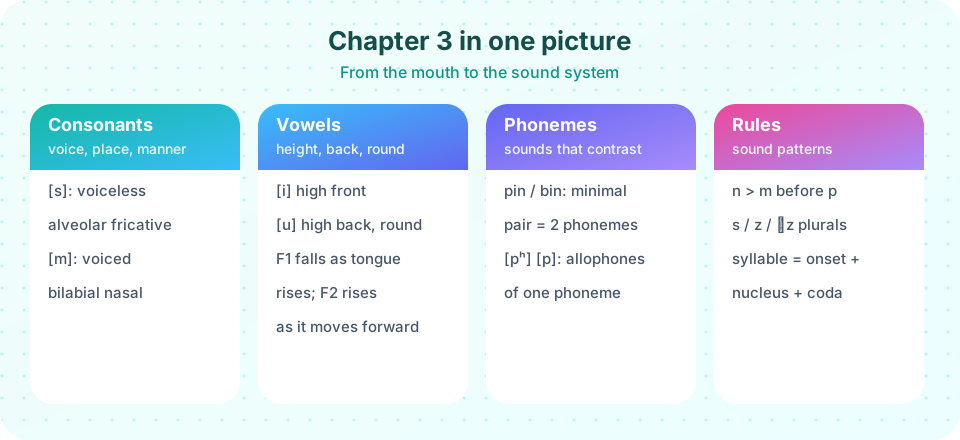
What you will learn
- To connect articulation, acoustics and the phoneme concept.
- To apply phonological rules to simple examples.
- To test yourself with a ten-question quiz.
Recap table
| Lesson | Big idea | Key terms |
|---|---|---|
| Articulatory phonetics | Consonants are described by voicing, place and manner | voicing, bilabial, alveolar, velar, plosive, fricative, nasal, aspiration |
| Vowels and acoustics | Vowels differ in height, backness and rounding; formants (F1, F2) reflect tongue position | vowel chart, diphthong, formant, source-filter model, spectrogram |
| Phonemes and allophones | A phoneme is a contrastive category; allophones are predictable variants | minimal pair, complementary distribution, free variation |
| Phonological rules and syllables | Sounds change in context; syllables have onset, nucleus and coda; sonority peaks at the nucleus | assimilation, deletion, insertion, phonotactics |
Key terms
Voicing, place, manner: the three features that describe a consonant.
Formant: a resonance band of the vocal tract; F1 and F2 identify vowels.
Minimal pair: two words that differ in one sound and so prove two phonemes.
Allophone: a predictable variant of a phoneme.
Sonority: how vowel-like a sound is; peaks in the syllable nucleus.
Common misconceptions
"The IPA symbol is the letter." The IPA has one symbol per sound; spelling is another system entirely.
"Phonemes are physical sounds." They are categories; actual sounds vary around them.
"Rules are only for careful speech." Assimilation, deletion and flapping happen in all speech, and speakers apply them without noticing.
Try it
First, a practice tool for IPA descriptions. For each description, write the symbol in the my_answers list and run. The key is in the code; try before checking.
Press Run (or Ctrl + Enter) to see the console output here.
No output.
Second, a tiny phonological "derivation". It starts from phoneme strings (between slashes) and applies three rules in order to get the phonetic forms (in square brackets): aspiration at the start of a word, flapping between vowels before an unstressed vowel, and nasal place assimilation. The rules are simplified (they ignore stress and many details), so the output is a teaching model, not a complete description of English.
Press Run (or Ctrl + Enter) to see the result here.
Program input · what you'd type while the program runs
Type the answers before you press Run, one per line. Each time the program reads a line (with input()), it gets the next line from this box.
Check your understanding
Quick check · 10 questions
of 10 answered You scored / 10 · perfect!
-
1. How is [g] described?
[g] is a plosive made at the velum with vocal fold vibration. -
2. What is the main difference between the vowels [i] and [ɑ] in terms of formants?
High front vowels have low F1 and high F2; low back vowels the reverse. -
3. What is the part of the vocal tract where the vocal folds are located?
The vocal folds sit in the larynx (the voice box). -
4. English 'pin' and 'bin' show that /p/ and /b/ are
A minimal pair shows contrast. -
5. Two sounds that never occur in the same environment are in
Complementary distribution suggests allophones of one phoneme. -
6. Which describes the nasal in 'impossible' compared with that in 'intolerant'?
The nasal copies the place of the following consonant. -
7. In the syllable /plænt/ which part is the nucleus?
The vowel is the nucleus; /pl/ is the onset and /nt/ the coda. -
8. What does the Sonority Sequencing Principle predict?
The sonority curve of a well-formed syllable is a hill with the vowel at the top. -
9. In North American English, why do 'writer' and 'rider' often sound similar?
Flapping makes /t/ and /d/ the same sound there; vowel length or quality may still differ slightly. -
10. Hindi 'pal' and 'phal' are a minimal pair. What does this show?
Because the aspirated and unaspirated plosives distinguish words, they are separate phonemes in Hindi.
Summary
- Consonants: voicing, place and manner. Vowels: height, backness, rounding, with formants F1 and F2 reflecting tongue position.
- The vocal tract works as a source (vocal folds) plus filter (the shape of the mouth).
- Phonemes are contrastive categories shown by minimal pairs; allophones are predictable variants shown by complementary distribution.
- Rules such as assimilation, deletion, insertion and flapping shape pronunciation, and syllables are built around sonority peaks.
Track your progress
Create a free account to tick off lessons and pick up where you left off on any device.
of Linguistics lessons completed