


















Lesson 21 of 49 · Morphology
Compounding and Word Formation
Learn how languages create new words: compounding and the right-hand head rule, blends, clipping, acronyms, conversion, back-formation and borrowing, with examples.
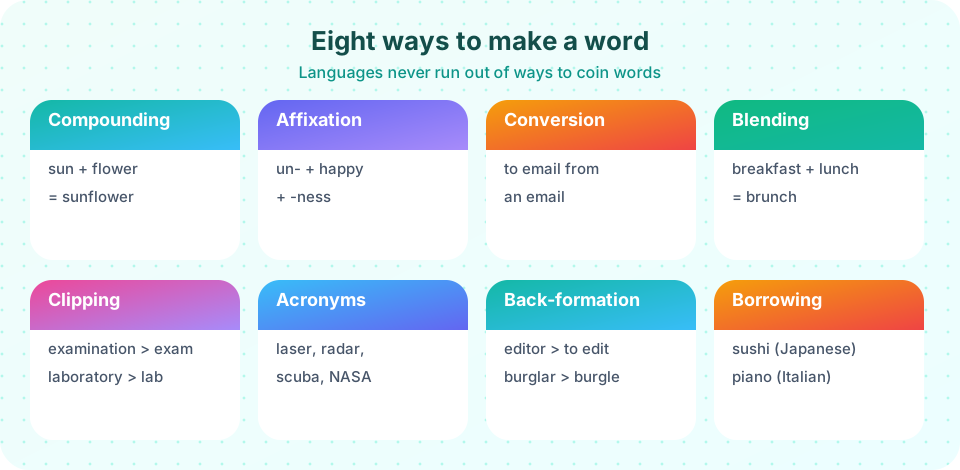
New words appear every day: selfie, podcast, doomscroll, hangry. Where do they come from? Almost never from nothing. Nearly every new word is built from material the language already has, by a small set of well-understood processes. Affixation (adding prefixes and suffixes) you met in the last lesson; this lesson covers the rest.
Learning these processes lets you see word creation as a system, not as random invention. It also lets you predict how a new word will behave: what category it has, what it means, and which other words it resembles.
What you will learn
- How compounds are built and what a head is.
- Blending, clipping, acronyms and initialisms.
- Conversion and back-formation.
- Borrowing, calques and other sources of new vocabulary.
Key terms
Compound: a word made from two or more words (or roots), such as sunflower.
Head: the part of a compound that determines its category and basic meaning.
Blend (portmanteau): a word made from parts of two words, such as brunch.
Conversion: changing a word's category without any affix (an email → to email).
Loanword: a word borrowed from another language.
Compounding
A compound puts two (or more) words together into one: sunflower, blackboard, toothbrush, babysit, over-the-counter. It is the most productive word-formation process in English and in many other languages. Spelling is unreliable as a test: the same type of word appears as one word (sunflower), as two words (ice cream) or with a hyphen (mother-in-law), and spelling conventions differ from dictionary to dictionary. A better clue is stress: in English compounds the main stress usually falls on the first part (BLACKboard), whereas a phrase stresses the last (black BOARD, any board that is black).
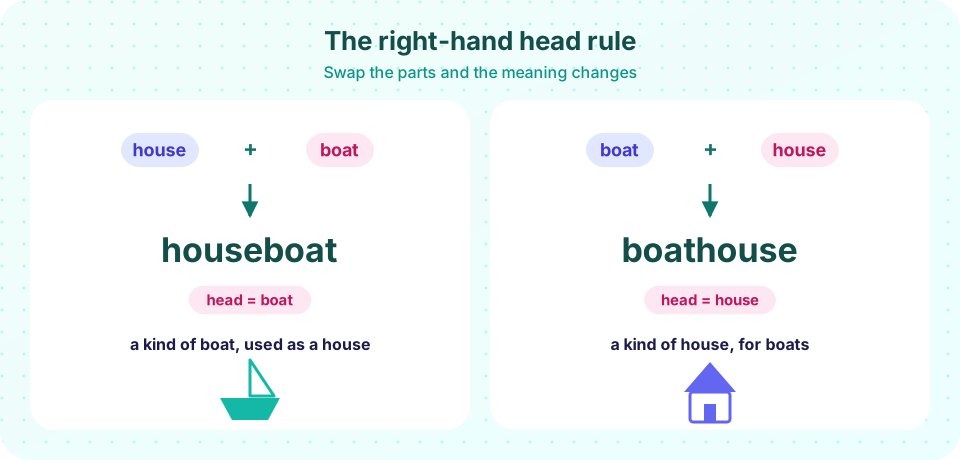
The right-hand head rule. In English compounds, the right-hand part is the head: it decides the category and the basic kind of thing the compound is. A houseboat is a kind of boat (used as a house); a boathouse is a kind of house (for boats). Swap the parts and the meaning changes.
Compounds fall into types:
- Endocentric compounds have a head: toothbrush is a kind of brush, blackboard a kind of board, snowman a kind of man.
- Exocentric compounds have no head inside them: a redhead is a person (not a kind of head), a pickpocket is a thief (not a kind of pocket).
- Copulative compounds name something that is both parts: singer-songwriter, bittersweet.
The relation between the two parts is also not fixed: a toothbrush is a brush for teeth, a windmill is a mill powered by wind, and a snowman is a man made of snow. Speakers work these relations out from context and knowledge of the world.
Languages differ. German writes long compounds as single words (Handschuh, "hand-shoe", means "glove"); Mandarin forms compounds with ease; in Romance languages the head of a noun-noun compound often comes first (French timbre-poste, "postage stamp", literally "stamp-post").
Blending, clipping and acronyms
Blends merge pieces of two words, usually the beginning of one and the end of the other: brunch (breakfast + lunch), smog (smoke + fog), motel (motor + hotel), Brexit (Britain + exit). The writer Lewis Carroll popularized the term portmanteau word in Through the Looking-Glass (1871), where Humpty Dumpty explains that slithy means "lithe and slimy".
Clipping cuts a word down: examination → exam, laboratory → lab, advertisement → ad, influenza → flu, telephone → phone. Clipped forms are often informal at first and then become the normal word (phone, bus from omnibus).
Acronyms are made from initial letters pronounced as a word: NASA, scuba (self-contained underwater breathing apparatus), laser (light amplification by stimulated emission of radiation). Initialisms are pronounced letter by letter: FBI, DVD, USB. Some acronyms lose their capital letters and are no longer recognized as such (laser, scuba).
Conversion and back-formation
Conversion (or zero derivation) changes a word's category with no change in form: the noun email became a verb (to email), the verb run a noun (a run), the adjective empty a verb (to empty). Sometimes stress marks the difference: the noun REcord and the verb reCORD. English does this easily because it has so little inflection that categories are not tightly marked.
Back-formation works the other way around: a speaker reanalyzes a word as if it were derived and removes the "affix" to make a supposed base: editor → to edit (the noun came first), burglar → to burgle, television → to televise, enthusiasm → to enthuse.
Borrowing and other sources
A great deal of vocabulary comes from other languages. English has borrowed sushi (Japanese), piano (Italian), kindergarten (German), pajamas (from Hindi/Urdu), algebra and alcohol (Arabic), chocolate (from Nahuatl through Spanish) and countless others, from French and Latin above all. A calque (loan translation) copies the structure of a foreign expression rather than the sound: English skyscraper has been calqued in German as Wolkenkratzer, "cloud-scratcher"; English flea market is a calque of French marché aux puces.
Other sources include:
- Eponyms: words from names (sandwich, after the Earl of Sandwich; boycott, after Captain Charles Boycott; diesel).
- Brand names that became ordinary words (Kleenex, to google).
- Onomatopoeia (zap, buzz).
- Reanalysis (folk etymology): hamburger comes from Hamburg, but speakers reanalyzed it as ham + burger, so we got cheeseburger and veggie burger.
A new word becomes part of the language not when it is invented, but when a community adopts it. Dictionaries such as the Oxford English Dictionary add words after they have shown steady use over time.
Common misconceptions
"Compounds are always spelled as one word." English spelling varies; stress and structure are better clues.
"Slang and new words are corruptions." They follow the same processes as all earlier word creation, and many everyday words started as slang.
"The first part of a compound is the head." In English the last part is; in some other languages the head comes first.
Try it
The first program turns the word-formation recipes into code. It builds blends from a split point in each word, clips words and creates acronyms from phrases (skipping small function words). Try your own words.
Press Run (or Ctrl + Enter) to see the console output here.
No output.
The second demonstration looks at compounds. A hand-picked list of compounds is classified by the categories of the parts, and the chart shows the patterns. The list is a small illustrative sample, so the counts say nothing about English as a whole.
Press Run (or Ctrl + Enter) to see the result here.
Program input · what you'd type while the program runs
Type the answers before you press Run, one per line. Each time the program reads a line (with input()), it gets the next line from this box.
Check your understanding
Quick check · 5 questions
of 5 answered You scored / 5 · perfect!
-
1. Which describes the head of the compound 'boathouse'?
English compounds have a right-hand head: a boathouse is a house. -
2. Which word is a blend?
Brunch combines the start of breakfast with the end of lunch. -
3. The verb 'to email' came from the noun 'email' by
The category changed with no change in form. -
4. 'Edit' was formed from 'editor' by
Speakers took 'editor' to be edit + -or and made a verb from it. -
5. What is a calque?
German Wolkenkratzer (cloud-scratcher) is a calque of English skyscraper.
Summary
- English builds new words by compounding (right-hand head), blending, clipping, acronyms and initialisms, conversion, back-formation and borrowing.
- Compounds can be endocentric (with a head), exocentric (no head) or copulative; stress is a better clue than spelling.
- Conversion changes category without any affix; back-formation removes a supposed affix.
- Loanwords, calques, eponyms, brand names and reanalyses add more.
- A word enters the language when a community adopts it.
Next: Morphological Typology
Track your progress
Create a free account to tick off lessons and pick up where you left off on any device.
of Linguistics lessons completed