


















Lesson 39 of 49 · Language Acquisition, Change and Variation
Chapter review: Acquisition, change and variation
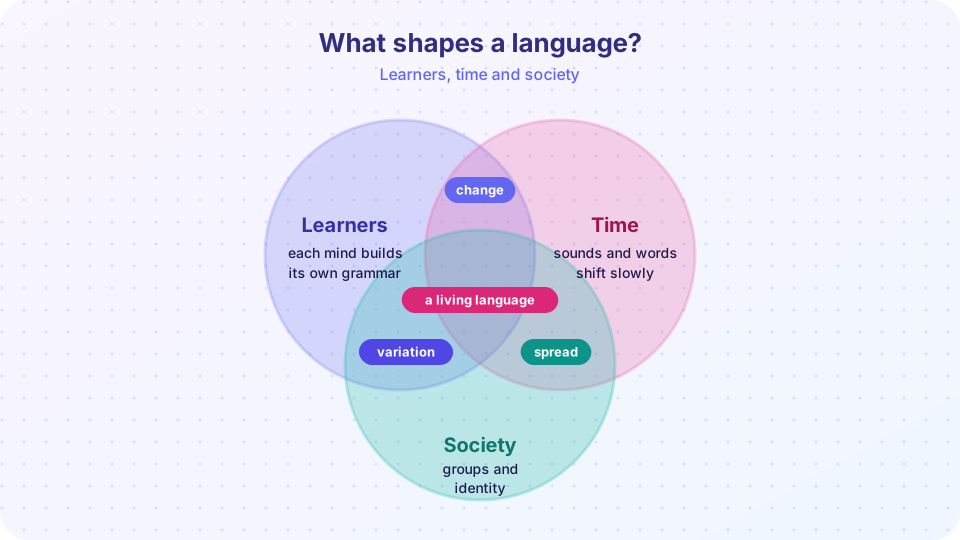
Review first and second language acquisition, historical change, language families and sociolinguistic variation with a Venn picture, recap table and ten-question quiz.
A language lives in three places at once: in the mind of each learner, in the long history of a community, and in the daily choices of speakers talking to each other. This review pulls the chapter together around one idea: variation supplies the raw material, learners decide what spreads, and time accumulates the results.
The chapter in one table
| Topic | Core idea | Names and terms |
|---|---|---|
| Infant perception | Perception narrows toward the native language by about a year | Werker and Tees; statistical learning (Saffran) |
| First words and grammar | Rule learning shows in forms like goed and in wug tests | Berko, Brown, Marcus |
| Theories | Nativist, usage-based, social-interactionist | Chomsky, Tomasello, Bybee |
| Critical period | Easier early, shape debated | Lenneberg, Newport, Hartshorne et al. |
| Second language | Interlanguage with transfer and overgeneralization | Selinker, Krashen, Swain |
| Bilingualism | Both languages active; cognitive advantage contested | Peal and Lambert, Bialystok |
| Sound change | Regular sound laws, Grimm's law | Neogrammarians, Verner |
| Comparative method | Regular correspondences reconstruct ancestors | Proto-Indo-European |
| Spread of change | S-curve | Kroch |
| Variation | Orderly by class, style, gender, network | Labov, Trudgill, Milroy |
| Attitudes | Standard is prestige, not better | AAE, matched-guise |
Common threads
- Rules in action. Children overgeneralize, learners transfer, sound laws apply without exception. Systematic errors and systematic change show underlying rules.
- Gradual, not sudden. Vocabulary grows along a curve, age effects decline gradually, and changes spread along an S-curve.
- Social facts. Prestige, identity and networks decide which variants win.
- Debate remains. Nativist versus usage-based accounts, sharp versus gradual critical period, bilingual advantage, and whether island-like constraints on change are grammatical all stay open.
Try it
The first demo sorts scenarios into the three processes of the chapter, as a quick way to practice naming what you see.
Press Run (or Ctrl + Enter) to see the console output here.
No output.
The second demo measures how similar the word for "water" is to English in several languages, by edit distance on spelling. It is a rough hint only. Real evidence of relatedness comes from regular sound correspondences across many words, not from one word's spelling.
Press Run (or Ctrl + Enter) to see the result here.
Program input · what you'd type while the program runs
Type the answers before you press Run, one per line. Each time the program reads a line (with input()), it gets the next line from this box.
Check your understanding
Quick check · 10 questions
of 10 answered You scored / 10 · perfect!
-
1. Which finding shows that infants narrow their perception toward the native language?
Perception tunes in to native contrasts by about a year. -
2. Why is goed good evidence that a child has learned a rule?
It is a novel form generated by the regular past-tense rule. -
3. Which theorist is most associated with poverty of the stimulus?
Chomsky argued that input alone underdetermines the grammar. -
4. What is fossilization in second-language learning?
Some interlanguage features stop changing for years. -
5. Which finding best fits a gradual critical period?
The 2018 large-scale study found a gradual decline. -
6. What is the Neogrammarian claim about sound change?
Apparent exceptions were assigned other causes, such as analogy or borrowing. -
7. How do changes typically spread?
Slow start, fast middle, slow end. -
8. What did Labov find about the lower middle class in the most formal styles?
Their use of the prestige variant surpassed the upper middle class. -
9. Habitual be in African American English shows that:
It marks habitual aspect, a distinction standard English does not mark with one form. -
10. What does the comparative method rely on most?
Isolated resemblances can be chance; regular correspondences cannot.
Summary
- Children and second-language learners build rule systems, and errors show the rules.
- Sound change is regular, families are found by regular correspondences, and changes spread along S-curves.
- Variation is orderly and carries social meaning; standard varieties are prestigious, not better.
- Learners, time and society together shape every language.
Track your progress
Create a free account to tick off lessons and pick up where you left off on any device.
of Linguistics lessons completed