


















Lesson 23 of 49 · Morphology
Chapter 4 Review: Morphology
Review Chapter 4 of the linguistics course: morphemes, inflection and derivation, word-formation processes and morphological types, with a recap table and ten-question quiz.
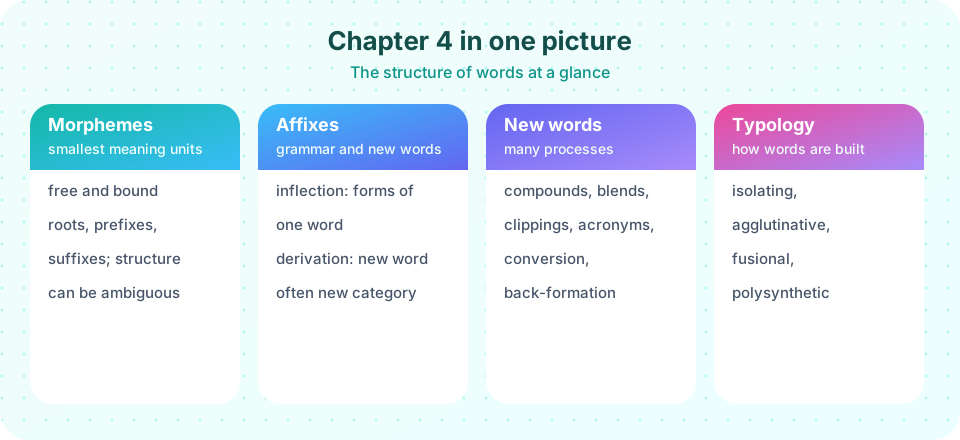
Chapter 4 showed that words are not atoms. They are built from morphemes, put together by inflection, derivation and a toolbox of word-formation processes, and languages differ in how much they pack into a single word. This review ties those threads together before you move up to the structure of sentences in Chapter 5.
What you will learn
- To connect the key ideas of the four morphology lessons.
- To segment words into morphemes and name the processes behind new words.
- To test yourself with a ten-question quiz.
Recap table
| Lesson | Big idea | Key terms |
|---|---|---|
| Morphemes and word structure | Words are built from morphemes in a hierarchical structure; allomorphs vary by context | free, bound, root, stem, affix, allomorph, infix, reduplication |
| Inflection and derivation | Inflection gives grammatical forms of a word; derivation creates new words; derivation sits closer to the root | paradigm, productivity, category change |
| Compounding and word formation | Compounds have a head (right-hand in English); blends, clipping, acronyms, conversion, back-formation, borrowing | head, endocentric, exocentric, calque |
| Morphological typology | Languages are isolating, agglutinative, fusional or polysynthetic, usually mixed; types can change | synthesis, fusion, grammaticalization |
Key terms
Morpheme: the smallest unit of meaning or grammatical function.
Allomorph: a variant form of a morpheme.
Head: the part of a compound that sets the category and basic meaning.
Agglutinative / fusional: chaining affixes with one meaning each / packing many meanings in one affix.
Common misconceptions
"The same letters mean the same morpheme." Corner is not corn + -er.
"Inflection and derivation are the same thing." One gives forms of a word; the other creates words.
"Word structure is flat." It is hierarchical, and grouping can change meaning.
Try it
First, practice segmenting. Edit the my_answers dictionary (use hyphens between morphemes), run the program and see which of your segmentations match.
Press Run (or Ctrl + Enter) to see the result here.
Program input · what you'd type while the program runs
Type the answers before you press Run, one per line. Each time the program reads a line (with input()), it gets the next line from this box.
Second, a process detector. Given a new word and its source, this program guesses which word-formation process produced it, using simple rules. It is a toy: real decisions need historical evidence.
Press Run (or Ctrl + Enter) to see the console output here.
No output.
Check your understanding
Quick check · 10 questions
of 10 answered You scored / 10 · perfect!
-
1. How many morphemes does 'unbreakables' contain?
un- + break + -able + -s. -
2. Which is a bound morpheme?
-ness cannot be a word on its own. -
3. The English plural /s/, /z/ and /ɪz/ are
They are variants selected by the preceding sound. -
4. Which of these is inflection?
-ed gives the past tense form of the same verb. -
5. In 'houseboat', what is the head?
The right-hand part is the head, so a houseboat is a kind of boat. -
6. 'Brexit' is an example of
It merges Britain and exit. -
7. What is conversion?
To email from an email is conversion. -
8. Which language type packs several meanings into one inseparable ending?
Latin -o in amo is the classic example. -
9. Turkish ev-ler-imiz-de ('in our houses') is typical of which type?
Each suffix has a single, separable meaning. -
10. Why is 'teach-s-er' impossible while 'teach-er-s' is fine?
The order in English is root, derivation, inflection.
Summary
- Words are built from morphemes (free and bound), and word structure is hierarchical.
- Inflection gives grammatical forms; derivation creates new words and sits closer to the root.
- English forms new words by compounding (right-hand head), blending, clipping, acronyms, conversion, back-formation and borrowing.
- Languages range from isolating to polysynthetic; most mix types, and types shift over time through grammaticalization.
Next: Chapter overview: Syntax
Track your progress
Create a free account to tick off lessons and pick up where you left off on any device.
of Linguistics lessons completed