


















Lesson 35 of 49 · Language Acquisition, Change and Variation
First-language acquisition
How children learn language: perception, statistical learning, first words, overgeneralization, the wug test, nativist and usage-based theories, and the critical period.
A two-year-old cannot tie shoelaces or add 2 and 3, yet she can produce and understand sentences in a complex grammar. By five she has mastered most of it. Nobody gave her grammar lessons, and she did it in a world where the speech she heard was messy, interrupted and unlabelled. How? This question, perhaps the most debated in linguistics, divides researchers into camps. First we look at what children do, then at the theories that try to explain it.
What you will learn
- What infants can do before they speak
- How children learn words and combine them
- Why overgeneralization is evidence for rule learning, and how common it really is
- The nativist, usage-based and social views, and what the critical period evidence shows
Key terms
Statistical learning: noticing regularities in the input, such as which syllables tend to follow each other.
Overgeneralization (overregularization): applying a rule to an exception: goed, mouses.
Telegraphic speech: early two- and three-word utterances that omit small grammatical words (Daddy go work).
Universal Grammar (UG): the hypothesis that humans are born with a language-specific blueprint.
Critical period: a window in development during which learning is easiest.
Before the first word
Newborns prefer their mother's voice and the rhythm of the language they heard in the womb. Young infants can distinguish almost every speech contrast, even ones their parents' language does not use. Janet Werker and Richard Tees (1984) found that English-learning infants at about six to eight months could still hear a contrast from Hindi that English adults could not, but by about ten to twelve months they had largely lost the ability: perception narrows toward the sounds that matter in the native language.
Statistical learning helps infants find words in a continuous stream. Jenny Saffran, Richard Aslin and Elissa Newport (1996) played eight-month-old infants two minutes of a stream of nonsense syllables. Within a "word", each syllable predicted the next perfectly, but across word boundaries the next syllable was less predictable. Infants later listened differently to words and part-words, so they had tracked these transitional probabilities after minutes of exposure. The same ability may serve many kinds of learning, not only language.
Words and word combinations
Babbling starts around six months, and the sounds drift toward the native language. First words arrive around the first birthday: mama, ball, more. Many children then learn words at an accelerating rate, with the "vocabulary spurt" often placed between 18 and 24 months, although studies find that many children show a steady increase and not a sharp spurt. Children can form a rough guess about a new word's meaning after one or two exposures ("fast mapping", Susan Carey and Elsa Bartlett, 1978), but the guess is refined over years. Children also make errors: overextension (dog for all four-legged animals) and underextension (cup only for one's own cup).
Around the second birthday children combine words into two-word utterances (more juice, Daddy go). Roger Brown (1973) charted how children's average utterance length grows and how grammatical endings (-ing, plural -s, past -ed, the) appear in a fairly consistent order across children, even though the timing differs.
Overgeneralization and the wug test
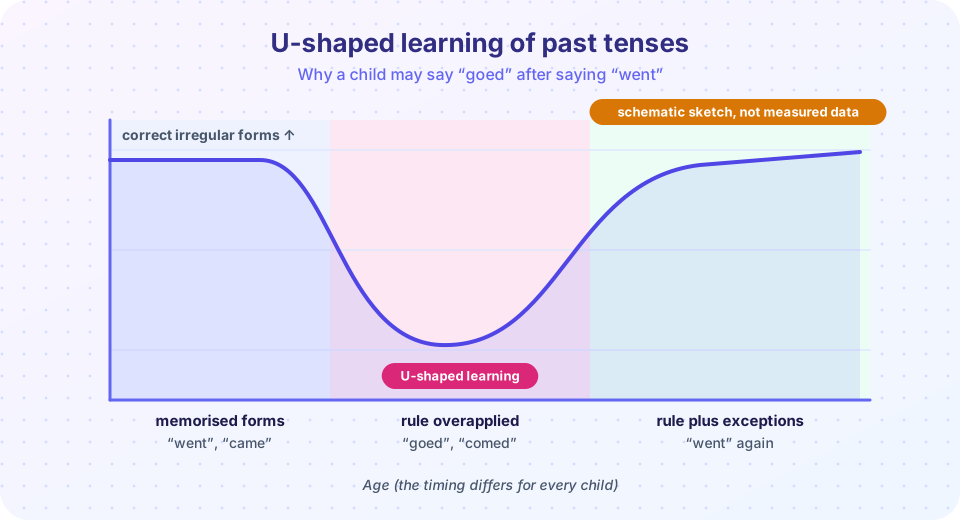
A child who has said went for months may start saying goed. She has not heard anyone say it. She has found a rule: add -ed for the past. In 1958 Jean Berko Gleason invented the wug test: she showed children a picture of a bird-like creature, said This is a wug. Now there are two of them. There are two ___, and children said wugs, using the rule on a word they had never heard. Children were far less willing to apply irregular patterns, such as bing/bang, to new words, which fits the view that the regular rule is the productive default.
How common is overregularization? Gary Marcus and colleagues (1992) analysed thousands of child utterances and found that children say the correct irregular form most of the time; overregularizations form only a few percent of irregular uses. The U-shaped pattern is real but small, and the details are still debated: connectionist modellers (Rumelhart and McClelland, 1986) argued that one network can learn both regular and irregular forms without an explicit rule, while Steven Pinker and Alan Prince argued that humans use both a rule and stored exceptions.
Theories of acquisition
Nativist (Chomsky). The input underdetermines the grammar (poverty of the stimulus), so children must start with built-in knowledge of what grammars can look like (UG). Evidence: children rarely produce certain structure-violating errors, and deaf children in Nicaragua who were brought together in the 1970s and 80s created a new sign language, Nicaraguan Sign Language, whose structure grew richer with each cohort of child learners (work of Ann Senghas and others).
Usage-based (Tomasello, Bybee). Children learn constructions from the language they hear, with general abilities such as pattern finding and reading others' intentions (joint attention). Early speech is often item-specific (Where's the ___?) before it generalises. Evidence: early utterances cluster around frequent frames.
Social-interactionist. Interaction is essential; children learn from responsive caregivers. Cross-cultural work (Elinor Ochs and Bambi Schieffelin) shows that child-directed speech (slow, high-pitched "motherese") is not universal, and children still learn: so it helps but is not required.
Is there a critical period?
Eric Lenneberg (1967) proposed a critical period ending around puberty. The tragic case of Genie, found in 1970 at age 13 after severe isolation and abuse, showed rapid but incomplete progress; yet the abuse makes it hard to separate the effect of age from trauma. Elissa Newport and Jacqueline Johnson (1989) found that the later in life immigrants had arrived in the US, the worse their grammar judgments, which fits an age effect, although later work finds a gradual decline rather than a sharp cut-off. The safest summary: language is learned most easily early, and the exact shape of the age effect is still debated.
Common misconceptions
"Parents teach children grammar by correcting errors." Studies find that parents rarely correct grammar, and children often ignore corrections.
"U-shaped learning means children get worse." The dip signals a new rule, a step forward.
"Everything in language is innate" or "Nothing is." Both extremes are rejected by most researchers. The dispute is about how much and what kind of structure is built in.
Try it
The first demo runs a wug-style plural rule. English plurals use three sounds depending on the final sound of the stem. This is a toy implementation of the rule children discover, using the stem's final sound given by hand.
Press Run (or Ctrl + Enter) to see the result here.
Program input · what you'd type while the program runs
Type the answers before you press Run, one per line. Each time the program reads a line (with input()), it gets the next line from this box.
The second demo simulates statistical learning. It builds a stream of syllables from four invented three-syllable "words" and measures how well each syllable predicts the next, inside words and across word boundaries.
Press Run (or Ctrl + Enter) to see the result here.
Program input · what you'd type while the program runs
Type the answers before you press Run, one per line. Each time the program reads a line (with input()), it gets the next line from this box.
Check your understanding
Quick check · 6 questions
of 6 answered You scored / 6 · perfect!
-
1. What did the wug test show?
Children said wugs for a nonsense word, so they use a productive rule. -
2. What did Saffran, Aslin and Newport (1996) show?
After two minutes of exposure, infants distinguished words from part-words. -
3. How common are overregularization errors such as goed, according to Marcus et al. (1992)?
Children usually say the correct irregular form, and the errors are a small minority. -
4. Which view stresses poverty of the stimulus?
The nativist argument holds that input alone underdetermines the grammar. -
5. Why is the case of Genie hard to interpret?
Isolation and abuse make it impossible to separate age from trauma. -
6. Is child-directed speech necessary for acquisition?
It may help, but it is not universal and children still acquire language.
Summary
- Infants tune their perception and track statistics before speaking.
- Children build rules (wugs, goed) while still learning exceptions; overregularization is real but rare.
- Nativist, usage-based and social accounts differ on how much is built in.
- Age matters for language learning, though the exact shape is debated.
Track your progress
Create a free account to tick off lessons and pick up where you left off on any device.
of Linguistics lessons completed