


















Lesson 32 of 49 · Semantics and Pragmatics
Speech acts and implicature
Learn pragmatics: how words do things (Austin and Searle), how speakers imply more than they say (Grice), and how scalar implicature and politeness work.
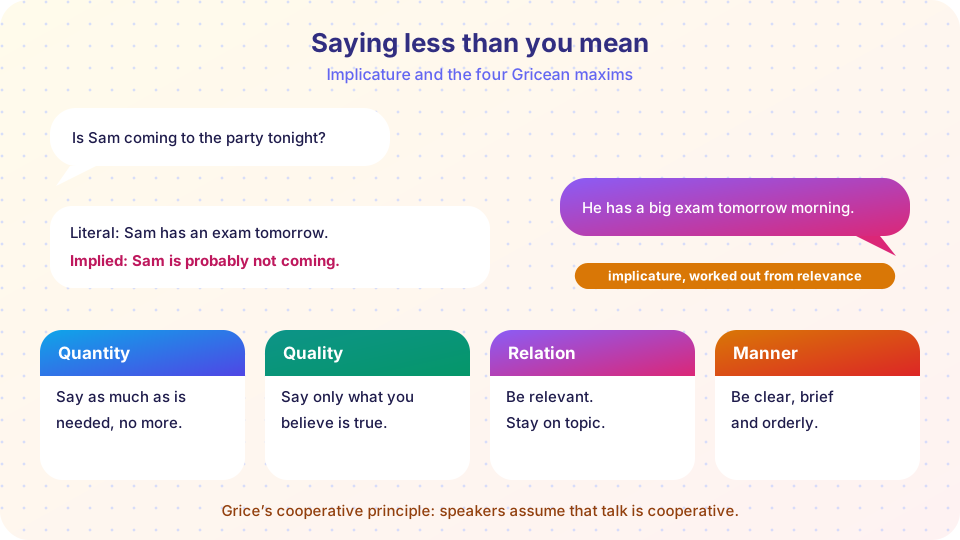
Suppose a friend asks, Is Sam coming to the party? and you reply, He has a big exam tomorrow. You never said no, and your friend understood no anyway. In another moment you say I promise to call you, and by saying it you have made a promise. Both cases show something that a theory of truth conditions alone cannot capture: people use language to act and to imply. This lesson covers the two classic theories, speech acts and conversational implicature.
What you will learn
- What Austin's performatives and the three layers of a speech act are
- Searle's five kinds of speech act and indirect speech acts
- Grice's cooperative principle, the four maxims and what flouting them does
- How scalar implicature works and how to test whether something is implied
Key terms
Speech act: an action done by speaking (promising, asking, warning).
Illocutionary force: what the speaker is doing with the words (a request, a promise).
Implicature: meaning conveyed beyond what is literally said.
Cooperative principle: the assumption that participants contribute to the conversation as required.
Cancellability: an implicature can be denied without contradiction.
Speech acts
The philosopher J. L. Austin gave lectures at Harvard in 1955, published as How to Do Things with Words (1962). He began from performatives: sentences that do not describe an action but perform it. I name this ship the Aurora. I apologize. I bet you five dollars it rains. A performative is not true or false; it can only succeed or fail, depending on felicity conditions: the speaker must have the authority (a stranger cannot name your ship), the procedure must be proper, and sincere intentions are expected.
Austin then showed that every utterance has three layers:
- Locutionary act: producing words with a meaning (Shoot her!).
- Illocutionary act: what you do in saying it (ordering, advising).
- Perlocutionary act: the effect on the hearer (frightening them, persuading them).
John Searle (1969, 1975) sorted illocutionary acts into five classes:
| Type | Point | Example |
|---|---|---|
| Assertives | commit to truth | It rained all night. |
| Directives | get the hearer to act | Please close the door. |
| Commissives | commit the speaker to act | I promise to call. |
| Expressives | express a feeling | Thank you. Sorry. |
| Declarations | change reality by saying | You're fired. I now pronounce you married. |
Indirect speech acts
Can you pass the salt? is grammatically a question about ability, yet no one answers Yes and sits still. It is a directive performed indirectly. Searle explained that the hearer first notices that a literal answer would be pointless, then infers the likely intention. Indirect forms are often a matter of politeness: Penelope Brown and Stephen Levinson (1987) argued that many are ways of protecting the hearer's "face" while making a request.
Grice and conversational implicature
In his 1975 article "Logic and Conversation", H. Paul Grice proposed that conversation is guided by a cooperative principle: make your contribution as is required, at the stage at which it occurs, by the accepted purpose of the exchange. He broke it down into four categories of maxims:
- Quantity: be as informative as required, and not more.
- Quality: do not say what you believe to be false or lack evidence for.
- Relation: be relevant.
- Manner: be clear, brief and orderly.
Listeners assume speakers follow these. When a reply seems to break one, the listener looks for a reading under which it does not. He has a big exam tomorrow looks irrelevant to the question about the party, so the hearer concludes that it is the reason Sam is not coming. That inferred meaning is an implicature.
When a speaker openly breaks a maxim, we say they flout it, and implicature results. Nice weather! said in a storm flouts Quality, signalling irony. A reference letter that only praises a candidate's handwriting flouts Quantity and implies the candidate has no other merits.
Two diagnostic tests
- Calculability: the hearer can work it out from the literal meaning plus the maxims.
- Cancellability: a genuine conversational implicature can be cancelled. Some of the students passed, in fact all of them did is not contradictory. By contrast an entailment cannot be: Tom is a cat, but he is not a mammal is.
Scalar implicature
Words such as some, most, all or warm, hot or or, and form scales ordered by strength (Larry Horn's scales). A speaker who uses a weaker word, when a stronger one would have been more informative and true, implies that the stronger one does not hold (Quantity). So Some students passed implicates not all; The soup is warm implicates not hot. Experimental work (Ira Noveck, 2001, and many later studies) found that young children are often less likely than adults to draw such inferences, and that adults sometimes take extra time when they do, which has fuelled debate about whether the inference is automatic or effortful.
Rival approaches
Relevance theory (Dan Sperber and Deirdre Wilson, 1986) replaces the four maxims by a single principle: hearers look for the interpretation that yields the greatest effects for the least processing effort. Neo-Gricean approaches (Levinson, Horn) keep a small set of principles. All agree that the process is inferential, which is why implicatures are flexible.
Common misconceptions
"Implicature is the same as a hint." A hint may be deniable by choice; a conversational implicature is the default, derivable result of cooperation.
"Literal meaning always comes first." Experiments show that context affects interpretation early, and some inferences appear without effortful steps.
"Declarations work in any mouth." They need authority and the right circumstances, or the act misfires.
Try it
The first demo is a toy classifier that sorts utterances into Searle's categories by simple opening patterns. It is a demonstration of the categories, not a real speech-act detector.
Press Run (or Ctrl + Enter) to see the console output here.
No output.
The second demo computes scalar implicatures from Horn-style scales and shows that they are cancellable while the literal meaning stays.
Press Run (or Ctrl + Enter) to see the result here.
Program input · what you'd type while the program runs
Type the answers before you press Run, one per line. Each time the program reads a line (with input()), it gets the next line from this box.
Check your understanding
Quick check · 6 questions
of 6 answered You scored / 6 · perfect!
-
1. Which of these is a performative?
By saying it, the speaker performs the act of promising. -
2. Which layer of a speech act is its effect on the hearer, such as frightening them?
Perlocutionary acts are the consequences produced in the hearer. -
3. Which maxim is broken when someone answers a question with something irrelevant?
The maxim of Relation asks speakers to be relevant. -
4. What does the cancellability test show?
Implicatures can be cancelled without contradiction; entailments cannot. -
5. Which inference does The soup is warm usually trigger?
Warm is weaker than hot on a scale, so the speaker implies not hot. -
6. Who argued that hearers seek the interpretation with the greatest effect for the least effort?
That is the central principle of relevance theory.
Summary
- Speech acts: saying can be doing; performatives succeed or fail by felicity conditions.
- Searle's five types cover most illocutionary acts, and indirect acts are common.
- Grice's cooperative principle and four maxims explain how hearers infer implicatures.
- Scalar implicatures are cancellable, which separates them from entailments; rival theories explain the inference in different ways.
Next: Chapter review: Meaning
Track your progress
Create a free account to tick off lessons and pick up where you left off on any device.
of Linguistics lessons completed