


















Lesson 9 of 49 · The Study of Language
Language Families and Diversity
Learn how linguists group about 7,000 languages into families using regular sound correspondences, meet the major families, and see why many languages are endangered.
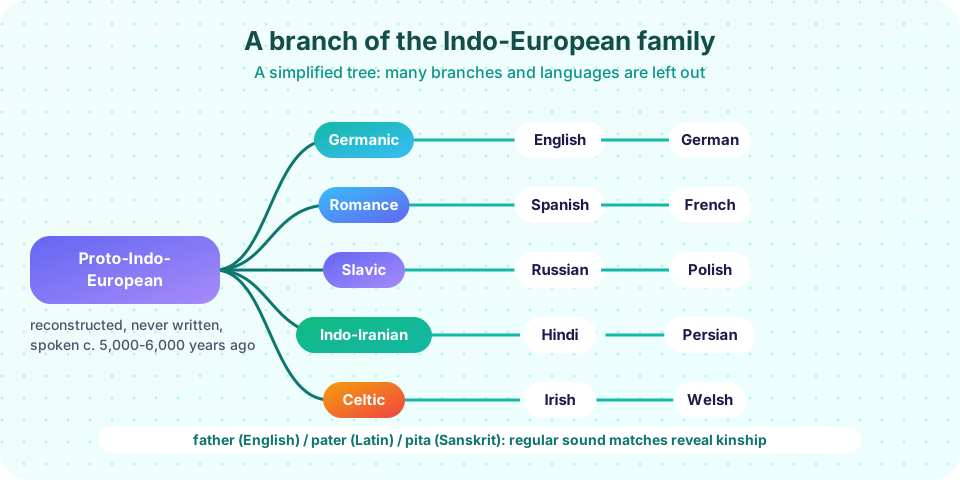
The world has roughly 7,000 living languages, but they are not unrelated. Spanish, French and Italian are like cousins: they all descend from Latin. English and German are cousins too, but more distant ones: they share an ancestor older than Latin. Linguists group languages into families by tracing such descent, in a way that resembles building a family tree.
This lesson shows how the grouping is done, introduces the main families, discusses the thorny question of what counts as a separate language, and ends with the fact that nearly half the world's languages are at risk of disappearing.
What you will learn
- How regular sound correspondences show that languages are related.
- The big language families and a few language isolates.
- Why "language versus dialect" is not a purely linguistic question.
- Why languages become endangered and what revitalization can do.
Key terms
Language family: a group of languages that descend from a common ancestor (a proto-language).
Cognates: words in related languages that descend from the same ancestral word, such as English father and Latin pater.
Comparative method: the technique of comparing related languages to reconstruct their ancestor.
Language isolate: a language with no demonstrated relatives, such as Basque.
Endangered language: a language whose speakers are few or are no longer passing it to children.
From curiosity to method
In 1786 Sir William Jones, a British judge in India, noticed that Sanskrit, Greek and Latin resembled each other in both vocabulary and grammar too much to be a coincidence, and suggested they came from a common source. In the early 1800s Rasmus Rask and Jacob Grimm showed that the resemblance was systematic.
Look at the pairs in the picture. Latin has a /p/ where English has /f/: pater and father, pes and foot, piscis and fish. Latin has /t/ where English has th: tres and three, tu and thou. Latin /k/ (written c) matches English h: canis and hound, cornu and horn. Latin /d/ matches English /t/: decem and ten, duo and two, dens and tooth.
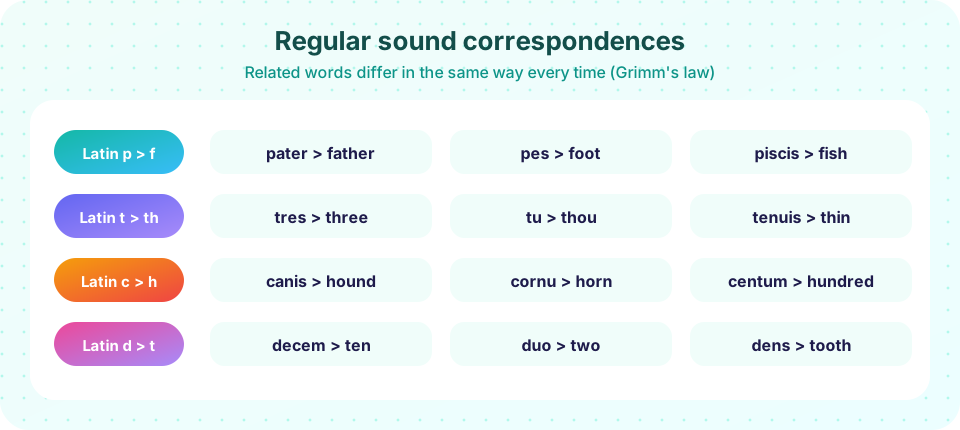
The shifts are called Grimm's law. What matters is that a correspondence is regular: not one pair but dozens, all showing the same change. Chance resemblances do not behave like that. For example, the Malay word mata and the Modern Greek word mati, both meaning "eye", look alike by pure accident, with no regular pattern behind them.
The comparative method goes further. By comparing cognates across many languages, linguists reconstruct features of the proto-language. The reconstructed Proto-Indo-European was never written; it was probably spoken some five to six thousand years ago, and the details are debated. Reconstructed words are written with an asterisk (for example *ph₂tḗr "father") to show that they are inferred, not recorded.
Two cautions. First, a resemblance can come from borrowing: English sushi is Japanese, but that does not make English and Japanese related. Second, comparison cannot go back forever; after perhaps 6,000 to 10,000 years, the regular correspondences are too eroded to detect, so claims of enormous "super-families" remain controversial.
The major families
| Family | Some members | Notes |
|---|---|---|
| Indo-European | English, Spanish, Hindi, Russian, Persian | Spoken by roughly half the world's people |
| Sino-Tibetan | Mandarin, Cantonese, Tibetan, Burmese | Largest by native speakers after Indo-European |
| Niger-Congo | Swahili, Yoruba, Zulu, Igbo | More than 1,000 languages |
| Afroasiatic | Arabic, Hebrew, Amharic, Hausa | Includes ancient Egyptian |
| Austronesian | Indonesian, Tagalog, Malagasy, Māori, Hawaiian | More than 1,000 languages across the Pacific and Indian Oceans |
| Dravidian | Tamil, Telugu, Kannada, Malayalam | Mostly southern India |
| Turkic | Turkish, Uzbek, Kazakh | Spread across Eurasia |
| Uralic | Finnish, Hungarian, Estonian | |
| Japonic | Japanese, Ryukyuan languages | Korean is usually treated as an isolate or a separate small family |
Many other families exist, such as the Algonquian, Uto-Aztecan, Quechuan and Mayan families in the Americas, and the large and varied families of Papua New Guinea, a country with more than 800 languages. Some languages have no known relatives at all: Basque in Europe and Burushaski in Pakistan are isolates.
Families are not the only way to group languages. Typology classifies languages by their structure (for example word order), regardless of ancestry. And languages in contact can share features without being related: languages of the Balkans share several traits despite belonging to different branches. You will meet typology again in Chapter 4.
Language or dialect?
Is Cantonese a dialect of Chinese or a separate language? Are Swedish and Norwegian two languages? Linguists use mutual intelligibility as a rough test: if speakers can understand each other without training, they speak varieties of one language. But the test is fuzzy and often loses to politics: Swedish and Norwegian are largely mutually intelligible and counted as separate languages, while Mandarin and Cantonese are not mutually intelligible yet are often both called "Chinese dialects" because they share a writing tradition and a national state. A famous remark, often attributed to the linguist Max Weinreich, says a language is a dialect with an army and a navy. The point is that the label reflects history and power as much as structure. This is why counts of the world's languages are estimates, not exact figures.
Diversity and endangerment
Languages are very unevenly distributed. A small number of languages have hundreds of millions of speakers, while thousands have fewer than ten thousand. Regions such as Papua New Guinea, Indonesia, Nigeria and India are especially diverse.
Roughly 40 percent of languages are considered endangered. A language is in trouble when children stop learning it, usually because families shift to a more widely useful language for school, work or status. Colonial history, forced assimilation and economic pressure have all played a role. When a language disappears, so do its oral literature, specialized knowledge of the local environment and a way of organizing thought and community. It also removes a data point about what human languages can be like.
Revitalization is possible but hard. Hebrew was revived as an everyday spoken language from the late 19th century, with Eliezer Ben-Yehuda as a leading figure. The Māori of New Zealand started kōhanga reo ("language nest") preschools in 1982, and Hawaiian communities began immersion preschools in the 1980s; both have raised the number of young speakers. Success depends on community commitment, teaching, and use at home, not just on recordings and dictionaries.
Common misconceptions
"Languages that look alike are related." Look-alikes can come from chance or borrowing. Regular correspondences are the evidence.
"Languages evolve from primitive to advanced." No language is more primitive; old and new languages are equally complex.
"One language is going to replace all the others anyway." Languages shift because of social conditions, which communities can influence.
Try it
The first tool takes cognate pairs and groups them by the first sound change, rebuilding the table above from raw word pairs. You can add pairs of your own.
Press Run (or Ctrl + Enter) to see the console output here.
No output.
The second demonstration builds a tiny family tree by computing how different the spellings of eight basic words are across eight languages and grouping the most similar languages. It is a toy: spelling is a poor stand-in for sound, a handful of words is tiny, and real work uses sound correspondences and many more words. Still, the tree it produces usually matches the family tree.
Press Run (or Ctrl + Enter) to see the result here.
Program input · what you'd type while the program runs
Type the answers before you press Run, one per line. Each time the program reads a line (with input()), it gets the next line from this box.
Check your understanding
Quick check · 5 questions
of 5 answered You scored / 5 · perfect!
-
1. What is the strongest kind of evidence that two languages are related?
Regularity, such as Latin p matching English f across many words, rules out chance and borrowing. -
2. Which is the best example of a chance resemblance?
Malay and Greek are unrelated, and the similarity has no regular pattern behind it. -
3. Why is the language-versus-dialect question not purely linguistic?
Swedish and Norwegian are mostly intelligible yet separate languages; Mandarin and Cantonese are not intelligible yet often both called Chinese. -
4. A language isolate is
Isolates are single-member families as far as current evidence goes. -
5. Which is a main reason languages become endangered?
Language shift under social and economic pressure is the typical cause.
Summary
- Languages are grouped into families by shared descent, shown by regular sound correspondences between cognates (Grimm's law is the classic example).
- The comparative method reconstructs proto-languages; chance resemblance and borrowing must be excluded.
- Major families include Indo-European, Sino-Tibetan, Niger-Congo, Afroasiatic and Austronesian; some languages are isolates.
- The line between language and dialect depends on social and political factors.
- Roughly 40 percent of languages are endangered; revitalization is possible but depends on communities.
Next: Writing Systems
Track your progress
Create a free account to tick off lessons and pick up where you left off on any device.
of Linguistics lessons completed