


















Lesson 8 of 49 · The Study of Language
Branches of Linguistics
Get a map of linguistics: the six core levels from phonetics to pragmatics, plus sociolinguistics, psycholinguistics, historical, computational and applied linguistics.
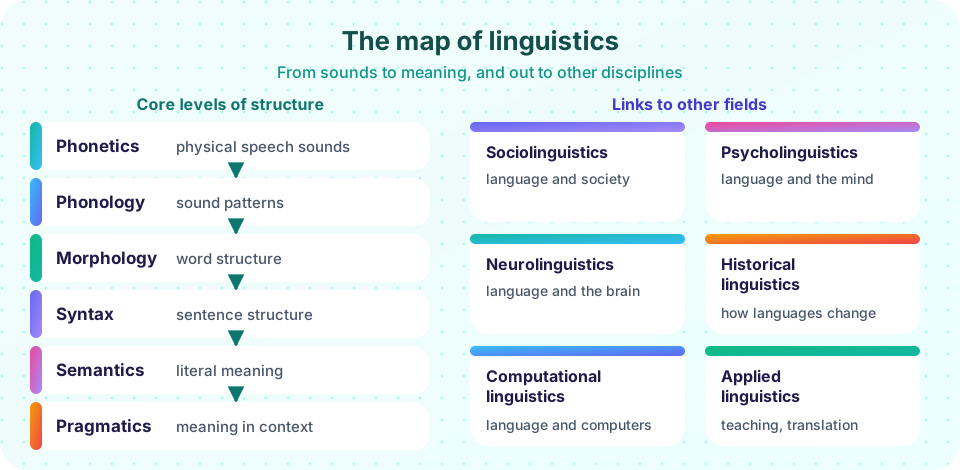
Linguistics is a large field, and beginners are often surprised by how many different kinds of questions fit inside it. A phonetician measuring how long a vowel lasts, a syntactician drawing sentence trees, a sociolinguist recording how teenagers speak in a city and a computational linguist building a translator are all linguists, and they are all studying language, but from very different angles.
This lesson gives you a map. It separates the core levels of linguistic structure, which this course explores one by one, from the interdisciplinary branches that connect linguistics to other fields.
What you will learn
- The six core levels and what question each asks.
- The main interdisciplinary branches.
- The difference between theoretical and applied linguistics, and between rival schools of thought.
Key terms
Phonetics: the physical study of speech sounds (how they are made, transmitted and heard).
Phonology: the study of how a language organizes its sounds into patterns.
Morphology / syntax: the structure of words / the structure of sentences.
Semantics / pragmatics: the study of literal meaning / of meaning in context.
Theoretical vs applied: building general theories of language versus using linguistic knowledge to solve practical problems.
One sentence, six questions
The best way to separate the levels is to ask different questions about the same sentence: The cats didn't see Maria.
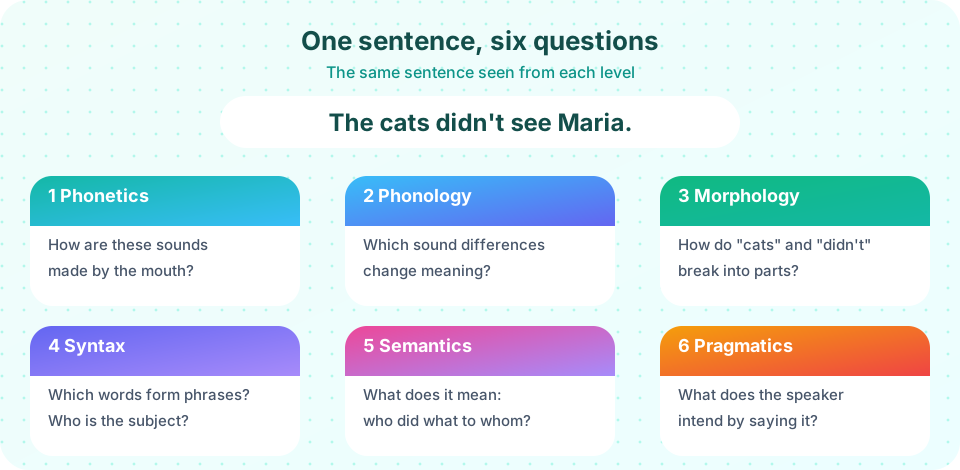
- Phonetics asks how the sounds are physically produced and perceived: where the tongue is for the t in cats, whether the vocal folds vibrate, how long the sounds last.
- Phonology asks how the sounds fit into the language's system. English speakers hear the t in top and in stop as "the same sound", although physically they differ slightly; a phonologist explains why.
- Morphology asks how words are built. Cats is cat plus a plural ending; didn't is did plus the reduced not.
- Syntax asks how words combine into phrases and sentences: the cats is a noun phrase that acts as the subject; see Maria is a verb phrase.
- Semantics asks what the sentence means, in terms of its words and structure: who did what to whom, and what negation does to the claim.
- Pragmatics asks what the speaker means by saying it in a particular situation: it might be an answer, a denial, a complaint or a hint.
These levels are not sealed boxes. Plurals involve sounds and meaning and grammar together; the meaning of a sentence can depend on stress. But the separation lets you study each kind of pattern in turn, and the course follows this order.
Interdisciplinary branches
Each of the following connects the core levels with another area of study.
- Sociolinguistics studies language and society: how speech varies with region, class, age, gender and situation, and how people use language to signal identity. William Labov's New York department-store study (Chapter 1) is a classic example.
- Psycholinguistics studies how the mind processes language: how we recognize words in milliseconds, how we plan sentences, how children acquire language.
- Neurolinguistics studies how the brain supports language, using brain imaging, patients with brain damage and electrical recordings.
- Historical linguistics studies how languages change and how they are related, including reconstructing ancestors such as Proto-Indo-European.
- Computational linguistics builds computer models of language: parsing, translation, speech recognition, and the language technologies behind chatbots. You will meet it in Chapter 8.
- Applied linguistics uses linguistic knowledge for practical purposes such as language teaching, translation, speech therapy, lexicography (dictionary-making), and forensic analysis of authorship.
There are others as well: typology (comparing the structures of many languages), anthropological linguistics (language and culture), documentary linguistics (recording and describing endangered languages) and corpus linguistics (using large text collections).
Theoretical and applied; different schools
Linguistics is also divided by approach. Theoretical linguists aim to build general theories about what language is and how it works; applied linguists use findings to solve real problems. The two feed each other.
Within theory, there are rival schools. In the generative tradition started by Noam Chomsky in the 1950s, the main goal is to model the mental grammar that speakers have, often assuming that important parts of it are innate. Functional and cognitive approaches stress that structure is shaped by communication and general cognition. Usage-based approaches argue that grammar emerges from experience with real language, and rely heavily on corpus data. These debates are lively; in this course we use ideas from all of them, and we flag disagreements.
Common misconceptions
"Linguistics is mostly about grammar rules." Grammar (syntax and morphology) is only part of it; sounds, meaning, social variation, history and computation are equally central.
"Only one approach is scientific." Different schools ask different questions, and many findings (like sound patterns across languages) are accepted by all.
"The levels are independent." They interact constantly: the plural ending changes sound with its neighbor, and stress can change meaning.
Try it
Click each level in the explorer to see what it asks about the sentence The cats didn't see Maria. Each answer is a short, standard observation about English.
Writing and sound are different levels. The chart below compares the number of letters with the number of sounds in six English words (typical General American pronunciation, counted by hand), showing why phonetics needs its own alphabet.
Press Run (or Ctrl + Enter) to see the result here.
Program input · what you'd type while the program runs
Type the answers before you press Run, one per line. Each time the program reads a line (with input()), it gets the next line from this box.
Check your understanding
Quick check · 5 questions
of 5 answered You scored / 5 · perfect!
-
1. Which branch studies how speech sounds are produced and heard?
Phonetics is the physical study of speech sounds; phonology studies how a language organizes them. -
2. Which pair is correctly matched?
Psycholinguistics studies mental processing; neurolinguistics the brain; historical linguistics change. -
3. Saying 'It's cold in here' to ask someone to close the window involves mainly
The literal meaning is a statement; the intended request depends on context, which is pragmatics. -
4. What distinguishes theoretical from applied linguistics?
Both are empirical; they differ in goals. -
5. Cats being cat + -s is an observation about
Morphology studies the internal structure of words, such as stems and endings.
Summary
- The core levels are phonetics, phonology, morphology, syntax, semantics and pragmatics: from sound to meaning in context.
- Interdisciplinary branches connect language to society, mind, brain, history, computers and teaching.
- Theoretical and applied linguistics feed each other; generative, functional and usage-based schools disagree about where structure comes from.
- The levels interact, but separating them makes each pattern easier to study.
Track your progress
Create a free account to tick off lessons and pick up where you left off on any device.
of Linguistics lessons completed