


















Lesson 36 of 49 · Language Acquisition, Change and Variation
Second-language learning and bilingualism
Explore how adults and children learn second languages: transfer, interlanguage, input and practice, age effects, and what research says about bilingual minds.
Roughly half the world's people use more than one language in daily life. Learning a second language (L2) is not simply a repeat of learning the first. The learner already has a language, a developed mind and often a classroom or a job that demands results. Yet the process shares deep similarities with first-language acquisition. This lesson explains what second-language researchers have found, from error patterns to the contested claim that bilingualism trains the brain.
What you will learn
- What interlanguage means and where its errors come from
- How transfer, overgeneralization and fossilization work
- Which factors affect adult learning: input, interaction, age, motivation
- What the research on bilingualism says, and where results are contested
Key terms
L1 / L2: first and second language.
Interlanguage: the learner's evolving rule system, between L1 and the target (Larry Selinker, 1972).
Transfer: carrying L1 habits into L2, helpful (positive) or not (negative).
Fossilization: errors that persist despite exposure and practice.
Code-switching: alternating between languages within a conversation.
From contrast to interlanguage
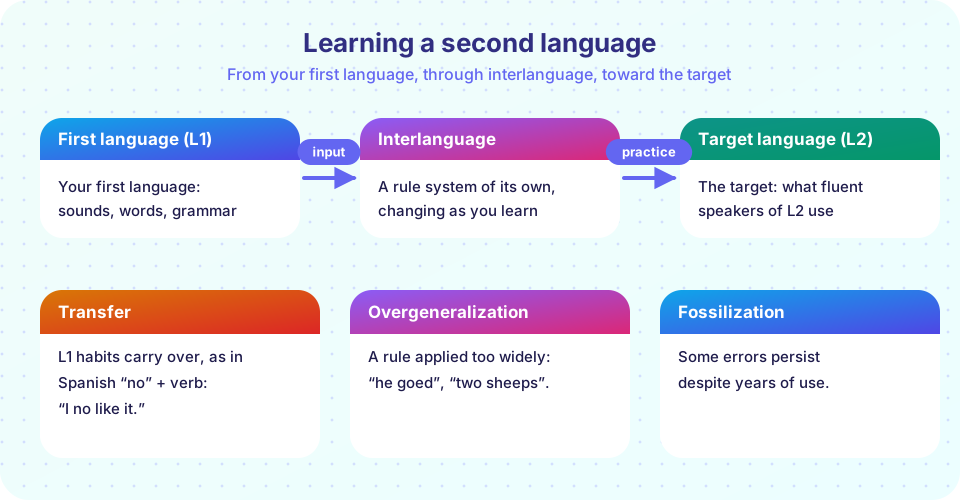
In the 1950s Robert Lado proposed contrastive analysis: compare the learner's L1 with the target and predict that differences will cause difficulty. It works sometimes. Japanese has a single liquid consonant, so many Japanese speakers find the English /l/–/r/ distinction hard to perceive, but training studies (for example Logan, Lively and Pisoni, 1991) show that adults can improve substantially with exposure to varied speakers. It fails often too: learners make errors that their L1 does not predict. Pit Corder's error analysis (1967) treated errors as evidence of an active learner testing hypotheses, not as mere failures. Selinker's interlanguage (1972) took this further: the learner has a real, rule-governed system of their own, changing as it moves toward the target.
Where interlanguage errors come from
- Transfer. A Spanish speaker may say I no like it because Spanish negates by placing no before the verb. Transfer can also help: Spanish and English share much vocabulary through Latin roots.
- Overgeneralization. Learners extend an L2 rule too far: he goed, two sheeps. This looks like the child's goed; many of the same developmental sequences appear in L1 and L2 learners of English, such as the order in which grammatical endings are acquired.
- Simplification and avoidance. Learners avoid constructions they find hard (a learner might avoid relative clauses).
- Fossilization. Selinker observed that some errors persist for years. Whether true fossilization exists or is only slow change is debated.
Input, interaction and output
Stephen Krashen (1982) proposed that acquisition happens when learners understand comprehensible input slightly above their current level ("i + 1"), and that conscious rule study only monitors output. His ideas shaped classrooms worldwide but are hard to test, and many researchers think they underrate the role of practice. Michael Long's interaction hypothesis says that negotiating meaning in conversation, with clarification requests and rephrasing, makes input usable. Merrill Swain's output hypothesis (1985) found that Canadian French-immersion students who had years of input still lacked accuracy in production, and argued that producing language forces learners to notice gaps. Today most researchers see input, interaction, output and feedback as all contributing.
Age, motivation and other factors
Does age matter? Jacqueline Johnson and Elissa Newport (1989) reported that the grammar skills of immigrants declined with later age of arrival. A much larger study by Joshua Hartshorne, Joshua Tenenbaum and Steven Pinker (2018), using data from several hundred thousand online participants, found that the ability to learn grammar stays high until about the late teens and then declines. This fits a gradual decline better than a sharp biological cut-off, and the reasons for the decline are debated (changes in the brain, in schooling and life circumstances, and in how much one uses the language). Older learners often progress faster at first, particularly in vocabulary and explicit rules, while younger learners tend to reach a more native-like pronunciation in the long run.
Motivation matters too. Robert Gardner and Wallace Lambert (1959) distinguished integrative motivation (wanting to join a community) from instrumental motivation (wanting a job or qualification); both can work. Anxiety, opportunities for contact and the learner's identity also shape progress.
Bilingual minds
Simultaneous bilinguals grow up with two languages; sequential bilinguals add one later. Evidence from eye-tracking and brain studies shows that both languages stay partly active even when one is in use: a Russian–English bilingual who hears marker may briefly look at a marka (a stamp). Code-switching is a skilled, rule-governed behavior: bilinguals switch at points where the grammars of the two languages fit, not randomly.
Is there a bilingual advantage?
In 1962 Elizabeth Peal and Wallace Lambert reported that bilingual children scored higher on some cognitive tests. Ellen Bialystok's later studies reported advantages in executive control, such as ignoring distractions, and a later onset of dementia symptoms. But large replications and meta-analyses have often found little or no advantage once age, income and other background factors are controlled, and critics point to publication bias (Paap and Greenberg, 2013; Lehtonen and colleagues, 2018). A fair summary: some studies find advantages, results vary widely, and the strong claim that bilingualism generally trains executive control is not well supported. The clearly established benefits are practical: more communication partners, cultural access and job options.
Common misconceptions
"Adults cannot learn a language well." Adults often learn quickly at first; most differences appear in accent and in the last stages of grammar. Many adult learners reach very high proficiency.
"Bilingual children get confused or delayed." Bilingual children reach milestones at similar ages; vocabulary is split across two languages, so each may be smaller, but total vocabulary is comparable.
"Errors are laziness." Errors reveal rule systems that follow logic.
Try it
The first demo does a toy contrastive analysis: which sound contrasts of English are missing from a learner's L1? The inventories list selected consonants only, and dialects differ, so treat it as a demonstration of the method.
Press Run (or Ctrl + Enter) to see the result here.
Program input · what you'd type while the program runs
Type the answers before you press Run, one per line. Each time the program reads a line (with input()), it gets the next line from this box.
The second demo plots two schematic pictures of age effects: a sharp critical period and a gradual decline. The curves are drawn to show the contrast in shape, not measured data.
Press Run (or Ctrl + Enter) to see the result here.
Program input · what you'd type while the program runs
Type the answers before you press Run, one per line. Each time the program reads a line (with input()), it gets the next line from this box.
Check your understanding
Quick check · 6 questions
of 6 answered You scored / 6 · perfect!
-
1. What is an interlanguage?
Selinker proposed that learners have a real, systematic language of their own. -
2. A Spanish speaker saying I no like it is showing:
The L1 negation pattern is carried into English. -
3. What did Merrill Swain's output hypothesis claim?
Immersion students had years of input but needed output practice for accuracy. -
4. How is the large 2018 study of Hartshorne, Tenenbaum and Pinker usually summarized?
The pattern looks like a gradual decline, not a sharp cut-off. -
5. What is the current status of the claim that bilingualism improves executive control?
Meta-analyses suggest small or no effects after controlling for background factors, and publication bias is a concern. -
6. Code-switching by bilinguals is best described as:
Switches occur at grammatically compatible points.
Summary
- Second-language learners build an interlanguage shaped by transfer, overgeneralization and simplification.
- Input, interaction and output all contribute to progress.
- Age effects exist, but evidence favors a gradual decline over a sharp critical period.
- Bilingual minds keep both languages active; claims about cognitive advantages are contested.
Track your progress
Create a free account to tick off lessons and pick up where you left off on any device.
of Linguistics lessons completed