


















Lesson 19 of 49 · Morphology
Morphemes and Word Structure
Learn to break words into morphemes: free and bound, roots and affixes, allomorphs, prefixes, suffixes, infixes and reduplication, and why word structure is hierarchical.
How do you find the morphemes in a word? It is not enough to look for pieces that are spelled alike or sound alike. The real test is meaning and function: a piece is a morpheme if it recurs in other words with a consistent contribution to meaning or grammar. In this lesson you will learn to segment words, to recognize the different kinds of morpheme, and to see that words have an internal structure, not just a sequence of pieces.
What you will learn
- How to identify morphemes and tell free from bound ones.
- Roots, stems, bases and the types of affix.
- What allomorphs are, with English and other languages.
- How to draw a simple word tree.
Key terms
Free / bound morpheme: one that can stand alone as a word / one that must attach to another.
Stem (base): the part of a word to which an affix is added.
Allomorph: a variant form of one morpheme, such as the three pronunciations of the plural -s.
Infix / circumfix: an affix inserted inside a root / one that wraps around it.
Reduplication: repeating all or part of a word to make a new form.
Finding morphemes
Take the words teacher, farmer and singer. Each ends in -er, and in each case -er contributes the meaning "a person who does it". The recurring form with a recurring meaning is a morpheme. Now take corner and water. They end in the same letters, but -er here means nothing like "one who", and corn and wat are not roots of anything related. So corner has one morpheme. The same trap appears in understand, which is not un- + derstand, and in under.
A useful method is to ask three questions of any piece:
- Does it recur in other words?
- Does it have the same meaning or function each time?
- Is the remainder also meaningful?
If the answer to all three is yes, you have found a morpheme. Linguists admit some awkward cases. The cran- of cranberry appears only in that word (a "cranberry morph"), and the -ceive of receive, deceive and perceive has no clear independent meaning in modern English. Such cases remind us that word structure carries history.
Free and bound, root and affix
A free morpheme can be a word on its own: sun, break, happy. A bound morpheme cannot: un-, -able, -s, -ing.
The root is the core of the word. A stem or base is whatever an affix attaches to; it may be a root (teach) or something bigger (teacher is the stem of teachers). Affixes are always bound and come in several types.
- Prefix: before the stem (un-happy, re-read).
- Suffix: after the stem (teach-er, happi-ness). English prefers suffixes: there are more suffixes than prefixes.
- Infix: inside the stem. Tagalog has the infix -um-: sulat "write" becomes sumulat, and kuha "take" becomes kumuha. English has nothing quite like it, except for expressive insertions like abso-bloomin'-lutely.
- Circumfix: two parts surrounding the stem. German forms many past participles with ge-...-t: spielen "play" gives gespielt "played".
- Reduplication: repetition. Indonesian buku "book" becomes buku-buku "books"; in Tagalog, kain "eat" gives kakain "will eat".
Not all morphology is chains of pieces. In Arabic and other Semitic languages a root of consonants such as k-t-b ("writing") interleaves with vowel patterns: kataba "he wrote", kitāb "book", kātib "writer", maktab "office". This is non-concatenative morphology.
Allomorphs
Just as a phoneme has allophones, a morpheme has allomorphs. The English plural morpheme has three regular forms depending on the preceding sound: /s/ (cats), /z/ (dogs), /ɪz/ (buses), which you met as a phonological rule in the previous chapter. The negative prefix in- has the forms im- (impossible), il- (illegal), ir- (irregular) and in- (inactive), again matching the next sound.
Some allomorphy is not phonological but lexical: the plural is -en in oxen and children, a vowel change in mice and feet, and no change at all in sheep (sometimes written as a zero morpheme, ∅). The past tense of go is went, with no resemblance at all, a case of suppletion. These irregular forms are stored, not built by rule.
Word structure is hierarchical
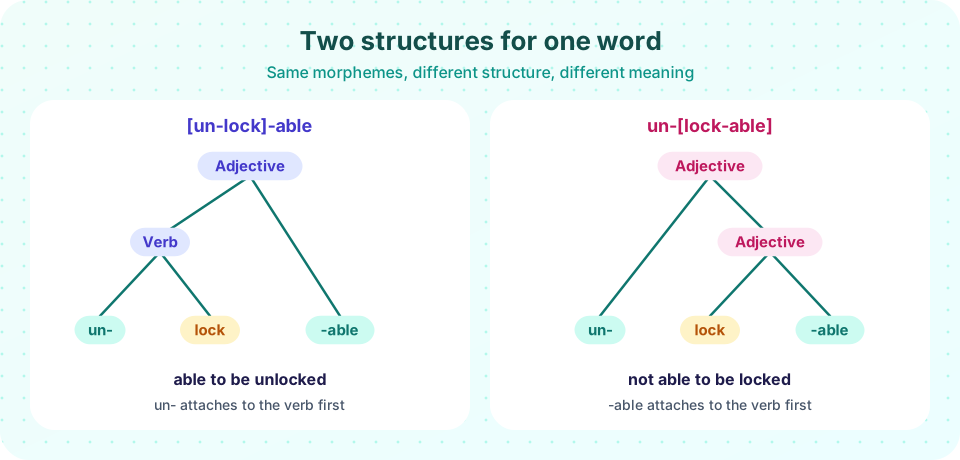
Words are not simply strings of morphemes. They have layers. Consider unlockable, which can mean two things:
- able to be unlocked (a door whose lock can be opened): first un- + lock gives a verb unlock, then -able gives an adjective;
- not able to be locked (a door that cannot be locked): first lock + -able gives lockable, then un- negates it.
The tree diagrams at the top of the lesson make the structure visible. In both trees the morphemes are the same, and the order is the same, but the grouping differs, and so does the meaning. The trees also show that suffixes usually decide the category of the whole word: -able makes adjectives, -er and -ness make nouns. This is sometimes called the right-hand head rule: in English, the rightmost morpheme of a word typically determines its category.
Common misconceptions
"If a word ends in -er it contains the suffix -er." Only if the ending carries the meaning: teacher yes, corner no.
"Morphemes are always visible pieces." Some are zero (sheep), some change a vowel (mice), some are root patterns (Arabic).
"Word structure is flat." It is hierarchical, and the grouping can change the meaning, as unlockable shows.
Try it
The first program is a naive "affix stripper". It removes a known prefix and suffix from words. It works for regular words, but notice how it goes wrong on corner, understand and even reader (it sees re- + ader): it does not know meaning, only spelling.
Press Run (or Ctrl + Enter) to see the console output here.
No output.
The second tool is a word builder. Pick a prefix, a root and a suffix and see whether the result is an established English word and what category it has. If it is not in the small dictionary, you may still have coined something that English could have.
Check your understanding
Quick check · 5 questions
of 5 answered You scored / 5 · perfect!
-
1. Which test best shows that a piece of a word is a morpheme?
Recurring form plus recurring meaning or function is the key test. -
2. In 'corner', is -er the agent suffix?
Corner is not 'corn' + 'er': the ending does not mean 'one who'. -
3. The Tagalog form sumulat from sulat 'write' shows
The morpheme -um- is inserted inside the root. -
4. What are the three forms of the English plural -s in cats, dogs, buses?
Allomorphs are variants of one morpheme chosen by the context. -
5. Why does 'unlockable' have two meanings?
Word structure is hierarchical; different groupings give different meanings.
Summary
- Morphemes are found by recurring form and meaning; spelling alone misleads (corner).
- Free morphemes stand alone; bound ones (affixes) do not. Affixes include prefixes, suffixes, infixes, circumfixes and reduplication; some languages use root-and-pattern morphology.
- A morpheme can have allomorphs (plural /s z ɪz/, im-/il-/ir-/in-), irregular forms (oxen, mice, sheep) and suppletion (go/went).
- Word structure is hierarchical, and the grouping affects meaning; the rightmost morpheme usually sets the category.
Track your progress
Create a free account to tick off lessons and pick up where you left off on any device.
of Linguistics lessons completed