


















Lesson 30 of 49 · Semantics and Pragmatics
Word senses and relations
Learn lexical semantics: synonymy, antonymy, hyponymy, polysemy versus homonymy, prototypes and semantic fields, with WordNet and the colour-term debate.
No word lives alone. Hot is understood against cold, dog against animal and puppy, bank against two quite different things you can do with money or a river. Lexical semantics studies the meanings of words and the web of relations among them. A dictionary lists senses; a linguist asks how those senses connect, how they differ and how speakers extend them.
What you will learn
- The main sense relations: synonymy, antonymy, hyponymy, meronymy
- How to tell polysemy from homonymy
- What componential analysis and prototype theory claim, and their limits
- How resources such as WordNet record meaning relations
Key terms
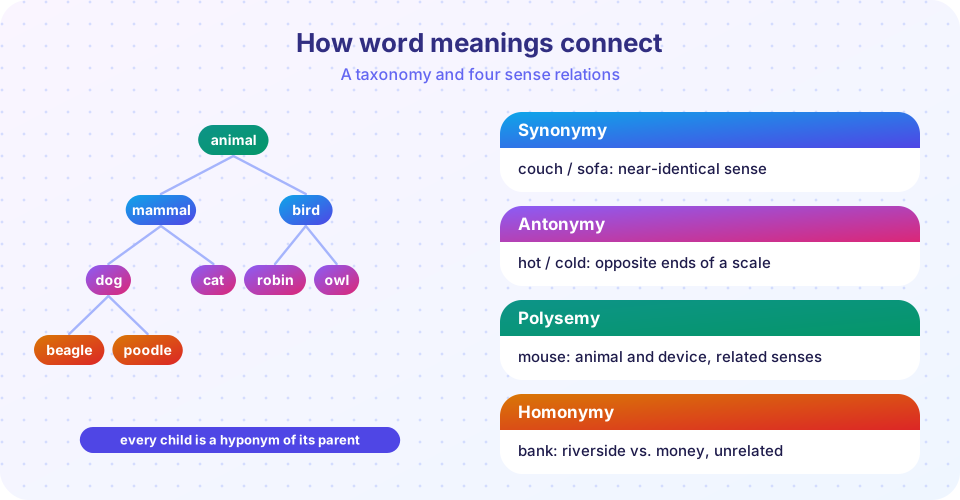
Hyponym / hypernym: beagle is a hyponym of dog; dog is the hypernym of beagle.
Synonym: words with nearly the same sense (couch and sofa).
Antonym: words with opposite senses (hot and cold).
Polysemy: one word with several related senses.
Homonymy: different words that happen to share a form.
Relations between senses
Hyponymy is the "is a kind of" relation. It builds hierarchies: beagle → dog → mammal → animal. It is transitive: a beagle is a mammal. It also gives entailments: It is a beagle entails It is a dog, but not the reverse. Meronymy is the part-whole relation: wheel is a meronym of car.
Synonymy is rarer than it seems. True synonyms would be interchangeable in every context, and few pass. Couch and sofa are close, but begin and commence differ in formality, and big and large split in my big sister (not my large sister). Most synonyms are near-synonyms.
Antonymy comes in kinds:
- Complementary pairs have no middle: alive/dead, on/off. Denying one asserts the other.
- Gradable pairs lie on a scale: hot/cold, with warm and cool between. They depend on a standard: a big mouse is smaller than a small elephant.
- Converse pairs describe the same relation from two sides: buy/sell, parent/child.
Polysemy and homonymy
Dictionaries separate homonyms (bank as river edge and bank as financial institution) from polysemes (one entry with related senses, such as mouse for an animal and for a device whose shape and movement resemble it). The usual criteria are history and relatedness: homonyms have different origins and no felt connection; polysemes share a source. Speakers' intuitions and etymology sometimes disagree, so the line is blurry. A handy test is zeugma: She lost her keys and her temper sounds witty because one verb is stretched over two quite different objects. The test is only a rough guide.
Polysemy is not random. Many senses follow regular patterns: a container for its contents (I drank the whole bottle), a place for its people (The town voted), an animal for its meat (We had lamb). Such regular sense extensions help learners guess new senses.
What is a word meaning made of?
Componential analysis, popular in the 1960s, decomposes a word into features: bachelor = [+human, +male, +adult, −married]. It explains why bachelor entails male and contradicts married. It struggles with many words, though: what are the necessary and sufficient features of game? Ludwig Wittgenstein (1953) argued there are none; games share a family resemblance, overlapping similarities with no single common core.
Eleanor Rosch's experiments in the 1970s found that categories have a prototype: people judge robin a better example of bird than penguin, respond faster to typical members, and list typical members first. Category membership looks graded, not all-or-nothing. Prototype theory has been very influential, though critics note that typicality is not the same as meaning: nobody thinks a penguin is less a bird, and some categories (odd number) have sharp edges and still show typicality effects.
Colour terms: a famous case
Brent Berlin and Paul Kay (1969) compared colour words across languages and argued that basic colour terms appear in a fixed order: black and white first, then red, then green or yellow, then blue, and so on. Later work refined or challenged details, finding more variation than the original implied, but the idea that languages divide the colour space in constrained rather than random ways remains central.
WordNet
George Miller's group at Princeton built WordNet in the 1980s: a lexical database of English that groups words into synsets (sets of near-synonyms) and links them by hyponymy, meronymy and antonymy. It has been used in language technology for decades to measure how related two words are, by counting steps through the hierarchy.
Common misconceptions
"Synonyms are interchangeable." Differences in register, collocation (strong tea, not powerful tea) and connotation almost always remain.
"Polysemy means a word is vague." A polysemous word has several distinct, related senses. A vague word has one sense with fuzzy boundaries (tall).
"Word meanings are fixed definitions in the mind." Prototype and usage-based evidence suggest meanings are flexible, graded and context-sensitive.
Try it
The first demo stores a small hyponymy hierarchy and answers "is a" questions by walking up the tree, the way WordNet-style tools measure relatedness.
Press Run (or Ctrl + Enter) to see the result here.
Program input · what you'd type while the program runs
Type the answers before you press Run, one per line. Each time the program reads a line (with input()), it gets the next line from this box.
The second demo scores how well some animals match a bird prototype using invented feature ratings. It shows graded membership, and also why naive counting is not enough: the bat ties with the penguin.
Press Run (or Ctrl + Enter) to see the result here.
Program input · what you'd type while the program runs
Type the answers before you press Run, one per line. Each time the program reads a line (with input()), it gets the next line from this box.
Check your understanding
Quick check · 6 questions
of 6 answered You scored / 6 · perfect!
-
1. Which pair shows hyponymy?
A beagle is a kind of dog, so beagle is a hyponym of dog. -
2. Buy and sell are examples of which kind of antonyms?
They describe the same transaction from opposite sides. -
3. Bank (riverside) and bank (money) are best described as:
They have different origins and no felt connection, so they are homonyms. -
4. What did Rosch's prototype studies suggest about categories?
People judge some members, such as robins, to be better examples of a category than others, such as penguins. -
5. What does WordNet group into synsets?
A synset is a set of words that express the same concept. -
6. What did Wittgenstein mean by family resemblance?
He used the word game as the example.
Summary
- Word senses connect through hyponymy, meronymy, synonymy and antonymy.
- Polysemy (related senses) differs from homonymy (unrelated words with one form), though the line is blurry.
- Feature lists and prototypes capture different parts of what a category is.
- Resources like WordNet encode these relations for computers.
Track your progress
Create a free account to tick off lessons and pick up where you left off on any device.
of Linguistics lessons completed