


















Lesson 2 of 49 · Getting Started
What Is Language?
Learn what linguists mean by language: sound, sign and writing, arbitrary signs, endless new sentences, and why language is more than communication.
Ask ten people what language is and you will get answers like "words", "talking", "how we communicate" or "what we write in". Each answer catches a piece of the truth, and each misses something. Dogs communicate, traffic lights communicate and a smile communicates, yet none of them is a language in the sense linguists care about.
In this lesson you will build a working definition step by step. By the end you will be able to explain why sign languages count, why writing does not, and why a child can say a sentence no one has ever said before.
What you will learn
- A working definition of language and the three layers it connects (meaning, grammar, sound or sign).
- Why signed languages are full languages and why writing is not language itself.
- What arbitrariness and productivity mean, with examples.
- How language differs from communication in general and from thought.
Key terms
Sign (in the linguist's sense): a pairing of a form (a sound, gesture or written shape) with a meaning.
Arbitrary: not predictable from the meaning; there is no natural reason why a dog is called "dog".
Productivity (or creativity): the ability to produce and understand endlessly many new sentences.
Modality: the channel a language uses, such as speech (sound), sign (hands, face, body) or writing.
Grammar: the system of rules and patterns that combines signs into larger units.
A working definition
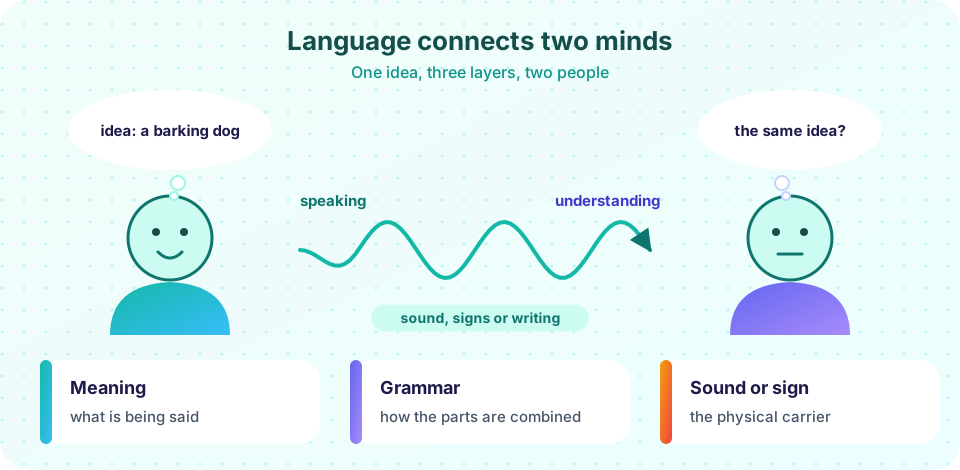
For this course, a language is a structured system of signs that lets people express an unlimited range of meanings and that is shared by a community. Three layers sit inside that sentence.
- Meaning: what is being communicated, from "the kettle is boiling" to "I wish I had told her sooner".
- Grammar: the system that organizes words into sentences, and sounds into words.
- Sound or sign: the physical signal that travels between people.
The speaker's job is to move downward through those layers (idea, words, sounds) and the listener's job is to move upward (sounds, words, idea). The marvel is how automatic this is: you understand a spoken sentence in a fraction of a second, even though your brain is solving a hard puzzle.
Speech, sign and writing
Most people meet language as speech, and speech is certainly the oldest and most widespread form. But speech is one modality, not the essence of language.
Sign languages are full human languages. American Sign Language (ASL), British Sign Language (BSL) and the many other sign languages around the world are not the same language, and none of them is a gestured version of a spoken language. ASL, for example, has its own grammar and is unrelated to English grammar. In 1960 the American linguist William Stokoe showed that ASL signs can be analyzed into smaller parts, such as handshape, location and movement, much as spoken words are built from sounds. A particularly striking case is Nicaraguan Sign Language, which emerged from the late 1970s onward when deaf children were brought together in schools in Nicaragua. Without a shared language to start from, the group developed one, and later cohorts of children made it more systematic. Researchers such as Ann Senghas have studied this development closely.
Writing is different. It is a technology for recording language, invented only a few times in history; the oldest known writing systems are roughly 5,000 years old. Spoken or signed language is far older, every typically developing child acquires it without lessons, and thousands of languages have never had a writing system. Children learn to talk by listening and interacting; they learn to write by being taught. For this reason linguists treat speech and sign as primary and writing as a derived system. You will study writing systems in their own right in Chapter 2.
Form and meaning are arbitrary
The word for a four-legged barking pet is dog in English, chien in French, Hund in German, perro in Spanish, inu in Japanese and mbwa in Swahili. If there were a natural link between the sound and the animal, every language would use the same or a similar word. Instead the link is arbitrary: it is a convention that a community has agreed on, often over centuries.
The Swiss linguist Ferdinand de Saussure (1857-1913) made arbitrariness a cornerstone of modern linguistics. He described a linguistic sign as a pair: a signifier (the sound pattern or form) and a signified (the concept). You will use these two terms in the next lessons.
Arbitrariness has limits worth knowing about:
- Onomatopoeia (words that imitate sounds) such as buzz, meow or bang is partly motivated, yet it still varies: a rooster says cock-a-doodle-doo in English and kikeriki in German.
- Sound symbolism exists too. In experiments going back to Wolfgang Köhler in 1929 and made famous by Vilayanur Ramachandran and Edward Hubbard in 2001, many people link the made-up word bouba with a round shape and kiki with a spiky one. The effect has been found in many groups of people, though its strength varies and it explains only a small corner of vocabulary.
So arbitrariness is a strong tendency, not an absolute law, and the arbitrary part is what lets a language have a huge vocabulary of independent words.
Language is endlessly creative
Read this sentence: A purple giraffe taught the accordion to my grandmother's parrot. Probably no one has ever written it before, yet you understood it at once. This is productivity: speakers combine a limited set of sounds into a large stock of words, and combine those words by rules into an unlimited number of sentences.
One source of that infinity is recursion: a sentence can contain another sentence. The cat sleeps. becomes Mia thinks that the cat sleeps. which becomes Omar says that Mia thinks that the cat sleeps., and so on. There is no longest sentence, just as there is no biggest number: you can always add one more clause (although real speakers get tired and listeners lose track).
Language, communication and thought
Animals communicate. A bee's waggle dance tells nestmates where food is; a vervet monkey's alarm call distinguishes different predators. These systems are fascinating, and you will compare them with human language in Chapter 2. For now note the contrast: such systems typically have a small, fixed set of messages, while human language can express new ideas about the past, the future, imaginary events and abstract ideas, without limit.
Language is also not the same as thought. You can know what you want to say and struggle to find the word; babies and many animals plainly think without sentences. How strongly a language shapes thought is a lively research topic (you will meet it in later chapters), and the sweeping claim that people cannot think about things their language has no word for is not supported by the evidence.
Common misconceptions
"Sign languages are just gestures." They have their own phonology-like structure, grammar and vocabulary and are acquired by deaf children as naturally as spoken languages by hearing children.
"Writing is language." Writing records language. Most of human history, and many present-day languages, have no writing, and children acquire speech or sign without it.
"Words are labels for things that are already there." Words are arbitrary conventions, and different languages carve up the world differently (for example in how they name colors or kinship).
Try it
The first demo shows productivity. A tiny grammar builds sentences, and each extra level of embedding multiplies the number of possible sentences. Move the slider and press the button.
The second demo tests arbitrariness with numbers. It measures how different the words for "dog" are in several unrelated languages (using edit distance, the number of letter changes needed to turn one word into another) and draws a heat map. This is a demonstration with a handful of words, not a research result.
Press Run (or Ctrl + Enter) to see the result here.
Program input · what you'd type while the program runs
Type the answers before you press Run, one per line. Each time the program reads a line (with input()), it gets the next line from this box.
Notice that no pair of words is very close. Where two languages share a word shape, the cause is usually shared ancestry or borrowing, not a natural link between sound and animal.
Check your understanding
Quick check · 5 questions
of 5 answered You scored / 5 · perfect!
-
1. Which statement about sign languages is correct?
ASL, BSL and other sign languages are distinct full languages; they are not tied to the grammar of any spoken language. -
2. What does it mean that the relation between a word's form and its meaning is arbitrary?
Arbitrariness means conventional rather than predictable. Onomatopoeia and sound symbolism are limited exceptions. -
3. A child says a sentence nobody has ever said before and is still understood. Which property of language does this illustrate?
Productivity: a finite set of sounds and words combines by rules into unlimited new sentences. -
4. Why do linguists treat writing as secondary to speech and sign?
Writing is a technology that records language; many languages have none, and acquisition of speech or sign does not depend on it. -
5. Recursion in a sentence means that
Embedding a clause within a clause can be repeated without a built-in limit, as in 'Omar says that Mia thinks that...'
Summary
- A language is a shared, structured system of signs that links meaning, grammar and sound (or sign), and it lets people express unlimited meanings.
- Speech and sign are the primary modalities; writing records language and is much younger.
- Signs are arbitrary pairings of form and meaning (Saussure), with limited exceptions such as onomatopoeia and sound symbolism.
- Productivity and recursion let a finite system produce an unlimited number of sentences.
- Language is not simply communication and not simply thought.
Track your progress
Create a free account to tick off lessons and pick up where you left off on any device.
of Linguistics lessons completed