


















Lesson 2 of 42 · Getting Started
What is agriculture?
Learn what agriculture is, how it began, how the Green Revolution changed yields, and which branches of agricultural science solve which problems.
Agriculture is the deliberate growing of plants and raising of animals to produce food, fibre, fuel and other useful goods. Everything on your plate, from bread and rice to cheese and chocolate, comes from it, and so do cotton shirts, wool blankets, timber, rubber and a growing share of biofuels.
The word is easy to define and hard to summarize, because agriculture is not one activity. A family growing cassava on a half-hectare plot in West Africa, a dairy farm milking hundreds of cows with robots in the Netherlands and a vegetable greenhouse in a desert are all agriculture, but they use very different tools. This lesson gives you the map: what the field includes, where it came from, and how its branches divide the work.
What you will learn
- A working definition of agriculture and the products it provides.
- The main branches of agricultural science and the question each one answers.
- Key turning points in agricultural history, from domestication to the Green Revolution.
- Why agriculture matters for jobs, economies, the environment and nutrition.
Key terms
Agriculture: growing crops and keeping animals for people's use.
Domestication: changing a wild species over many generations, by selecting the plants or animals people prefer, until it depends on human care.
Agronomy: the science of field crops and the soils they grow in.
Horticulture: the science of fruits, vegetables, flowers and ornamental plants, often grown intensively.
Livestock: domesticated animals kept for products or work, such as cattle, sheep, goats, pigs and poultry.
The picture of a whole food system
Agriculture is the production end of a longer chain. Inputs such as seed, water, fertilizer and fuel go into farms. Harvested products travel through storage, processing and transport to markets and kitchens. At every step some food is lost or wasted, and at the end some people still do not get enough to eat. Later chapters follow the whole chain, but this chapter starts at the farm gate.
The farm itself is a system, which Lesson 3 explores in detail. For now, remember the three big groups of products. Crops supply cereals, pulses, oilseeds, roots and tubers, fruits and vegetables, sugar and fibre. Livestock supply meat, milk, eggs, wool and leather and, in many regions, draught power and manure. Trees and water add timber, fruit, resin and fish (forestry and aquaculture are often counted as neighbours of agriculture).
A short history of farming
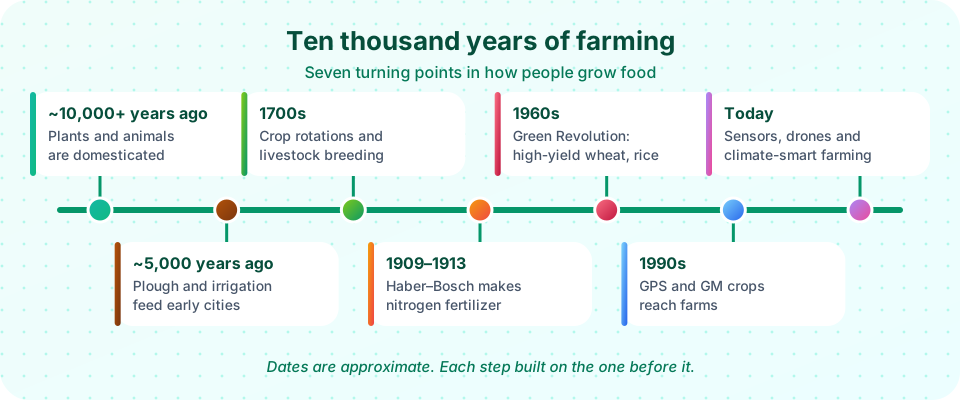
For most of human history people were hunter-gatherers. Between roughly 10,000 and 12,000 years ago, in several regions at about the same time, people began to plant and tend certain plants and to keep certain animals. The best-known early centers include the Fertile Crescent of the Middle East (wheat, barley, lentils, sheep and goats), parts of China (rice and millet), Mesoamerica (maize, beans and squash) and the Andes (potatoes). Domestication was slow. Over many generations people saved seed from plants that held their grain instead of shattering, grew larger fruits or ripened together, and the crop slowly changed from its wild ancestor.
Settled farming allowed larger populations, stored surpluses, specialist jobs and cities. Around five thousand years ago, tools such as the animal-drawn plough and canal irrigation in river valleys of Mesopotamia, Egypt, the Indus and China let farmers work bigger areas and grow crops where rain alone was not enough.
In 18th-century Britain, new rotations (such as wheat, turnips, barley and clover) and deliberate livestock breeding raised output without clearing more land. In the 19th century, mechanical reapers, railways and scientific studies of plant nutrition began a shift from muscle to machine.
The biggest chemical step came in the early 20th century. Fritz Haber showed in 1909 how to make ammonia from nitrogen in the air and hydrogen, and Carl Bosch scaled the process for industry by 1913. Cheap nitrogen fertilizer, which Chapter 2 explains, helped feed billions of people who could not otherwise have been fed.
From the 1960s the Green Revolution spread short-strawed, high-yielding wheat and rice varieties, together with fertilizer, irrigation and better crop protection. Plant breeders such as Norman Borlaug worked on semi-dwarf wheat that could carry heavy grain heads without falling over. Cereal yields in many countries rose sharply and famines that experts had predicted did not happen at the predicted scale. The revolution also brought costs: heavy use of water and chemicals, loss of crop diversity, and uneven benefits for farmers who could not afford inputs.
Since the 1990s, satellite navigation, sensors, genetic tools and data have added a digital layer, covered in Chapter 7.
The branches of agricultural science
| Branch | Main question | Example topic |
|---|---|---|
| Soil science | What is the soil made of and how fertile is it? | Texture, pH, nutrients |
| Agronomy | How do we grow field crops well? | Planting dates, rotations |
| Horticulture | How do we grow fruit, vegetables and flowers? | Greenhouses, pruning |
| Plant protection | How do we limit losses to pests and disease? | Weed control, IPM |
| Animal science | How do we feed, breed and keep animals healthy? | Rations, genetics, welfare |
| Agricultural engineering | Which machines and structures do the job? | Tractors, irrigation systems |
| Agricultural economics | What is profitable, and what do markets and policies do? | Costs, prices, trade |
In practice the branches overlap. A decision about nitrogen fertilizer involves soil science (how much is already there), agronomy (what the crop needs), economics (what it costs) and environmental science (what leaks into rivers).
Why agriculture matters
- Food and nutrition. Agriculture supplies calories, protein and micronutrients. Yet hunger and obesity can exist in the same country, so quantity is not the only issue.
- Livelihoods. Roughly a quarter of the world's workers are employed in agriculture, and the share is much higher in low-income countries and much lower in wealthy ones.
- Economy. Farming is a small share of global economic output (a few percent), but it is a much larger share in some low-income economies and it feeds manufacturing, trade and rural towns.
- Environment. Agriculture occupies a large share of the world's habitable land, uses most of the fresh water that people withdraw, and contributes substantially to greenhouse gas emissions and biodiversity loss. It is also one of the sectors that can help most, through carbon storage in soils, better water use and wiser land use.
- Resilience. Weather shocks, plant diseases and conflicts can all disrupt harvests, so stable food supplies depend on good science and good policy.
A frequently quoted estimate from international agencies is that food production may need to rise substantially, by something like half or more compared with the early 2000s, to feed a population that is expected to level off at around 10 billion in this century. The estimates differ, so the useful lesson is the size of the task. Meeting it by growing more per hectare, wasting less and eating differently is easier on forests and wildlife than clearing new land.
Common misconceptions
"Farming is simple and low-tech." Modern farming uses plant genetics, soil chemistry, machine engineering, weather forecasting, accounting and animal health science at once.
"The Green Revolution was only about fertilizer." It combined new varieties, fertilizer, irrigation, pest control, credit and markets. Remove any one part and the yield gains shrink.
"Organic always means pesticide-free." Organic standards restrict synthetic inputs but permit certain natural pesticides. Organic and conventional systems each have strengths and trade-offs, which Chapter 7 explores.
Try it
Press Run (or Ctrl + Enter) to see the result here.
Program input · what you'd type while the program runs
Type the answers before you press Run, one per line. Each time the program reads a line (with input()), it gets the next line from this box.
Check your understanding
Quick check · 5 questions
of 5 answered You scored / 5 · perfect!
-
1. Which pair of fertilizer-related pioneers made large-scale nitrogen fertilizer possible?
Fritz Haber demonstrated ammonia synthesis in 1909 and Carl Bosch scaled it for industry by 1913. -
2. Which statement about domestication is correct?
Domestication happened independently in several regions, over generations of selection. -
3. Which branch of agricultural science focuses on fruit, vegetables and ornamental plants?
Horticulture deals with intensively grown garden crops, while agronomy covers field crops. -
4. A 50 % rise in food output over 30 years needs about how much average growth per year?
1.5 to the power 1/30 is about 1.0136, which is roughly 1.4 % growth per year. -
5. Which is NOT a typical cost of the Green Revolution?
Cereal yields rose in many countries; the costs were environmental and distributional.
Summary
- Agriculture is growing crops and keeping animals for food, fibre and fuel.
- Domestication began 10,000 to 12,000 years ago and was slow and independent in several regions.
- Plough, irrigation, rotations, Haber-Bosch nitrogen and the Green Revolution each raised yields.
- Branches such as soil science, agronomy, animal science and economics overlap in every real decision.
- Agriculture matters for food, jobs, economies and the environment, and meeting future demand needs higher yields, less waste and wise land use.
Next: Farming systems
Track your progress
Create a free account to tick off lessons and pick up where you left off on any device.
of Agricultural Science lessons completed