


















Lesson 29 of 42 · Water and Irrigation
Water and Irrigation: Chapter Review
Review the water balance, crop water use, irrigation scheduling, methods and efficiency with a one-page summary, a runnable formula toolbox and ten questions.
The chapter's story is a chain with four links. Weather sets the demand (ET₀). The crop and its stage scale it (Kc, giving ETc). The soil bucket decides how often and how much to irrigate (TAW, RAW). And the irrigation system decides how much water you must really pump (efficiency, salts, energy). Break any link and water, money or yield is lost.
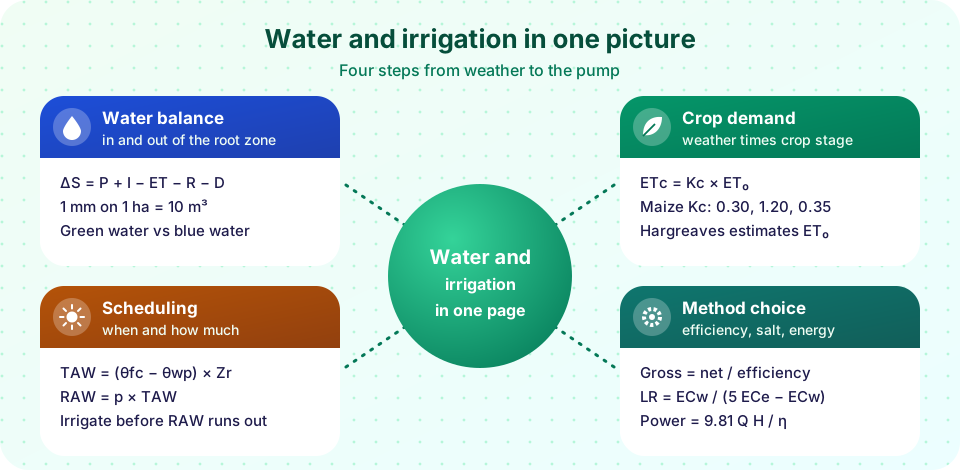
Recap
| Topic | Key ideas | Formula |
|---|---|---|
| Water balance | Rain and irrigation in; ET, runoff and drainage out; green vs blue water | ΔS = P + I − ET − R − D; 1 mm/ha = 10 m³ |
| Crop demand | ET₀ from weather; Kc by growth stage; effective rain | ETc = Kc × ET₀; Hargreaves: 0.0023 (T + 17.8) √ΔT Ra |
| Scheduling | Field capacity, wilting point, depletion fraction | TAW = (θfc − θwp) Zr; RAW = p × TAW; interval = RAW / ETc |
| Methods | Surface, sprinkler, drip; salinity; pumps | gross = net / Ea; LR = ECw / (5 ECe − ECw); P = 9.81 Q H / η |
Worked end-to-end example
A farmer grows 5 ha of maize on a loam (θFC 0.30, θPWP 0.15, roots 1 m). At peak demand ET₀ is 6 mm/day and Kc is 1.2.
- ETc = 1.2 × 6 = 7.2 mm/day.
- TAW = (0.30 − 0.15) × 1 × 1000 = 150 mm; RAW with p = 0.55 is 82.5 mm.
- Interval = 82.5 / 7.2 ≈ 11.5 days, so irrigate every 11 days at most.
- With a pivot of 75% efficiency, gross depth = 82.5 / 0.75 = 110 mm; for 5 ha that is 110 × 10 × 5 = 5,500 m³ per irrigation.
The same answers appear in the toolbox below. Predict them before you run it.
Why each link matters
Weather sets the demand. ET₀ is the evaporative power of the atmosphere. It is largest on hot, dry, windy, sunny days and smallest on cool, humid, calm, cloudy ones. Nothing the farmer does changes it, but it tells you how fast the bucket will drain.
The crop scales the demand. A seedling covers little ground and a full canopy of maize covers all of it, so Kc climbs from about 0.30 to about 1.20 and falls again as the crop matures. This is why irrigation needs peak in mid-season and why a calendar of crop stages is part of every irrigation plan.
The soil stores the supply. The root zone holds only the water between field capacity and wilting point, and the crop can use only the readily available part of it before stress starts. That is why sandy soils need small, frequent irrigations and deep loams can wait longer.
The system delivers it. No system is perfect. Efficiency, salts and energy decide how much must be pumped to deliver the net amount, and how much it costs. A surface system with low efficiency may be cheap to build and expensive in water; drip irrigation is the reverse.
Three habits of good irrigators
- Measure first. Use sensors, a spade or a soil probe to see what the root zone holds before deciding to irrigate.
- Irrigate the root zone, not the field. Apply the depth the soil can store, not more. Extra water drains below the roots, carrying nutrients away.
- Keep records. Write down dates, depths and rainfall. A season of records turns guesses into a plan for next year.
Try it
Press Run (or Ctrl + Enter) to see the result here.
Program input · what you'd type while the program runs
Type the answers before you press Run, one per line. Each time the program reads a line (with input()), it gets the next line from this box.
The helper below suggests an irrigation method from four yes-or-no questions. It encodes simple rules of thumb from the chapter, nothing more.
Check your understanding
Quick check · 10 questions
of 10 answered You scored / 10 · perfect!
-
1. Which is NOT a loss term in the field water balance?
Irrigation adds water; the others remove it. -
2. How many m³ is 25 mm over 3 ha?
25 × 10 × 3 = 750 m³. -
3. ET0 = 4 mm/day, Kc = 0.5. ETc is:
ETc = 0.5 × 4 = 2 mm/day. -
4. Soil has θFC = 0.34, θPWP = 0.14 and roots to 0.5 m. TAW is:
(0.34 - 0.14) × 0.5 × 1000 = 100 mm. -
5. With p = 0.5 and ETc = 5 mm/day, how long does that 100 mm bucket last before stress?
RAW = 50 mm, interval = 50 / 5 = 10 days. -
6. A drip system has Ea = 0.90. What gross depth supplies a net of 45 mm?
45 / 0.90 = 50 mm. -
7. What does the leaching requirement protect against?
Extra water that drains below the roots carries salts away. -
8. A pump needs 8 kW for a given job. What happens to the power if the efficiency rises from 0.60 to 0.75?
Power is inversely proportional to efficiency: 8 × 0.60 / 0.75 = 6.4 kW. -
9. Which crop stage is typically most sensitive to water shortage in maize?
Water stress at silking cuts grain number sharply. -
10. Why is a field-level water saving not always a basin-level saving?
Return flows recharge aquifers or reach downstream users, so basin accounting matters.
Summary
- The chain is weather (ET₀), crop (Kc), soil (TAW, RAW) and system (efficiency, salts, energy).
- Learn the unit conversion: 1 mm per hectare equals 10 m³.
- Schedule from the root-zone bucket, protect critical stages, and match the method to soil, crop, water and money.
Next: Sustainable and precision agriculture: the big picture
Track your progress
Create a free account to tick off lessons and pick up where you left off on any device.
of Agricultural Science lessons completed