


















Lesson 28 of 42 · Water and Irrigation
Irrigation Methods and Efficiency
Compare surface, sprinkler and drip irrigation, calculate gross water need from efficiency, leaching requirement for salty water, and pump power and energy cost.
You know how much water a crop needs. Getting it there is the next problem, and it is rarely perfect. Water leaks from canals, evaporates from spray, runs past the end of a furrow or soaks below the roots. A system that puts 60 of every 100 liters into the root zone is considered ordinary; one that puts in 90 is excellent. The difference is huge when the water is scarce and the pump bill is large.
This lesson compares the three main families of irrigation, shows how efficiency turns a net requirement into a gross one, and adds two more practical calculations that every irrigation designer needs: leaching salts and sizing a pump.
What you will learn
- Describe surface, sprinkler and drip irrigation and where each one fits
- Use application efficiency to convert net to gross irrigation depth
- Calculate the leaching requirement for salty irrigation water
- Estimate pump power and energy cost per cubic meter
- Choose a method by comparing soil, crop, water, energy and money
Key terms
Application efficiency (Ea): the fraction of applied water that ends up stored in the root zone where the crop can use it.
Gross irrigation requirement: the water that must be applied, net requirement divided by efficiency.
Electrical conductivity (EC): a measure of salinity in dS/m; ECw is the water's, ECe is the soil's (saturation extract).
Leaching requirement (LR): the extra fraction of water that must drain through the root zone to wash salts away.
Total head (H): the height in meters, including lift and pressure, that a pump has to raise water.
Three families of irrigation
Surface irrigation
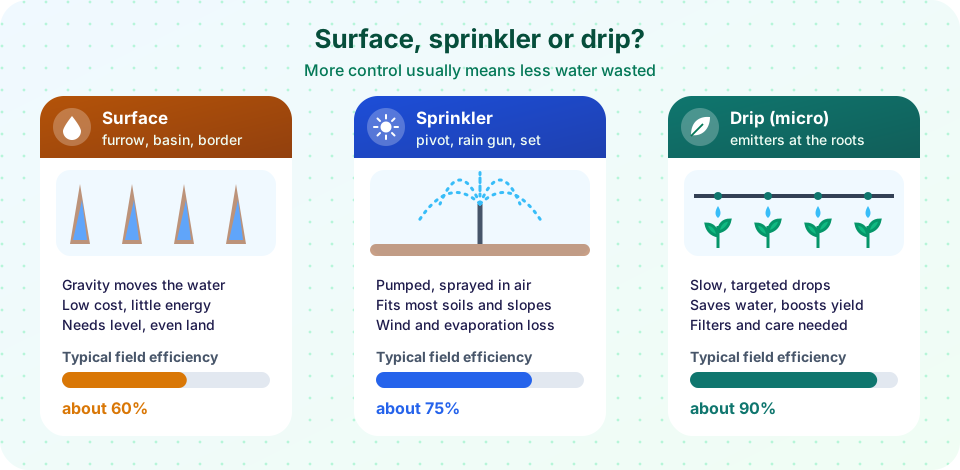
Water flows over the soil by gravity. In furrow irrigation it runs down small channels between crop rows; in border irrigation it sheets down long, level strips (common for wheat and pasture); in basin irrigation it floods a leveled, bunded plot, which suits rice and orchard trees. Surface systems need little energy and are cheap to build, and they are by far the most widespread type worldwide. But they need land that is level or gently and evenly sloped, the water at the head of the field soaks in longer than at the tail, and over-irrigating causes waterlogging and drainage losses. Laser land leveling, shorter runs and cutback flows all improve efficiency.
Sprinkler irrigation
Pumped, pressurized water leaves nozzles and falls like rain. A center pivot is a long pipe on wheeled towers that rotates around a central point; a pivot with a radius of 400 m irrigates a circle of about 50 hectares. Other types are hand-moved or solid-set sprinklers and rain guns. Sprinklers work on rolling land and many soil types, apply controlled depths, and can carry fertilizer. The Christiansen uniformity coefficient (CU) measures how evenly water is spread, and good systems exceed 85%. Losses come from wind drift and evaporation in the air, and the pumping needs energy; low-pressure nozzles near the crop canopy reduce both.
Drip (micro) irrigation
Water drips slowly from emitters on small pipes placed at each plant or along each row. Only a part of the root zone is wetted, so evaporation from bare soil is low, leaf wetting is avoided, and each plant gets water exactly where its roots are. Typical emitter flow rates are around 1 to 8 liters per hour, with pressures around 100 kPa. Fertigation (dissolving fertilizer in the water) is easy, and yields of vegetables, fruit and some field crops rise while water use falls. The costs are the equipment, the filters needed to stop emitters clogging, and the care to keep the system working. Salt can build up at the edge of the wetted zone, so a seasonal flushing is wise.
Efficiency and gross requirements
Not all applied water helps the crop. Application efficiency is
Ea = water stored in the root zone / water applied
and the water that must be applied is the net requirement divided by Ea:
gross = net / Ea
Typical field values are around 60% for surface, 75% for sprinkler and 90% for drip, though management makes a big difference: a well-managed furrow system beats a badly run sprinkler. Using the maize example from the last lesson with a net seasonal requirement of 398 mm:
| Method | Ea | Gross water (mm) | per hectare (m³) |
|---|---|---|---|
| Surface | 0.60 | 663 | 6,630 |
| Sprinkler | 0.75 | 531 | 5,310 |
| Drip | 0.90 | 442 | 4,420 |
A shorter example: if the next irrigation should add a net 40 mm and the system is 75% efficient, the pivot must apply 40 / 0.75 ≈ 53 mm.
There is an important caveat. Water lost from a field is not always lost from the river basin: runoff and deep drainage may recharge an aquifer or supply farmers downstream. A switch to drip on one farm may reduce return flow, so basin-scale accounting matters.
Drip run-time example
Suppose 4 L/h emitters are spaced 0.5 m apart on drip lines 1.5 m apart. Each emitter serves 0.5 × 1.5 = 0.75 m², so the application rate is 4 / 0.75 = 5.33 L/h per m², i.e. 5.33 mm/h. To apply a gross 6 mm: 6 / 5.33 ≈ 1.1 hours.
Salinity and the leaching requirement
Water that evaporates or is taken up by plants leaves its salts behind. If nothing washes them out, the salinity of the root zone climbs until the crop suffers. Crops differ in tolerance: ECe, the soil's salinity at saturation, is expressed in dS/m. Maize begins to lose yield above about 1.7 dS/m, beans above about 1.0 dS/m, tomatoes above about 2.5 and wheat above about 6 dS/m.
The leaching requirement is the fraction of the applied water that must drain below the roots to keep salinity at the crop's limit. A widely used formula is
LR = ECw / (5 × ECe − ECw)
where ECw is the irrigation water's EC and ECe is the soil salinity the crop can tolerate. For maize (ECe 1.7) with water of ECw = 1.0 dS/m, LR = 1.0 / (8.5 − 1.0) ≈ 0.13, so about 13% extra water must be drained. Drip irrigation can keep soil near the emitter fresh, and drainage ditches or tile drains are needed so that the leachate can leave.
Pumps: power and energy
Lifting and pressurizing water takes energy. The power a pump needs is
P (kW) = 9.81 × Q × H / η
with Q in m³/s, H in meters of total head and η the pump-and-motor efficiency (a fraction). A pump delivering 20 L/s (0.020 m³/s) against 40 m at η = 0.65 needs 9.81 × 0.020 × 40 / 0.65 ≈ 12.1 kW. Energy per cubic meter is 9.81 × H / (3600 × η) kWh/m³, which for H = 40 m and η = 0.65 is about 0.17 kWh/m³. Each 1 bar (100 kPa) of operating pressure adds about 10.2 m of head, so a sprinkler system at 3 bar adds about 31 m on top of the lift from the well. Low-pressure drip and sprinkler systems, high-efficiency pumps and solar power each cut costs.
Choosing a method
No method wins everywhere. Ask:
- Soil and land: sandy soils favor frequent, light irrigation (sprinkler or drip); heavy clays on flat land suit surface systems.
- Crop: rice favors basins; orchards and vegetables suit drip; wheat and maize fit pivots or furrows.
- Water: scarce or salty water justifies precise systems; plentiful cheap water may not.
- Energy and capital: surface needs labor and land leveling, sprinklers need pressure, drip needs filters and money.
- Management skill and support: a good system run badly beats nothing, but a modest one run well often beats an expensive one run badly.
Common misconceptions
"Drip irrigation always uses 90% less water." Efficiency gains depend on what was lost before. Against a well-managed furrow the saving is much smaller, and drip may mean more irrigation days with more consumptive use.
"Salty water can never be used." Moderately saline water can grow tolerant crops with good drainage and extra leaching. The mistake is using it with no drainage.
"The bigger the pump the better." An oversized pump wastes energy and pressure; match Q and H to the system curve.
Try it
This program compares the three methods for a 10 ha maize field using the efficiencies above and illustrative pumping heads and an assumed electricity price. Change the inputs to see how the comparison shifts. The figures are examples, not measurements of any real system.
Press Run (or Ctrl + Enter) to see the result here.
Program input · what you'd type while the program runs
Type the answers before you press Run, one per line. Each time the program reads a line (with input()), it gets the next line from this box.
The second tool runs the leaching requirement and the drip run-time formulas. Change the numbers and watch the answers move.
Check your understanding
Quick check · 5 questions
of 5 answered You scored / 5 · perfect!
-
1. A net irrigation of 36 mm is needed. The system has Ea = 0.80. What gross depth must be applied?
gross = net / Ea = 36 / 0.80 = 45 mm. -
2. Which method typically has the highest application efficiency?
Drip puts water slowly at the roots with little evaporation or runoff, about 90% typical. -
3. Irrigation water has EC 2.0 dS/m and the crop's limit ECe is 3.0 dS/m. What is the leaching requirement?
LR = 2.0 / (5 × 3.0 - 2.0) = 2.0 / 13 = 0.154, about 15%. -
4. A pump delivers 10 L/s at 30 m head with efficiency 0.60. Approximate power?
P = 9.81 × 0.010 × 30 / 0.60 = 4.9 kW. -
5. Which statement about center pivots is correct?
Area = π × 400² ≈ 503,000 m², about 50 ha. Pivots use pressure and can carry fertilizer.
Summary
- Surface, sprinkler and drip irrigation trade off cost, energy, control and efficiency; typical Ea is about 60%, 75% and 90%.
- Gross requirement = net / Ea; savings at field scale do not always mean savings for the whole basin.
- The leaching requirement LR = ECw / (5 ECe − ECw) prevents salt build-up and needs drainage.
- Pump power P = 9.81 Q H / η; each bar of pressure adds about 10.2 m of head.
- Choose a method from soil, crop, water quality, energy, capital and the skill of the people who will run it.
Track your progress
Create a free account to tick off lessons and pick up where you left off on any device.
of Agricultural Science lessons completed